
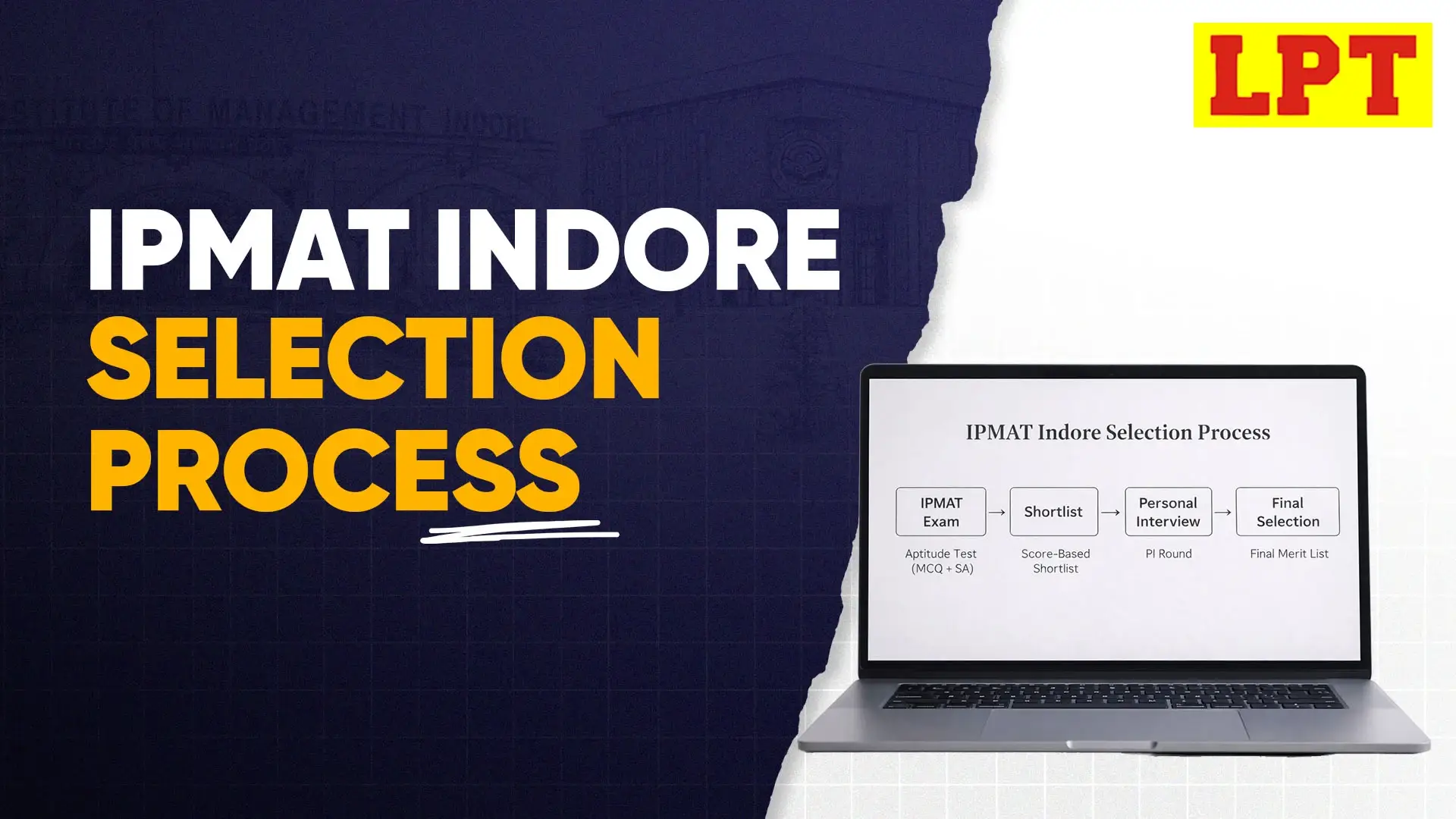
The IPMAT Indore selection process is not limited to just clearing the entrance exam. With only 150 seats and thousands of applicants every year, the IPMAT Indore selection rate is extremely low, making the process highly competitive and multi-layered.
You are evaluated through both your Aptitude Test performance and Personal Interview, ensuring that only the most well-rounded candidates are selected. This means your preparation must go beyond scoring marks to have consistency across sections and strong interview readiness to secure admission into IIM Indore’s prestigious IPM program.
Upcoming Exam:
IPMAT Indore Selection Process: Overview
The selection process of IPMAT Indore includes application, aptitude test, shortlisting based on cut-offs, personal interview, and final selection using a composite score combining test and interview performance.
| Stage | Description |
|---|---|
| Stage 1 | Application submission and eligibility verification |
| Stage 2 | Aptitude Test (IPMAT Indore exam) |
| Stage 3 | Shortlisting based on sectional and overall cut-offs |
| Stage 4 | Personal Interview (PI) round |
| Stage 5 | Final selection based on Composite Score (ATS + PI) |
Explore the List of Top IIMs in India
Stage-wise IPMAT Indore Selection Process 2026
The IPMAT Indore selection process evaluates you across multiple stages—starting from eligibility to final merit. Each stage is eliminative, so you must clear every step to move forward.
Stage 1: Application Submission & Eligibility Check
This is the first step where you submit the IPMAT Indore application form and ensure you meet all eligibility criteria. Only candidates who fulfill age, academic qualification, and minimum marks requirements are considered for the next stage. Any incorrect or incomplete application can lead to rejection at this level itself.
IPMAT Indore Eligibility Criteria:
| Criteria | Details |
|---|---|
| Age Limit | Candidate should be born on or after August 1, 2006 |
| Age Relaxation | 5 years relaxation for SC/ST/PwD (Born on or after August 1, 2001) |
| Educational Qualification | Must have completed Class 10 & 12 in 2024, 2025, or appearing in 2026 |
| Minimum Marks (General/EWS/OBC) | Minimum 60% marks in both Class 10 & Class 12 |
| Minimum Marks (SC/ST/PwD) | Minimum 55% marks in both Class 10 & Class 12 |
| Eligible Streams | All streams (Commerce, Science, Arts) |
| 12th Appearing Candidates | Eligible (subject to meeting criteria at admission stage) |
Stage 2: Aptitude Test (IPMAT Indore Exam)
In this stage, you appear for the IPMAT Indore exam, which tests your Quantitative Ability and Verbal Ability. This is the most critical stage because your score here determines your chances of getting shortlisted for the interview.
| Section | Questions | Time | Marks | Marking |
|---|---|---|---|---|
| Quantitative Aptitude (SA) | 15 | 40 min | 60 | +4, No Negative |
| Quantitative Aptitude (MCQ) | 30 | 40 min | 120 | +4, -1 |
| Verbal Ability | 45 | 40 min | 180 | +4, -1 |
| Total | 90 | 120 min | 360 | — |
What You Must Focus On:
- High accuracy in MCQs
- Attempt all SA questions (no negative marking)
- Strong performance in Verbal (highest weightage)
- Time management within sectional limits
ATS Weightage Breakdown:
| Section | Weightage |
|---|---|
| Quantitative Ability (MCQ) | 25% |
| Quantitative Ability (SA) | 25% |
| Verbal Ability | 50% |
| Total ATS | 100% |
- Verbal Ability carries maximum weight (50%)
- Ignoring any section can lead to elimination
- Balanced performance across all sections is essential
- High accuracy is more important than attempts
Must Checkout the IPMAT Rohtak 2026 Question Paper
Stage 3: Shortlisting Based on Cut-Offs
After the exam, candidates are shortlisted based on their scores. You must clear both sectional cut-offs and overall performance criteria. Even if your total score is high, failing in one section will eliminate you.
Key Shortlisting Criteria:
| Criteria | Requirement |
|---|---|
| Positive Raw Score | Mandatory |
| Sectional Cut-Off | Must be cleared |
| Overall Performance | Used for merit-based shortlist |
| Category-wise Ranking | Applied |
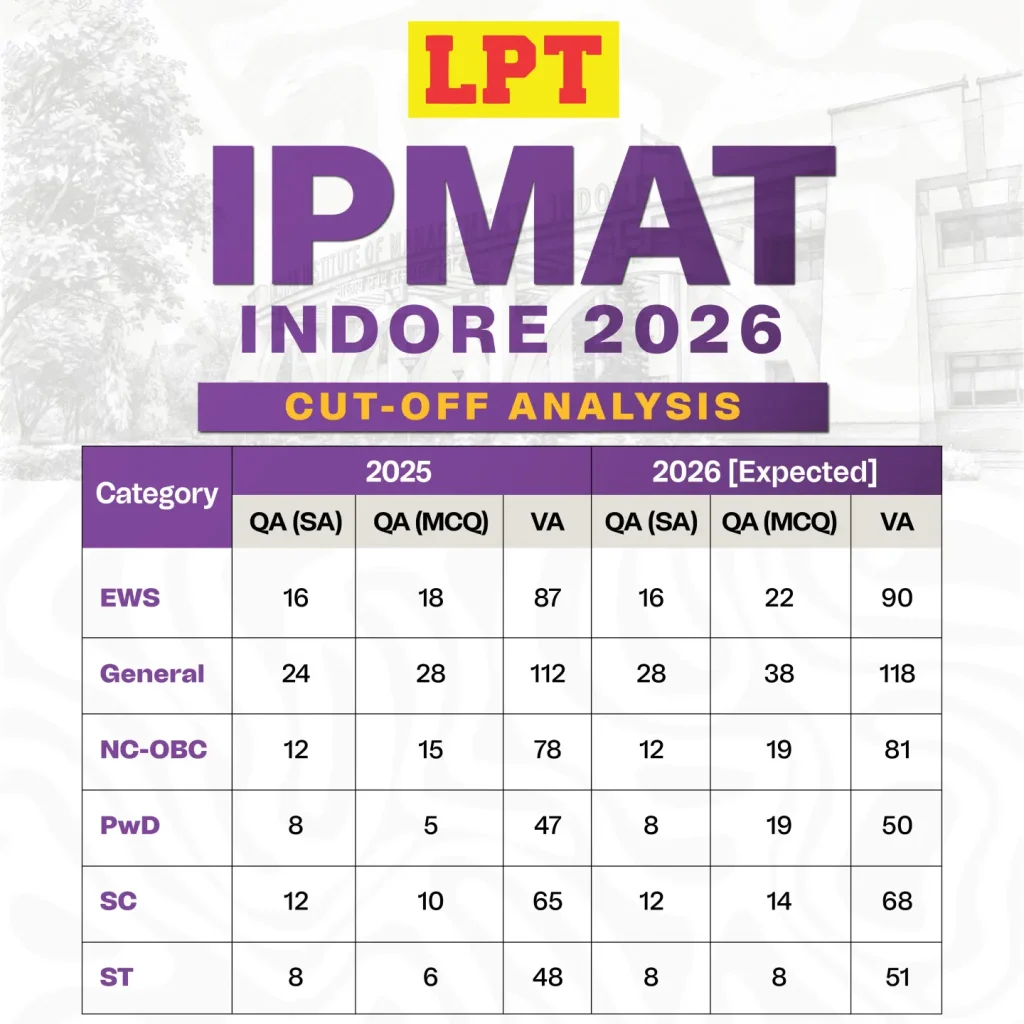
IPMAT 2026 Cut-off (Expected):
| Category | QA (SA) | QA (MCQ) | VA |
| EWS | 16 | 22 | 90 |
| General | 28 | 38 | 118 |
| NC – OBC | 12 | 19 | 81 |
| PwD | 8 | 19 | 50 |
| SC | 12 | 14 | 68 |
| ST | 8 | 8 | 51 |
You must clear all three sectional cut-offs to move ahead.
Stage 4: Personal Interview (PI)
Candidates who clear the IPMAT Indore cut-offs are shortlisted for the Personal Interview. This stage evaluates your personality, communication skills, clarity of thought, and awareness.
What is Assessed in PI:
- Communication skills
- Confidence and clarity
- Academic understanding
- General awareness
- Motivation for management
Key Insights:
- PI is conducted online (generally)
- Performance here can significantly impact your final selection
- Balanced personality matters more than just knowledge
Stage 5: Final Selection (Composite Score)
The final selection is based on a Composite Score (CS), which combines your Aptitude Test Score and Personal Interview performance. This ensures that both academic aptitude and personality are considered.
Composite Score Calculation:
| Component | Weight |
|---|---|
| Aptitude Test Score (ATS) | 65% |
| Personal Interview (PI) | 35% |
| Final Score (CS) | Total of above |
Read more about IPMAT Rohtak exam analysis
IPMAT Indore Selection Rate
The IPMAT Indore selection rate is approximately 0.5% to 1%. It is extremely low due to high competition and only 150 seats in IIM Indore.
| Parameter | Data |
|---|---|
| Total Applicants | 25,000 – 30,000 (Approx.) |
| Total Seats | 150 |
| Candidates Shortlisted for PI | 2,000 – 3,000 (Approx.) |
| Final Selected Candidates | 150 |
| Selection Rate | ~0.5% – 1% |
The low IPMAT Indore selection rate means you are not competing to just clear the exam—you are competing to be among the top 1%. This demands strong preparation, consistency, and smart strategy.
Practice with IPMAT PYQs:
| IPMAT Previous Year Question Paper | IPMAT Rohtak Previous Year Papers |
| IPMAT Indore Previous Year Papers | IPMAT 2024 Question Paper |
| IPMAT 2023 Question Paper | IPMAT 2022 Question Paper |
Stage-wise Elimination Funnel of IPMAT Indore
The IPMAT Indore process is designed to filter candidates at every stage. Here’s how the competition narrows down:
| Stage | Candidates (Approx.) | What Happens | Elimination % |
|---|---|---|---|
| Registrations | 25,000 – 30,000 | Students apply for IPMAT | — |
| Appear for Exam | 20,000 – 25,000 | Actual test takers | — |
| Clear Sectional Cut-Offs | 6,000 – 8,000 | Basic qualification stage | ~70% eliminated |
| Shortlisted for PI | 2,000 – 3,000 | Top performers selected | ~60% eliminated |
| Final Selection | 150 | Admission offered | ~95% eliminated |
Get the latest update on the IPMAT Indore admit card
What Matters Most in IPMAT Indore Selection Process?
Your selection depends on balanced performance across sections, high accuracy, and strong interview skills. Clearing cut-offs is not enough—you must score significantly higher and present a confident personality in the PI round to convert your shortlist into final selection.
- High Aptitude Test Score: A strong score well above cut-offs increases your chances of shortlisting and builds a solid base for final merit ranking.
- Sectional Balance: Consistent performance across QA (MCQ), QA (SA), and Verbal is critical. Weakness in one section leads to elimination.
- Accuracy Over Attempts: Negative marking makes blind attempts risky. High accuracy ensures better percentile and ranking.
- Interview Performance: Your communication, clarity, and confidence in the PI round directly impact your final selection chances.
- Consistency in Preparation: Regular mock practice and analysis help maintain steady improvement, which is essential for a top rank.
More helpful resources for the IPMAT Indore exam:
How to Clear Each Stage in IPMAT Indore?
Use this IPMAT Indore preparation strategy to clear each stage:
Stage 1: Clearing the Aptitude Test
- Focus on concepts in Quant and reading speed for Verbal
- Practice sectional tests regularly
- Build speed without compromising accuracy
- Attempt IPMAT Indore mocks in real exam conditions
Stage 2: Clearing Sectional Cut-Offs
- Do not ignore any section
- Identify your weakest area early
- Maintain minimum safe attempts in each section
- Track sectional scores in mocks
Stage 3: Getting Shortlisted for PI
- Aim for scores well above cut-offs
- Improve time management across sections
- Analyze mock performance deeply
- Focus on percentile, not just raw score
Stage 4: Cracking the Personal Interview
- Prepare common HR and academic questions
- Stay updated with current affairs
- Practice mock interviews
- Work on communication and confidence
Stage 5: Final Conversion
- Maintain consistency across ATS + PI
- Avoid overconfidence after shortlisting
- Work on personality development
- Seek mentorship and feedback
Start with free mocks by LPT:
| IPMAT Rohtak Mock Test | IPMAT Logical Reasoning Mock Test |
| IPMAT VARC Mock Test | Free IPMAT Mock Test PDF |
| IPMAT Quant Mock Test |
Common Reasons for Rejection in IPMAT Indore
- Not clearing sectional cut-offs
- Over-dependence on one strong section
- Low accuracy due to guesswork
- Poor time management during exam
- Weak performance in Personal Interview
- Lack of clarity in answers during PI
- Ignoring mock analysis
- Inconsistent preparation
- Nervousness or lack of confidence
- Not preparing for current affairs or basics
Role of Mock Tests in IPMAT Indore Selection
IPMAT Indore Mock tests are the closest simulation of the actual IPMAT Indore exam. They help you identify weak areas, improve speed, and build the temperament required to perform under pressure. Most top rankers consistently rely on mocks to refine their strategy and improve accuracy.
- Real Exam Simulation: You experience the same pressure, time constraints, and question patterns as the actual exam.
- Performance Analysis: Detailed insights help you understand strengths, weaknesses, and improvement areas.
- Time Management Mastery: You learn how to allocate time efficiently across sections.
- Accuracy Improvement: Regular practice reduces guesswork and increases precision.
- Strategy Building: You develop your own attempt strategy based on data, not assumptions.
How LPT Helps You in IPMAT Indore Selection?
Cracking IPMAT Indore requires a strategic system. LPT’s approach in offline and online IPMAT coaching focuses on concept clarity, practice, analysis, and mentorship, ensuring you are prepared for every stage of the selection process.
1. Concept-First Learning Approach
Strong fundamentals in Quant and Verbal ensure you can solve both easy and advanced questions with clarity.
2. Structured Preparation Plan
A well-defined roadmap keeps your preparation consistent and aligned with exam requirements.
3. Advanced Mock Ecosystem
Regular full-length and sectional mocks with detailed analysis help you improve continuously.
4. Personal Mentorship & Guidance
Guidance from experienced mentors helps you stay on track and avoid common mistakes.
5. Interview Preparation Support
Dedicated sessions for PI preparation ensure you are ready beyond the written exam.
6. Online + Offline Learning Flexibility
You can choose between classroom learning or structured online programs without compromising quality.
The combination of strategy + mocks + mentorship ensures you are prepared not just to clear IPMAT Exam, but to convert your seat at IIM Indore.
Explore important resources for IPMAT exam:
| IPMAT 2026 Answer Key | Best Books for IPMAT Exam |
| IPMAT Syllabus | IPMAT Cut Off |
| IPMAT Indore v/s Rohtak | IPMAT Full Form |
| IPMAT Exam Centres | IPMAT Registration |
| IPMAT Rohtak Exam Centres | IPMAT Seats |
FAQs About IPMAT Indore Selection Process
No, the process includes only Aptitude Test and Personal Interview.
Aptitude Test carries 65% weight, while PI carries 35% in final selection.
Around 2,000–3,000 candidates are shortlisted for the interview round.
It is approximately 0.5% to 1%, making it highly competitive.
Yes, you must clear sectional cut-offs in all sections.
No, poor PI performance can lead to rejection despite a high score.
Yes, category-wise cut-offs and merit lists are applied.
Focus on communication skills, academics, current affairs, and mock interviews.
Discover More Study Resources for IPMAT Rohtak: