
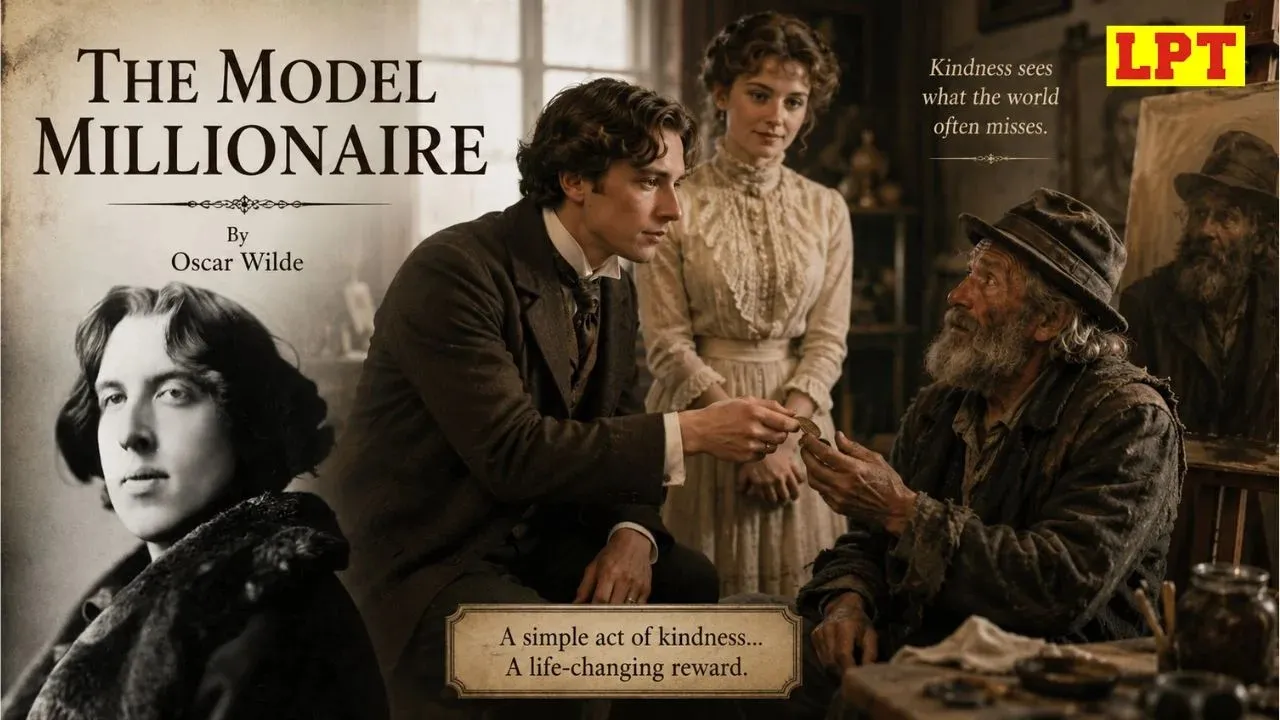
The Model Millionaire by Oscar Wilde is a witty and heartwarming short story that explores kindness, generosity, appearances, wealth, and human compassion through a surprising and ironic narrative. The story revolves around Hughie Erskine, a kind but financially poor young man, his artist friend Alan Trevor, and a mysterious old beggar who turns out to be far more important than he appears.
One of the most interesting aspects readers notice in the Model Millionaire is how the story challenges social assumptions about poverty and wealth while highlighting the value of genuine kindness. The central theme of the story focuses on generosity without selfish motives and the danger of judging people only by external appearance.
Below, we have covered the complete summary, major characters, themes, literary devices, important questions and answers, moral message, quotes, symbolism, and everything else students should know about Model Millionaire by Oscar Wilde.
Explore The Complete Summaries of Novels, Stories & Essay Notes
Key Details About The Model Millionaire by Oscar Wilde
These are the most important things to know about The Model Millionaire story:
| Particular | Details |
|---|---|
| Story Name | The Model Millionaire |
| Author | Oscar Wilde |
| Genre | Short Story / Social Satire |
| Main Themes | Kindness, Generosity, Wealth, Appearances |
| Setting | London and Artist Studio |
| Writing Style | Humorous, Witty, Satirical |
| Tone | Light, Ironical, Emotional |
| Central Idea | True kindness matters more than wealth or social status |
| Main Conflict | Poverty versus social expectations |
| Important Literary Elements | Irony, Satire, Humor, Contrast |
| Main Focus | Human Compassion and Social Appearance |
| Narrative Style | Character-Driven and Conversational |
The Model Millionaire Summary
Below is the summary of The Model Millionaire by Oscar Wilde:
Beginning
The Model Millionaire story begins with the introduction of Hughie Erskine, a handsome, cheerful, and kind-hearted young man who is liked by everyone around him. Despite his good nature and attractive personality, Hughie is financially poor and unsuccessful in building a stable career. He is deeply in love with Laura Merton, the daughter of a retired colonel. However, Laura’s father refuses to approve their marriage until Hughie earns ten thousand pounds, which seems almost impossible for him at the time.
One day, Hughie visits his close friend Alan Trevor, a famous painter, at his studio. There he notices an old beggar dressed in torn clothes and sitting as a model for one of Alan’s paintings. The old man appears weak, poor, and miserable. Hughie immediately feels sympathy for him because he understands struggle and poverty emotionally. The beginning of the story establishes themes like kindness, social status, wealth, compassion, and appearances.
Middle
As the story continues, Hughie becomes increasingly disturbed by the poor condition of the old beggar. While Alan Trevor briefly leaves the room, Hughie speaks kindly to the old man and decides to help him financially despite having very little money himself. Out of genuine compassion, he gives the beggar a gold sovereign, even though it is a large amount for someone with limited financial resources. Hughie performs this act without expecting any reward or recognition.
After leaving the studio, Hughie casually mentions the incident to Alan Trevor. At this point, the story introduces its major twist and irony. Alan laughs and reveals that the “beggar” was actually Baron Hausberg, one of the richest men in Europe. The old man had simply been posing as a poor model for the painting. Hughie becomes embarrassed and worried because he thinks he behaved foolishly by giving money to a millionaire.
The middle section strongly highlights the central theme of appearances versus reality. Hughie judged the old man purely by external appearance, but unlike society’s usual judgment, his mistake came from kindness rather than arrogance. Through humor and irony, Oscar Wilde shows how wealth and poverty can sometimes be hidden behind deceptive appearances.
Ending
The next morning, a messenger arrives at Hughie’s house carrying a sealed envelope from Baron Hausberg. Hughie initially fears that the wealthy man might have been offended by his actions. However, when he opens the envelope, he discovers a cheque for ten thousand pounds. Along with the cheque comes a message stating that it is a wedding gift for Hughie and Laura.
The story ends happily, with Hughie finally receiving enough money to marry Laura Merton. The conclusion delivers the moral lesson that genuine kindness and generosity often receive unexpected rewards. It also reinforces the ironic nature of the story because the poorest man in the room emotionally turns out to be the richest, while the wealthy millionaire proves more humble and compassionate than expected.
Through humor, irony, and emotional warmth, the story highlights the value of kindness, human compassion, and generosity beyond social class or material wealth.
Short Summary of The Model Millionaire Story
The Model Millionaire is a humorous and heartwarming story about Hughie Erskine, a kind but financially poor young man who wants to marry Laura Merton. During a visit to his artist friend’s studio, Hughie feels sympathy for an old beggar posing as a model and gives him money despite his own financial struggles.
Later, he discovers that the “beggar” is actually Baron Hausberg, one of the richest men in Europe. Touched by Hughie’s genuine kindness, the Baron rewards him generously. The story highlights themes like compassion, appearances versus reality, generosity, wealth, irony, and the importance of kindness without selfish motives.
About the Author Oscar Wilde
Oscar Wilde was one of the most famous writers, playwrights, and storytellers in English literature. Born in 1854, Wilde became widely known for his wit, humor, satire, and elegant writing style. His works often explored themes like beauty, society, wealth, human behavior, hypocrisy, and morality through clever dialogue and ironic storytelling. He had a unique ability to combine entertainment with deep social observation, which made his stories memorable and meaningful at the same time.
Wilde’s writing style is simple, sharp, humorous, and highly engaging for readers. He frequently used irony and satire to criticize social attitudes and human pretensions subtly. Many of his stories contain unexpected twists and moral lessons hidden beneath light conversation and humor.
His works remain extremely popular among students because they improve comprehension, understanding of irony, interpretation skills, and appreciation of literary humor through easy yet intelligent storytelling.
The Model Millionaire by Oscar Wilde: Character Sketch
Hughie Erskine
Hughie Erskine is the central character of the story. He is handsome, cheerful, kind-hearted, and emotionally generous despite being financially poor. Hughie genuinely cares about people and helps the old beggar without expecting anything in return. His character symbolizes compassion, innocence, honesty, and the idea that true human value does not depend on wealth or social status.
Baron Hausberg
Baron Hausberg is one of the richest men in Europe, although he initially appears as a poor beggar in the artist’s studio. Despite his enormous wealth, he behaves humbly and appreciates genuine kindness deeply. His character symbolizes irony, hidden reality, generosity, and the idea that appearances can often be misleading.
Alan Trevor
Alan Trevor is Hughie’s close friend and a successful artist. He is witty, practical, and observant, often adding humor and irony to the narrative. His studio becomes the setting for the central event of the story. Alan’s character symbolizes realism and social awareness while helping reveal the story’s ironic twist.
Laura Merton
Laura Merton is Hughie’s love interest and the daughter of a retired colonel. She genuinely loves Hughie despite his lack of money, but financial expectations create obstacles in their relationship. Her character symbolizes emotional loyalty, love, and the social reality where financial stability often influences marriage decisions.
Read Short Story Summaries
Read concise and student-friendly summaries of famous short stories along with themes, moral lessons, literary devices, and important questions:
Themes of The Model Millionaire Short Story
- Kindness and Generosity: The story highlights how genuine kindness and compassion can create meaningful and unexpected rewards in life.
- Appearances vs Reality: One of the central themes is that external appearance can be deceptive and should not determine how people are judged.
- Wealth and Poverty: The narrative explores the contrast between financial condition and human values, showing that money alone does not define character.
- Human Compassion: Hughie’s willingness to help a stranger despite his own struggles reflects emotional sensitivity and human empathy.
- Irony and Surprise: The story uses irony effectively because the “poor beggar” turns out to be an extremely wealthy man.
- Love and Financial Expectations: The relationship between Hughie and Laura reflects how social and financial conditions influence personal relationships and marriage.
- Social Class and Status: The story subtly comments on society’s obsession with wealth, status, and external success while valuing inner goodness more highly.
The Model Millionaire Literary Devices
The literary devices used in The Model Millionaire include irony, satire, symbolism, characterization, contrast, humor, etc.
| Literary Device | How It Is Used in the Story |
|---|---|
| Irony | The poor-looking beggar is actually one of the richest men in Europe, creating the story’s central irony. |
| Satire | The story subtly criticizes society’s obsession with wealth, status, and external appearance. |
| Symbolism | The beggar’s appearance symbolizes how reality and social identity can be misleading. |
| Characterization | Oscar Wilde develops Hughie’s kindness and innocence through realistic dialogue and actions. |
| Contrast | Strong contrast exists between wealth and poverty, appearance and reality, kindness and social judgment. |
| Humor | Light humor and witty narration make the story engaging while carrying deeper moral meaning. |
| Moral Commentary | The narrative indirectly teaches lessons about generosity, compassion, and human values. |
The Model Millionaire Questions and Answers
Who wrote The Model Millionaire?
The Model Millionaire was written by Oscar Wilde, one of the most famous literary figures known for his wit, humor, satire, and ironic storytelling. His works often explore themes like wealth, social class, appearances, morality, and human behavior through entertaining and meaningful narratives.
What is the main theme of The Model Millionaire?
The main theme of the story is kindness and generosity. The story also explores appearances versus reality, wealth and poverty, human compassion, social status, and the idea that genuine goodness matters more than money or external appearance.
Who is Hughie Erskine?
Hughie Erskine is the central character of the story. He is handsome, cheerful, kind-hearted, and emotionally generous but financially poor. Despite his own struggles, he helps a man he believes to be a poor beggar. His character symbolizes compassion, innocence, and genuine humanity beyond social status or wealth.
Why could Hughie not marry Laura initially?
Laura’s father, Colonel Merton, refused to allow their marriage because Hughie did not have financial stability. He demanded that Hughie first earn ten thousand pounds before marrying Laura, showing society’s strong connection between money and marriage decisions.
Who was the old beggar in the story?
The old beggar was actually Baron Hausberg, one of the richest men in Europe. He was posing as a beggar model for Alan Trevor’s painting. This revelation creates the central irony and surprise of the story.
Why did Hughie give money to the beggar?
Hughie felt genuine sympathy for the old man because he believed the beggar was poor and suffering. Even though Hughie himself had very little money, he acted out of compassion and generosity without expecting any reward or recognition.
What is the irony in The Model Millionaire?
The major irony is that Hughie, who is financially poor, gives money to a man who is actually a millionaire. Another irony is that the richest man in the story appears as the poorest person in the room.
What does Baron Hausberg symbolize in the story?
Baron Hausberg symbolizes hidden reality, generosity, humility, and the idea that external appearance can be deceptive. His character also reinforces the theme that true human value cannot be judged by clothing, status, or outward image.
What message does The Model Millionaire give readers?
The story teaches that kindness, generosity, and compassion are more valuable than wealth or social position. It also encourages readers not to judge people purely based on appearance because reality can often be very different from what is visible externally.
How does Oscar Wilde use humor in the story?
Oscar Wilde uses light humor, witty dialogue, and ironic situations throughout the story. The humorous contrast between appearance and reality keeps the narrative entertaining while also delivering deeper social and moral commentary.
Why is the story called The Model Millionaire?
The title refers to Baron Hausberg, who is both a model for the artist’s painting and a millionaire. The title cleverly combines the literal and ironic meaning of the story’s central twist.
What role does Alan Trevor play in the story?
Alan Trevor acts as Hughie’s friend and the artist whose studio becomes the setting for the main event. He also helps reveal the truth about Baron Hausberg, adding humor and irony to the narrative.
Moral Message of The Model Millionaire
The Model Millionaire teaches that kindness, generosity, and compassion are far more valuable than money or social status. The story also reminds readers not to judge people only by appearance because true character and reality often remain hidden beneath external image and wealth.
The Model Millionaire PDF
Download free PDF of The Model Millionaire by Oscar Wilde:
Explore Other Exam Preparation Resources
Prepare smarter with our dedicated coaching programs, preparation guides, mock tests, and study resources for top competitive exams in India.