 Talk to a Counsellor
IPM/BBA:
Talk to a Counsellor
IPM/BBA:  Support
A Client by Raja Rao: Summary, Themes, QnA, Literary Devices
Last Updated on 24 Jun 2026

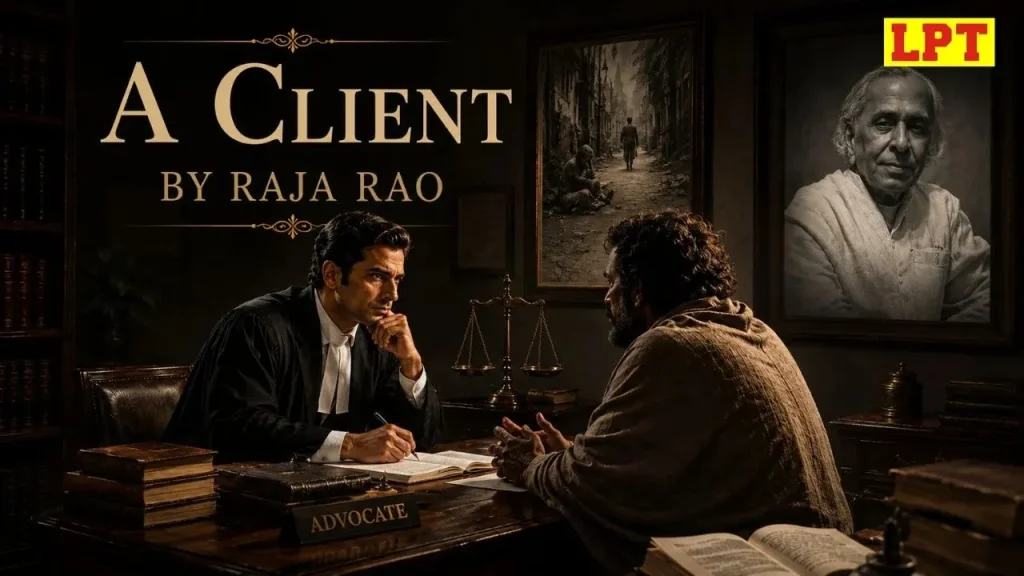
A Client by Raja Rao is a thoughtful and philosophical short story that explores morality, spirituality, human suffering, justice, and inner emotional conflict through a realistic social situation. The story mainly revolves around the interaction between a lawyer and his client, gradually revealing deeper questions about ethics, responsibility, truth, and the complexity of human behavior.
One of the most important aspects readers notice in the summary of A Client by Raja Rao is how ordinary events slowly develop into deeper reflection on life, morality, and human values. The narrative also highlights themes like compassion, social reality, emotional struggle, faith, and personal conscience.
Through reflective storytelling and psychological realism, the story presents not only an external social situation but also the inner emotional and moral conflict experienced by individuals. Below, we have covered the complete summary, characters, themes, literary devices, symbolism, important questions and answers, quotes, moral message, and everything else readers should know about A Client story by Raja Rao.
Table Of Contents
- CLAT PG: All About CLAT Postgraduate Exam for LLM
Key Details About A Client by Raja Rao
These are the most important things to know about A Client story by Raja Rao:
| Particular | Details |
| Story Name | A Client |
| Author | Raja Rao |
| Genre | Philosophical / Social Short Story |
| Main Themes | Morality, Faith, Human Suffering, Justice |
| Tone | Serious and Thoughtful |
| Central Idea | Human morality and conscience influence decisions and relationships deeply |
| Main Conflict | Ethical responsibility versus personal and social reality |
| Important Literary Elements | Symbolism, Realism, Irony, Philosophical Narration |
Explore The Complete Summaries of Novels, Stories & Essay Notes
Summary of A Client by Raja Rao
Find the summary of A Client by Raja Rao:
Beginning
A Client story begins by introducing a lawyer who becomes involved in a case through a client seeking legal help. At first, the situation appears ordinary and professional, centered around legal advice and social responsibility. However, as the interaction between the lawyer and the client develops, deeper emotional and moral questions slowly emerge.
The story immediately creates a thoughtful atmosphere by focusing not only on external events but also on human emotions, ethical thinking, and personal conscience. The lawyer observes the client carefully and begins reflecting on the complexity of human suffering, responsibility, and morality.
The beginning establishes themes like justice, morality, spirituality, human relationships, and emotional conflict. Raja Rao uses reflective narration and psychological realism to create intellectual and emotional depth within a simple social situation.
Middle
As the story progresses, the lawyer gradually learns more about the client’s circumstances, emotional condition, and personal struggles. The interaction between the two characters becomes more than a professional relationship and slowly turns into a deeper reflection on life, ethics, suffering, and human behavior.
The lawyer experiences inner conflict while trying to balance legal duty, moral responsibility, and personal conscience. He realizes that human problems cannot always be solved simply through law or formal systems because emotional and moral complexity often exist beneath external situations. The client’s suffering and emotional reality force the lawyer to think beyond professional boundaries.
The middle section focuses heavily on psychological and philosophical reflection. The story examines how people deal with guilt, responsibility, pain, morality, and difficult choices in life. Through ordinary conversation and realistic situations, the narrative explores larger human questions about justice, compassion, truth, and spiritual awareness.
Raja Rao presents emotional conflict subtly rather than dramatically. The story’s power comes from thoughtfulness, reflection, and realistic emotional tension rather than external action or suspense.
Ending
Towards the ending, the lawyer achieves deeper understanding about human nature, suffering, and moral responsibility. The conclusion does not provide a simple or perfect solution to the client’s situation. Instead, it leaves readers reflecting on the complexity of life, justice, and human emotions.
The ending emphasizes that morality and conscience are more complicated than legal rules or social expectations. Human beings carry emotional struggles, weaknesses, fears, and ethical dilemmas that cannot always be judged easily. The lawyer’s reflections highlight the importance of compassion, understanding, and self-awareness while dealing with others.
Through philosophical narration and psychological realism, Raja Rao explores morality, spirituality, human suffering, emotional conflict, and social reality thoughtfully and realistically. The story ultimately encourages readers to think deeply about justice, humanity, and personal responsibility beyond surface-level understanding.
Download PDFA Client Short Summary
A Client is a philosophical and reflective story about morality, justice, human suffering, and emotional conflict. The narrative revolves around a lawyer and his client, whose interaction gradually develops into deeper reflection on ethics, conscience, compassion, and social reality.
As the lawyer learns more about the client’s struggles and emotional condition, he begins questioning the limitations of law and the complexity of human judgment. Through realistic narration and psychological observation, Raja Rao explores themes like spirituality, responsibility, human values, and moral awareness. The story highlights that true understanding of people often requires compassion and emotional sensitivity beyond legal or social rules.
About the Author Raja Rao
Raja Rao was one of the most important Indian English writers known for blending Indian philosophy, spirituality, and social realism within modern English literature. Born in 1908, he became famous for exploring themes like morality, identity, faith, spirituality, human suffering, and Indian culture through reflective and intellectual storytelling.
Raja Rao’s writing style is philosophical, symbolic, and deeply rooted in Indian thought and tradition. His stories focus on inner emotional conflict, moral responsibility, and spiritual understanding rather than fast-moving action. He combined realistic social situations with deeper reflections on life and human values, making his works intellectually rich and emotionally meaningful.
Many readers appreciate his ability to present complex philosophical ideas through ordinary human experiences and realistic characters. His stories remain highly valuable for students because they improve comprehension, critical thinking, emotional interpretation, and understanding of philosophical literature through thoughtful and reflective narration.
Main Characters in A Client by Raja Rao
Lawyer / Narrator
The lawyer is thoughtful, observant, reflective, and emotionally sensitive. Through his interaction with the client, he experiences moral questioning and deeper understanding of human suffering and responsibility. His character symbolizes conscience, ethical reflection, and the struggle between professional duty and emotional humanity.
Client
The client represents human suffering, emotional conflict, and social reality. His circumstances and emotional condition become the center of the lawyer’s moral reflection. The client symbolizes the complexity of human life, where people often face situations that cannot be understood through simple judgment alone.
Other Social Characters
The other social figures and surrounding environment contribute to the story’s exploration of justice, morality, and social responsibility. They help create the realistic atmosphere in which personal struggle and ethical conflict become emotionally meaningful.
Read Short Story Summaries
Read concise and student-friendly summaries of famous short stories along with themes, moral lessons, literary devices, and important questions:
| A Cup of Tea by Katherine Mansfield | Upper Division Love by Manohar Malgonkar |
| The Night The Ghost In by James Thurber | Dr. Heideggers Experiment by Nathaniel Hawthorn |
Themes of A Client by Raja Rao
The story revolves around these themes:
- Morality and Ethics: The story explores how moral responsibility and ethical thinking influence human decisions and relationships deeply.
- Human Suffering: The narrative highlights emotional pain, personal struggle, and the difficulties people face within social reality.
- Justice and Responsibility: The story questions the limits of legal systems and examines the deeper emotional side of justice and accountability.
- Spirituality and Reflection: Raja Rao combines social realism with philosophical reflection about life, humanity, and inner understanding.
- Compassion and Humanity: The narrative emphasizes the importance of empathy, emotional understanding, and kindness while judging others.
- Inner Conflict: The lawyer experiences emotional and ethical conflict while balancing professional duty with personal conscience.
- Social Reality: The story realistically portrays human struggle, social pressure, and emotional complexity within ordinary life situations.
Literary Devices Used in A Client Short Story
A Client by Raja Rao have these literary devices:
| Literary Device | How It Is Used in the Story |
| Realism | The story realistically portrays human suffering, legal situations, and emotional conflict within society. |
| Symbolism | The client symbolizes human struggle, moral complexity, and emotional suffering beyond surface reality. |
| Characterization | Raja Rao develops characters through emotional reflection, dialogue, and psychological observation. |
| Philosophical Narration | The narrative combines ordinary events with deeper reflection on morality, justice, and spirituality. |
| Irony | The story subtly shows the difference between legal judgment and deeper human truth. |
| Emotional Contrast | The contrast between professional duty and emotional compassion creates psychological depth. |
| Imagery | Descriptive details and reflective narration create a serious and thoughtful atmosphere throughout the story. |
Explore the Best Novels for IPMAT Preparation
Why Read A Client Story?
- Improves Understanding of Philosophical Literature: The story introduces readers to reflective storytelling that explores morality, justice, and human conscience deeply.
- Develops Critical Thinking Skills: The narrative encourages readers to think beyond simple right and wrong while understanding emotional complexity.
- Helps in Character Analysis: The lawyer and client provide excellent examples of psychological and moral conflict within realistic situations.
- Improves Reading Comprehension: The reflective narration and philosophical themes strengthen analytical reading and interpretation abilities naturally.
- Encourages Compassion and Emotional Awareness: The story reminds readers that understanding human suffering requires empathy, patience, and emotional sensitivity.
Read Essay Summaries
Explore student-summaries of famous essays with detailed themes, moral lessons, literary devices, analysis, and important exam-focused questions.
| El Dorado by RL Stevenson | The Convalescent by Charles Lamb |
| The Golden Age by AG Gardiner | Tight Corners By EV Lucas |
Important Questions and Answers on A Client by Raja Rao
1. Who wrote A Client?
A Client was written by Raja Rao, one of the most respected Indian English writers known for combining philosophy, spirituality, realism, and psychological depth within his stories.
2. What is the main theme of A Client?
The main theme of the story is morality and human conscience. The narrative also explores justice, emotional suffering, ethical responsibility, compassion, spirituality, and the complexity of human behavior and relationships.
3. Who is the central character in the story?
The central character is the lawyer or narrator, whose interaction with the client becomes the foundation for deeper moral and philosophical reflection throughout the story.
4. What role does the client play in the story?
The client represents human suffering, emotional conflict, and moral complexity. His circumstances force the lawyer to think beyond legal duty and reflect more deeply on justice, compassion, and human values.
5. How does the story portray morality?
The story presents morality as emotionally and psychologically complex rather than simple or absolute. It shows that human situations often require compassion, understanding, and reflection instead of quick judgment.
6. What is the central idea of A Client?
The central idea is that law and social systems alone cannot fully explain human suffering and emotional reality. Personal conscience and compassion are equally important in understanding people and situations.
7. How does Raja Rao use philosophical narration in the story?
Raja Rao combines realistic situations with deeper reflection on ethics, spirituality, suffering, and human responsibility, giving the narrative intellectual and emotional depth.
8. What inner conflict does the lawyer experience?
The lawyer struggles between professional responsibility and emotional understanding. As he learns more about the client, he begins questioning the limits of legal judgment and the complexity of human morality.
9. What literary devices are used in A Client?
The story mainly uses realism, symbolism, irony, philosophical narration, imagery, emotional contrast, and characterization. These literary devices help create reflective and psychologically rich storytelling.
10. Why is compassion important in the story?
Compassion becomes important because the narrative shows that human suffering cannot always be understood through rules, law, or social judgment alone. Emotional understanding is necessary for true humanity.
11. What message does the story give readers?
The story teaches readers to think deeply about morality, justice, and human suffering. It also reminds people not to judge others quickly without understanding their emotional and personal struggles.
12. Why is A Client considered a philosophical story?
The narrative focuses heavily on ethical reflection, emotional conflict, spirituality, and questions about human responsibility rather than dramatic action or external suspense.
13. How does the story portray social reality?
The story realistically presents emotional suffering, personal struggle, legal responsibility, and human weakness within ordinary social situations and relationships.
14. What makes A Client emotionally meaningful?
The emotional depth comes from the realistic portrayal of suffering, moral uncertainty, compassion, and the lawyer’s inner struggle between professional duty and emotional conscience.
Moral Message of A Client
A Client teaches that true understanding of people requires compassion, patience, and emotional sensitivity. The story reminds readers that morality and justice are often more complex than simple judgment, and human suffering should be approached with humanity, conscience, and deeper awareness rather than only rules or external appearances.
Read More Such Summaries
Explore Other Exam Preparation Resources
Prepare smarter with our dedicated coaching programs, preparation guides, mock tests, and study resources for top competitive exams in India.

Nidhi Priya
Nidhi Priya has over 6 years of experience in EdTech content and SEO. She specializes in content strategy, organic growth, and mentoring editorial teams, with previous experience at iQuanta, CollegeDekho, and Careers360.