Talk to a Counsellor
IPM/BBA:
Talk to a Counsellor
IPM/BBA:  Support
14 Best Novels for IPMAT VARC, Critical Thinking & Leadership
Last Updated on 25 Jun 2026

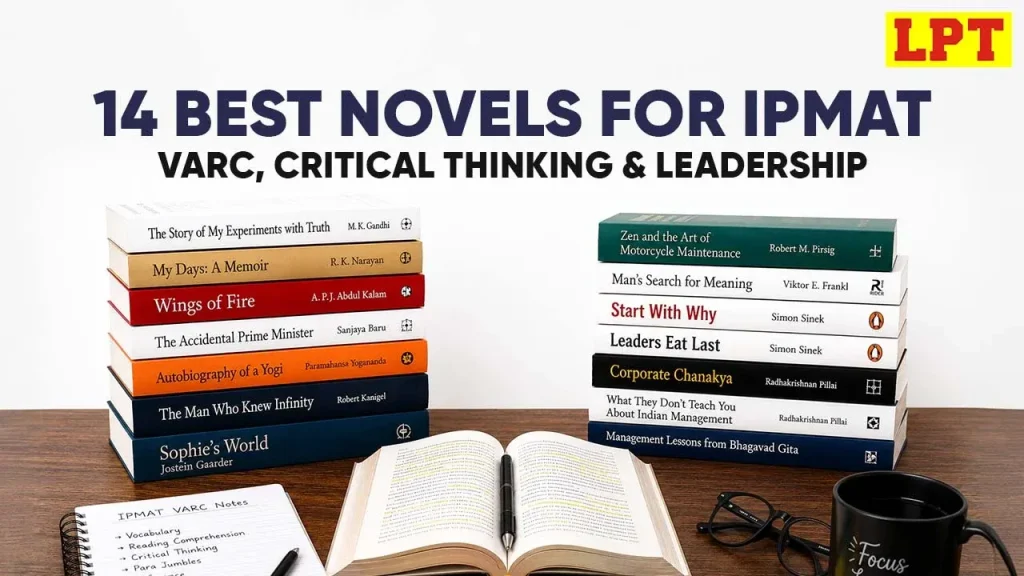
Reading is one of the most underrated habits for IPMAT aspirants. While aptitude preparation is important, your reading ability, vocabulary, comprehension skills, communication, and thinking style also play a major role in cracking IPMAT and performing well in the Personal Interview round.
This is why top mentors at LPT, India’s best IPMAT Online coaching institute, strongly recommend developing a daily reading habit through meaningful books and biographies. Some of the best novels for IPMAT preparation include Wings of Fire, Man’s Search for Meaning, Sophie’s World, The Story of My Experiments with Truth, and Corporate Chanakya.
These novels to read for IPMAT not only improve your reading speed and understanding but also help you build maturity, leadership qualities, decision-making skills, and better perspectives about life and management.
Table Of Contents
- CLAT PG: All About CLAT Postgraduate Exam for LLM
Best Novels to Read for IPMAT
Following are the most recommended novels for IPMAT aspirants:
| Sr. No. | Book Name | Author | Genre | Why IPMAT Aspirants Should Read It |
|---|---|---|---|---|
| 1 | The Story of My Experiments with Truth | Mahatma Gandhi | Autobiography | Builds discipline, honesty, and perspective towards life |
| 2 | My Days: A Memoir | R.K. Narayan | Memoir | Improves storytelling understanding and simple communication style |
| 3 | Wings of Fire | A.P.J. Abdul Kalam | Autobiography | Inspires hard work, ambition, and resilience |
| 4 | The Accidental Prime Minister | Sanjaya Baru | Political Memoir | Gives insights into leadership and decision-making |
| 5 | Autobiography of a Yogi | Paramahansa Yogananda | Spiritual Autobiography | Develops deeper thinking and self-awareness |
| 6 | The Man Who Knew Infinity | Robert Kanigel | Biography | Inspires analytical thinking through Ramanujan’s journey |
| 7 | Sophie’s World | Jostein Gaarder | Philosophical Fiction | Improves curiosity and intellectual thinking |
| 8 | Zen and the Art of Motorcycle Maintenance | Robert M. Pirsig | Philosophy | Encourages deep thinking and problem-solving mindset |
| 9 | Man’s Search for Meaning | Viktor Frankl | Psychology/Memoir | Teaches resilience, purpose, and mental strength |
| 10 | Start With Why | Simon Sinek | Leadership | Helps understand leadership and motivation |
| 11 | Leaders Eat Last | Simon Sinek | Management | Builds understanding of teamwork and leadership culture |
| 12 | Corporate Chanakya | Radhakrishnan Pillai | Management | Explains management lessons through Chanakya’s principles |
| 13 | What They Don’t Teach You About Indian Management | Anand Kumar | Management | Gives practical Indian business and leadership insights |
| 14 | Management Lessons from Bhagavad Gita | Arun Kumar | Management/Spirituality | Connects management principles with Indian philosophy |
1. The Story of My Experiments with Truth – Mahatma Gandhi
The Story of My Experiments with Truth is the autobiography of Mahatma Gandhi, where he shares his journey from childhood to becoming one of the most influential leaders in the world. The book talks honestly about his mistakes, struggles, discipline, values, and personal growth.

Gandhi explains how small habits, self-control, truthfulness, and consistency shaped his personality and leadership. The language is simple, making it easy for students to read and understand.
Key Lessons for Students:
- Importance of honesty and integrity in life
- Power of discipline and consistency
- Learning from mistakes and failures
- Building strong self-control and focus
- Staying committed to long-term goals
- Importance of simplicity and humility
- Developing leadership through actions
Benefits from IPM Perspective:
- Improves reading comprehension through simple yet meaningful writing
- Helps in personality development for Personal Interview rounds
- Builds maturity and clarity in communication
- Develops leadership and ethical thinking important for future managers
- Helps students form thoughtful opinions for interviews and discussions
- Encourages consistency and discipline during preparation journey
2. My Days: A Memoir – R.K. Narayan
My Days: A Memoir is the autobiographical work of R.K. Narayan, one of India’s most respected writers. In this book, he shares stories from his childhood, writing journey, struggles, personal losses, and literary success in a simple and engaging way.

The writing style is smooth, conversational, and easy to understand, making it an excellent choice for young readers. The book gives students a closer look at creativity, observation skills, emotional intelligence, and everyday life experiences.
Mentors recommended it as a novel to read for IPMAT because it improves reading habits naturally while also helping students understand human behavior, communication, and storytelling.
Key Lessons for Students:
- Importance of patience in career growth
- Learning through real-life experiences
- Staying grounded despite success
- Developing creativity and observation skills
- Handling personal struggles with resilience
- Value of consistency in work and learning
Benefits from IPM Perspective:
- Improves reading speed and comprehension ability
- Enhances communication and storytelling skills
- Helps in building thoughtful interview conversations
- Develops emotional intelligence and observation power
- Makes students comfortable with long-form reading
- Improves vocabulary through simple literary writing
3. Wings of Fire – A.P.J. Abdul Kalam
Wings of Fire is the inspiring autobiography of Dr. A.P.J. Abdul Kalam, former President of India and one of the country’s greatest scientists. The book covers his journey from a small town in Tamil Nadu to leading India’s missile and space programs. It highlights hard work, discipline, learning, failures, and determination in a very motivating way.

Dr. Kalam’s life story inspires students to dream big and stay committed to their goals despite challenges. This is called the most recommended novel for IPMAT aspirants because it motivates students to develop strong ambition, focus, and a growth mindset during preparation.
Key Lessons for Students:
- Importance of hard work and discipline
- Never giving up after failures
- Power of dreams and ambition
- Learning continuously throughout life
- Respecting teachers and mentors
- Staying humble despite achievements
Benefits from IPM Perspective:
- Motivates students during stressful preparation phases
- Builds confidence and positive mindset
- Helps in personality development for interviews
- Encourages leadership and responsibility
- Improves reading consistency and focus
- Provides real-life examples useful in PI discussions
Explore important resources for the IPMAT exam:
| IPMAT Exam | Best Books for IPMAT Exam |
| IPMAT Full Form | IPMAT Registration |
| IPMAT Syllabus | IPMAT Rohtak Total Marks |
| IPMAT Indore v/s Rohtak | IPMAT Exam Centres |
4. The Accidental Prime Minister – Sanjaya Baru
The Accidental Prime Minister is a political memoir written by Sanjaya Baru, former media advisor to Prime Minister Dr. Manmohan Singh. The book gives readers an inside view of Indian politics, governance, leadership challenges, communication, and decision-making at the highest level.

It explains how power structures work and how leaders handle pressure, criticism, and responsibilities. The writing is informative yet engaging, making it useful for students interested in management, leadership, and current affairs.
Key Lessons for Students:
- Understanding leadership under pressure
- Importance of strategic communication
- Learning how decision-making works
- Balancing authority and responsibility
- Importance of teamwork in leadership
- Handling criticism and public perception
Benefits from IPM Perspective
- Helps students develop awareness about leadership and governance
- Improves understanding of management and decision-making
- Useful for Personal Interview and group discussion topics
- Builds analytical and critical thinking ability
- Enhances knowledge of current affairs and administration
- Improves reading stamina through non-fiction content
5. Autobiography of a Yogi – Paramahansa Yogananda
Autobiography of a Yogi is a spiritual autobiography written by Paramahansa Yogananda, one of the most respected spiritual teachers from India. The book shares his life journey, experiences with meditation, spiritual learning, and interactions with saints and yogis across India.

Even though the book is spiritual in nature, it teaches students valuable lessons about focus, inner peace, discipline, self-awareness, and purpose in life. The writing introduces readers to deeper thinking and mindfulness, which can help students stay mentally balanced during competitive exam preparation.
Key Lessons for Students:
- Importance of self-discipline and focus
- Staying calm during difficult situations
- Developing self-awareness and clarity
- Value of patience and inner strength
- Balancing ambition with peace of mind
- Understanding the importance of purpose in life
Benefits from IPM Perspective:
- Helps students manage stress and anxiety during preparation
- Improves focus and mental clarity
- Builds emotional maturity for interviews
- Encourages disciplined daily routines
- Develops deeper thinking and self-confidence
- Helps maintain balance between studies and mental wellness
Resources to explore after IPMAT exam:
| IPMAT Answer Key | IPMAT Exam Analysis |
| IPMAT Cut Off | IPMAT Seats |
6. The Man Who Knew Infinity – Robert Kanigel
The Man Who Knew Infinity is the biography of Srinivasa Ramanujan, one of the greatest mathematical geniuses in history. Written by Robert Kanigel, the book tells the story of Ramanujan’s journey from a small town in India to Cambridge University, where his mathematical talent gained global recognition.

The book beautifully captures his struggles, passion for learning, dedication, and extraordinary thinking ability. It inspires students to pursue excellence despite limited resources or challenges. The story also shows the importance of curiosity, persistence, and intellectual growth, making it highly relevant for ambitious students preparing for competitive exams and management careers.
Key Lessons for Students:
- Power of dedication and self-learning
- Importance of curiosity and deep thinking
- Never letting challenges stop your growth
- Staying committed to your passion
- Value of perseverance and hard work
- Importance of intellectual discipline
Benefits from IPM Perspective:
- Inspires analytical and problem-solving mindset
- Motivates students to stay consistent in preparation
- Develops appreciation for logical thinking
- Helps build resilience during competitive preparation
- Encourages long-term academic focus
- Improves reading comprehension through biography-style storytelling
7. Sophie’s World – Jostein Gaarder
Sophie’s World is a philosophical fiction novel that introduces readers to the history of philosophy through an engaging story. The book follows a young girl named Sophie as she receives mysterious letters that teach her about famous philosophers, ideas, and human thinking.

It simplifies complex philosophical concepts in an interesting and easy-to-understand manner. For students, the book improves curiosity, questioning ability, and intellectual thinking. It also encourages readers to look beyond textbooks and think independently.
Key Lessons for Students:
- Importance of questioning and curiosity
- Learning to think independently
- Understanding different perspectives and ideas
- Developing intellectual awareness
- Importance of knowledge beyond academics
- Building logical and analytical thinking
Benefits from IPM Perspective:
- Improves critical thinking and reasoning ability
- Helps students perform better in interviews and discussions
- Builds intellectual maturity and awareness
- Encourages curiosity-driven learning
- Enhances comprehension and concentration
- Develops better articulation of thoughts and opinions
8. Zen and the Art of Motorcycle Maintenance – Robert M. Pirsig
Zen and the Art of Motorcycle Maintenance is a philosophical novel that combines a motorcycle journey with deep discussions about life, quality, thinking, and human values. The book explores how people understand the world, solve problems, and balance logic with emotions.

Even though the title sounds technical, the book mainly focuses on mindset, discipline, and meaningful living. It encourages readers to think deeply rather than accepting things blindly. For students, this book develops patience, analytical ability, and thoughtful decision-making.
It is especially useful for aspirants who want to improve their perspective, concentration, and intellectual maturity during preparation.
Key Lessons for Students:
- Importance of quality in work and learning
- Balancing logic with emotions
- Thinking independently and deeply
- Developing patience and focus
- Understanding problem-solving approaches
- Building a meaningful perspective towards life
Benefits from IPM Perspective:
- Improves analytical and reasoning skills
- Develops intellectual depth for interviews
- Encourages structured and thoughtful thinking
- Helps students improve concentration
- Builds maturity in communication and opinions
- Strengthens problem-solving mindset useful in management education
9. Man’s Search for Meaning – Viktor Frankl
Man’s Search for Meaning is one of the most powerful books on human psychology, resilience, and purpose. Written by Viktor Frankl, the book is based on his experiences in Nazi concentration camps during World War II.

Despite extreme suffering, he explains how people can survive difficult situations if they have a strong purpose in life. The book teaches mental strength, emotional resilience, optimism, and self-belief in a very impactful way.
Its writing is simple yet deeply meaningful, making it highly recommended for students preparing for competitive exams and life challenges beyond academics.
Key Lessons for Students:
- Importance of purpose and goals in life
- Staying mentally strong during struggles
- Developing resilience and emotional stability
- Learning to handle failures positively
- Importance of hope and optimism
- Building inner strength and self-control
Benefits from IPM Perspective:
- Helps students manage exam stress effectively
- Builds emotional maturity for Personal Interviews
- Encourages long-term motivation and consistency
- Improves perspective towards challenges and failures
- Develops thoughtful and meaningful communication
- Helps students stay positive during preparation journey
Check the IPMAT previous year question papers:
| IPMAT Previous Year Papers | IPMAT 2024 Question Paper |
| IPMAT 2023 Question Paper | IPMAT 2022 Question Paper |
| IPMAT Rohtak Previous Year Papers | IPMAT Indore Previous Year Papers |
10. Start With Why – Simon Sinek
Start With Why is a leadership and management book by Simon Sinek that explains why successful leaders and organizations focus on purpose before strategy or products. The book introduces the concept of the “Golden Circle,” where great leaders first understand their purpose, then communicate it effectively to inspire others.

Through examples from companies and global leaders, the book shows how clarity of purpose creates trust, motivation, and strong leadership. For students, the book is highly useful in understanding leadership, communication, and goal-setting. It also helps aspirants think about their own ambitions, career goals, and motivation clearly.
Key Lessons for Students:
- Importance of understanding your purpose
- Leadership starts with clarity and vision
- Communication becomes powerful with purpose
- Motivation is stronger when goals are meaningful
- Great leaders inspire rather than command
- Long-term success requires clear direction
Benefits from IPM Perspective
- Helps students build leadership mindset
- Useful for Personal Interview preparation
- Improves communication and presentation skills
- Encourages goal-oriented thinking
- Develops management and leadership understanding
- Helps aspirants articulate career goals confidently
11. Leaders Eat Last – Simon Sinek
Leaders Eat Last is a management and leadership book where Simon Sinek explains how great leaders create trust, teamwork, and strong organizational culture. Through real-life examples from businesses, the military, and successful organizations, the book shows that good leadership is not about authority alone but about responsibility and care for people.

The writing is practical, engaging, and easy to understand for students. It teaches how teamwork, empathy, communication, and trust play an important role in achieving success.
Key Lessons for Students:
- Leadership is about responsibility and trust
- Teamwork is essential for success
- Empathy makes better leaders
- Strong communication builds strong teams
- Respect and support improve performance
- Great leaders focus on people first
Benefits from IPM Perspective:
- Builds understanding of management and leadership culture
- Helps in interview discussions about teamwork and leadership
- Develops communication and interpersonal understanding
- Encourages collaborative mindset useful in business schools
- Improves awareness about organizational behavior
- Helps students think like future managers and leaders
Estimate your score using the IPMAT Indore Answer Key.
12. Corporate Chanakya – Radhakrishnan Pillai
Corporate Chanakya is a management book that explains Chanakya’s ancient principles in a modern business and leadership context. Written by Radhakrishnan Pillai, the book simplifies Chanakya Niti and connects it with leadership, strategy, communication, decision-making, and management practices used today.

The examples are practical and easy to relate to for students. It teaches how discipline, planning, intelligence, and strategic thinking help leaders succeed in competitive environments.
The book also gives readers insights into Indian management wisdom, making it a unique and valuable read for students preparing for management careers and competitive entrance exams.
Key Lessons for Students:
- Importance of strategic thinking
- Leadership requires discipline and planning
- Decision-making should be practical and balanced
- Communication plays a major role in leadership
- Intelligence must be combined with ethics
- Preparation and foresight lead to success
Benefits from IPM Perspective
- Introduces students to management concepts early
- Helps develop leadership and strategic thinking
- Useful for Personal Interview and GD discussions
- Improves decision-making and analytical ability
- Builds understanding of Indian management philosophy
- Encourages disciplined preparation approach
Start with IPMAT mocks by LPT:
| IPMAT Indore Mock Test | Free IPMAT Mock Test PDF |
| IPMAT Rohtak Mock Test | IPMAT Quant Mock Test |
| IPMAT VARC Mock Test | IPMAT Logical Reasoning Mock Test |
| IPMAT Mock Test |
13. What They Don’t Teach You About Indian Management – Anand Kumar
What They Don’t Teach You About Indian Management focuses on practical management lessons inspired by Indian business culture, traditions, and real-life experiences. The book explains how management in India often works differently from textbook theories and highlights the importance of adaptability, relationships, communication, and practical intelligence.

It gives students a realistic understanding of leadership and workplace dynamics in the Indian context. The writing style is simple and relatable, making it suitable for beginners interested in management studies.
Key Lessons for Students:
- Practical thinking is important in management
- Adaptability helps in challenging situations
- Relationships and communication matter greatly
- Real-life experience teaches beyond textbooks
- Leadership requires understanding people
- Problem-solving needs flexibility and awareness
Benefits from IPM Perspective:
- Gives practical understanding of management concepts
- Helps students develop business-oriented thinking
- Useful for interviews and management discussions
- Improves awareness about Indian corporate culture
- Encourages practical decision-making mindset
- Builds confidence in discussing management topics
14. Management Lessons from Bhagavad Gita – Arun Kumar
Management Lessons from Bhagavad Gita connects the teachings of the Bhagavad Gita with modern leadership and management principles. The book explains concepts like decision-making, self-control, discipline, leadership, focus, and handling pressure through examples from the Gita.

It presents ancient Indian wisdom in a simple and practical way that students can easily understand and apply in daily life. The book is especially useful for young aspirants who want to develop emotional balance, leadership qualities, and mental clarity during competitive exam preparation. It also helps readers understand how values and ethics influence successful leadership.
Key Lessons for Students:
- Importance of discipline and self-control
- Staying focused during difficult situations
- Leadership requires calm and clarity
- Ethical values are important in success
- Decision-making should be balanced and thoughtful
- Mental strength helps overcome challenges
Benefits from IPM Perspective:
- Helps students manage stress and pressure
- Builds emotional intelligence and maturity
- Develops leadership and ethical thinking
- Useful for Personal Interview discussions
- Encourages balanced and focused preparation
- Improves clarity in communication and decision-making
Best IPMAT Novels Based on Your Personality Type
If You Like Inspirational Stories
- Wings of Fire: Perfect for students who feel motivated by stories of hard work, ambition, and success against all odds.
- The Man Who Knew Infinity: A great choice for aspirants who admire intelligence, dedication, and academic excellence in challenging situations.
- The Story of My Experiments with Truth: Best for students who want to learn discipline, honesty, leadership, and self-improvement through real-life experiences.
If You Like Philosophy & Deep Thinking
- Sophie’s World: Ideal for curious students who enjoy questioning ideas, understanding perspectives, and exploring intellectual concepts deeply.
- Zen and the Art of Motorcycle Maintenance: Recommended for aspirants who enjoy thoughtful discussions about life, logic, quality, and problem-solving approaches.
- Man’s Search for Meaning: Best for students interested in psychology, purpose, resilience, and understanding the deeper meaning of success and struggles.
If You Want Leadership & Management Lessons
- Start With Why: Perfect for students who want to understand leadership, communication, motivation, and how successful leaders inspire people.
- Leaders Eat Last: A strong choice for aspirants interested in teamwork, organizational culture, empathy, and people-focused leadership.
- Corporate Chanakya: Best for students who want to learn practical leadership and management lessons inspired by Indian strategic thinking.
If You Want Better Communication Skills
- My Days: A Memoir: The simple writing style and storytelling improve communication, understanding and reading comfort naturally.
- The Accidental Prime Minister: Helpful for students who want to improve awareness about communication, public image, and leadership discussions.
- Sophie’s World: Improves articulation and thought expression by exposing readers to intellectual and philosophical conversations.
If You Want Indian Wisdom & Practical Life Lessons
- Management Lessons from Bhagavad Gita: Perfect for aspirants who want to learn discipline, emotional control, focus, and leadership through Indian philosophy.
- What They Don’t Teach You About Indian Management: Recommended for students who want practical insights into Indian business thinking and real-world management situations.
- Autobiography of a Yogi: Best for students looking to improve self-awareness, concentration, peace of mind, and emotional balance.
Check the IPMAT Indore Result here
Read Short Story Summaries
Read concise and student-friendly summaries of famous short stories along with themes, moral lessons, literary devices, and important questions:
How to Effectively Read Novels for IPMAT Preparation?
Read Daily for 20–30 Minutes
Consistency matters more than reading for long hours occasionally. Reading daily improves comprehension speed, vocabulary, focus, and concentration gradually over time.
Keep a Vocabulary Notebook
Whenever you find a new word, note its meaning, usage, and sentence formation. This helps improve vocabulary naturally for the IPMAT verbal sections.
Focus on Understanding, Not Speed
Do not rush to finish novels quickly. Try to understand the ideas, emotions, arguments, and lessons explained in the book properly.
Highlight Important Lines & Ideas
Mark meaningful quotes, leadership lessons, philosophical ideas, and communication styles that can help during Personal Interview preparation later.
Read Different Types of Novels
Do not limit yourself to only biographies or fiction. Read philosophy, management, memoirs, and leadership books to develop broader perspectives.
Discuss Novels With Friends or Mentors
Talking about books improves communication skills, opinion-building ability, and confidence in expressing thoughts during interviews and group discussions.
Connect Learnings With Real Life
Try applying the lessons from novels to your daily habits, studies, discipline, leadership, and decision-making to make reading more meaningful.
Build Reading Stamina Gradually
Initially, long novels may feel difficult. Start with simple books like Wings of Fire and slowly move towards deeper philosophical novels.
Avoid Reading Only Summaries
Summaries may save time but they do not improve comprehension, vocabulary, or analytical thinking as effectively as full books do.
Maintain a Reading Habit Alongside Preparation
Reading should support your IPMAT preparation, not disturb it. Dedicate a fixed daily time slot without affecting aptitude practice sessions.
Benefits of Reading Novels for IPMAT Aspirants
- Improves Reading Comprehension: Regular reading improves your ability to understand lengthy passages quickly, which directly helps in IPMAT verbal ability sections.
- Builds Strong Vocabulary: Novels naturally introduce new words, phrases, and sentence structures that improve vocabulary without memorizing difficult word lists daily.
- Develops Critical Thinking: Meaningful books help you analyze situations, perspectives, and ideas deeply, improving logical thinking and decision-making abilities for interviews.
- Improves Communication Skills: Reading quality books improves your speaking style, sentence formation, confidence, and ability to express thoughts clearly during group discussions.
- Helps in Personal Interview Preparation: Books expose you to leadership, philosophy, management, and real-life struggles, helping you develop mature and meaningful interview answers.
Discover More Useful Information Related to the IPMAT Exam
| IPMAT Full Form | IPMAT Score V/S Percentile |
| IPMAT Indore Answer Key | IPMAT Indore Seats |
| IPMAT Indore Subjects | IPMAT Indore Exam Centers |
| IPMAT Rohtak Passing Marks | IPMAT Rohtak Answer Key |
FAQs About Novels for IPMAT

Nidhi Priya
Nidhi Priya has over 6 years of experience in EdTech content and SEO. She specializes in content strategy, organic growth, and mentoring editorial teams, with previous experience at iQuanta, CollegeDekho, and Careers360.
Also Read : Online IPMAT Coaching , IPMAT Mock Tests , IPMAT Study Material
IPMAT Trending Blogs
- IPMAT Syllabus 2027: Subject-Wise Detailed Syllabus (PDF)
- IPMAT Registration 2027: Date, Application Form, Fee, Process
- IPMAT Previous Year Question Papers (2019-2026): FREE PYQs
- IPMAT Cut Off 2027: Category-wise Rohtak and Indore Cut Off
- IPMAT Exam Date 2027, Complete Schedule and Important Dates
- IPMAT Result 2027: IIM Indore & Rohtak Result Date, Cutoff
Other Related Blogs