 Talk to a Counsellor
IPM/BBA:
Talk to a Counsellor
IPM/BBA:  Support
Karma by Khushwant Singh: Summary, Themes, QnA, Moral
Last Updated on 24 Jun 2026

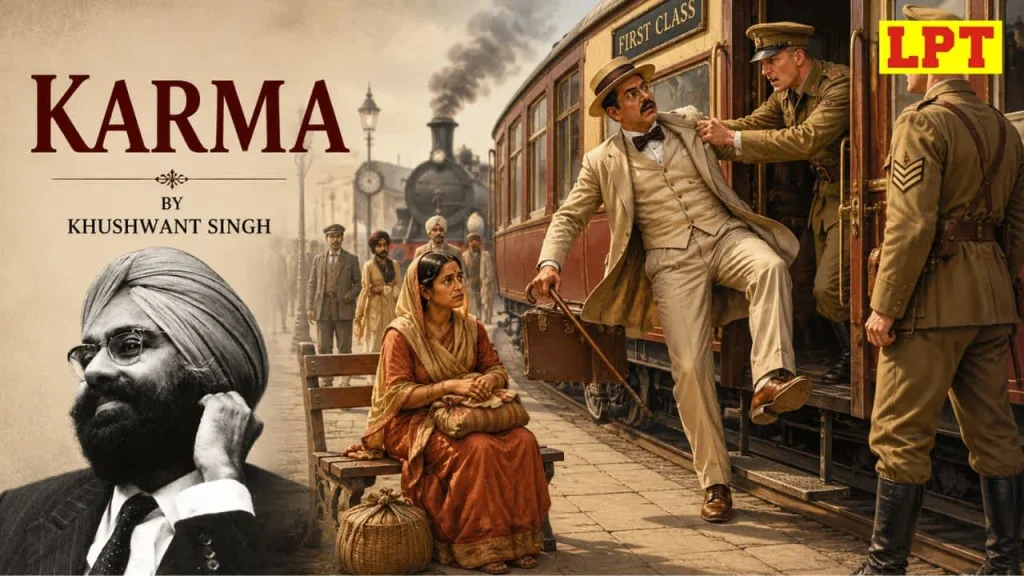
Karma by Khushwant Singh is a sharp and ironic short story that explores colonial mentality, identity, pride, class difference, and cultural insecurity through the life of Sir Mohan Lal, an English-educated Indian man deeply obsessed with British culture and lifestyle. The story takes place mainly at a railway station and inside a train compartment, where Sir Mohan Lal’s arrogance, westernized behavior, and desire for social superiority gradually lead to humiliation.
Alongside him, his wife Lachmi represents simplicity, traditional Indian values, and emotional honesty. One of the most important aspects readers notice in the summary of Karma story of Khushwant Singh is the powerful use of irony and satire to criticize blind imitation of foreign culture and loss of self-identity.
The story also highlights themes like appearance versus reality, ego, social class, and cultural conflict. Below, we have covered the complete summary, characters, themes, literary devices, symbolism, important questions and answers, quotes, moral message, and everything else students should know about Karma by Khushwant Singh.
Table Of Contents
- CLAT PG: All About CLAT Postgraduate Exam for LLM

Explore The Complete Summaries of Novels, Stories & Essay Notes
Key Details About Karma by Khushwant Singh
These are the most important things to know about Karma story written by Khushwant Singh:
| Particular | Details |
|---|---|
| Story Name | Karma |
| Author | Khushwant Singh |
| Genre | Social Satire / Short Story |
| Main Themes | Colonial Mentality, Pride, Identity, Irony |
| Setting | Railway Station and Train |
| Writing Style | Satirical, Realistic, Ironical |
| Tone | Critical and Humorous |
| Central Idea | Blind imitation and arrogance can lead to humiliation |
| Main Conflict | Identity versus artificial westernization |
| Important Literary Elements | Irony, Satire, Symbolism, Contrast |
| Main Focus | Cultural Identity and Human Ego |
| Narrative Style | Character-Driven Social Commentary |
Karma by Khushwant Singh: Summary
Below is the summary of Karma short story by Khushwant Singh:
Beginning
Karma begins at a railway station where Sir Mohan Lal and his wife Lachmi are preparing to travel by train. Sir Mohan Lal is an English-educated Indian man who is deeply obsessed with British culture, language, manners, and lifestyle. He dresses elegantly in western clothes, smokes imported cigarettes, drinks whisky, and speaks polished English with great pride. He considers himself superior to ordinary Indians and feels uncomfortable associating with traditional Indian culture.
In contrast, his wife Lachmi is simple, traditional, and uneducated. She wears traditional Indian clothes, eats homemade food, and behaves naturally without pretending to be westernized. Sir Mohan Lal feels embarrassed by her appearance and chooses not to sit with her during the journey. Instead, he enters the first-class compartment alone because he believes he belongs among wealthy and educated British passengers. The beginning of the story establishes themes like colonial mentality, identity crisis, class difference, pride, and cultural imitation.
Middle
As the train journey begins, Sir Mohan Lal sits comfortably in the first-class compartment feeling proud of his appearance, English accent, and western lifestyle. He enjoys imagining himself as equal to the British officers and believes his polished manners make him superior to other Indians. He confidently smokes, drinks, and practices his English conversation while waiting for British passengers to appreciate him.
Soon, two British soldiers enter the compartment. Sir Mohan Lal becomes excited because he expects friendly interaction and social acceptance from them. However, instead of respecting him, the soldiers view him simply as another Indian passenger. They ignore his polished English and western appearance completely. When Sir Mohan Lal protests against their rude behavior, the soldiers physically throw him and his luggage out of the compartment onto the railway platform.
This section becomes the emotional and ironic center of the story. Sir Mohan Lal’s belief that western clothing, language, and manners could make him socially equal to the British collapses instantly. Khushwant Singh uses strong irony and satire to expose the foolishness of blind cultural imitation and loss of self-respect.
Ending
Towards the ending, Sir Mohan Lal lies humiliated on the railway platform after being thrown out of the train. His expensive clothes, polished English accent, and western behavior fail to protect him from racial discrimination and social rejection. The British soldiers continue their journey without caring about his feelings or status.
Meanwhile, Lachmi calmly continues sitting in the ordinary women’s compartment, eating food and chewing betel leaves peacefully. Unlike Sir Mohan Lal, she does not suffer emotional humiliation because she remains comfortable with her own identity and culture. The contrast between the two characters becomes the final moral statement of the story.
The ending powerfully highlights themes like identity, pride, colonial mentality, self-respect, and cultural insecurity. Through irony and social criticism, the story shows that blindly copying another culture while rejecting one’s own identity can lead to humiliation rather than acceptance or dignity.
Download PDFShort Summary of Karma Story
Karma is a satirical and ironic story about Sir Mohan Lal, an English-educated Indian man obsessed with British culture, language, and lifestyle. During a train journey, he separates himself from his simple and traditional wife Lachmi because he believes he belongs to a higher social class. Sir Mohan Lal proudly sits in a first-class compartment expecting respect from British passengers.
However, two British soldiers insult and throw him out of the train despite his western manners and appearance. Through strong irony and satire, Khushwant Singh explores themes like colonial mentality, identity crisis, pride, cultural imitation, social class, and self-respect.
Read Novel Summaries
Expand your reading with these popular novel summaries helpful for students, competitive exam aspirants, and curious readers:
| Wings of Fire by APJ Abdul Kalam | Leaders Eat Last by Simon Sinek |
| Story of My Experiments With Truth by Gandhi | My Days: A Memoir by RK Narayan |
About the Author Khushwant Singh
Khushwant Singh was one of India’s most famous writers, journalists, and social commentators. Born in 1915, he became widely known for his sharp wit, realistic storytelling, bold opinions, and satirical writing style. His works often explored Indian society, politics, human relationships, religion, identity, and cultural conflict with honesty and humor.
Khushwant Singh’s writing style is simple, direct, realistic, and highly observant. He frequently used irony and satire to expose social hypocrisy, arrogance, and blind imitation of western culture. Many of his stories focus on ordinary human behavior and psychological weaknesses while presenting deeper social commentary beneath simple situations.
His storytelling remains highly valuable for students because it improves comprehension, understanding of irony, cultural interpretation, and literary analysis through engaging and thought-provoking narratives. His ability to combine humor with criticism makes his stories memorable and relevant even today.
Karma by Khushwant Singh: Character Sketch
Sir Mohan Lal
Sir Mohan Lal is the central character of the story. He is highly educated, westernized, proud, and deeply obsessed with British culture and social status. He believes speaking English and adopting British manners make him superior to other Indians. His character symbolizes colonial mentality, identity crisis, arrogance, and blind imitation of foreign culture.
Lachmi
Lachmi is Sir Mohan Lal’s wife and represents simplicity, traditional Indian culture, and emotional honesty. She is uneducated, practical, and comfortable with her identity. Unlike Sir Mohan Lal, she does not pretend to be someone else or seek social validation from foreigners. Her character symbolizes self-acceptance, cultural rootedness, and natural dignity.
Read Short Story Summaries
Read concise and student-friendly summaries of famous short stories along with themes, moral lessons, literary devices, and important questions:
| The Tell Tale Heart by Edgar Allan Poe | Upper Division Love by Manohar Malgonkar |
| The Night The Ghost In by James Thurber | Dr. Heideggers Experiment by Nathaniel Hawthorn |
Themes of Karma Story by Khushwant Singh
- Colonial Mentality: The story criticizes the blind admiration and imitation of British culture among colonized Indians during colonial rule.
- Identity Crisis: Sir Mohan Lal rejects his own cultural identity and desperately tries to appear British, leading to emotional humiliation.
- Pride and Ego: The story shows how arrogance and false superiority can blind people to reality and self-respect.
- Appearance vs Reality: Despite his western clothes and polished English, Sir Mohan Lal remains socially unequal in the eyes of the British soldiers.
- Cultural Conflict: The narrative highlights the clash between traditional Indian identity and artificial westernization.
- Irony of Human Behavior: The story uses irony powerfully because Sir Mohan Lal’s efforts to gain British acceptance ultimately lead to humiliation.
- Self-Respect and Authenticity: Lachmi’s natural behavior contrasts sharply with Sir Mohan Lal’s artificial personality, emphasizing the value of authenticity and self-respect.
Karma by Khushwant Singh: Literary Devices
Literary devices used in Karma by Khushwant Singh include:
| Literary Device | How It Is Used in the Story |
|---|---|
| Irony | Sir Mohan Lal’s obsession with British culture leads not to respect but public humiliation. |
| Satire | The story satirically criticizes colonial mentality and blind imitation of western culture. |
| Symbolism | The train compartment symbolizes social hierarchy, colonial power, and cultural separation. |
| Contrast | Strong contrast exists between Sir Mohan Lal and Lachmi in behavior, identity, and self-respect. |
| Characterization | Khushwant Singh develops Sir Mohan Lal’s arrogance and insecurity through actions, language, and thoughts. |
| Imagery | Descriptions of clothing, station atmosphere, and train scenes create realism and social context. |
| Social Commentary | The narrative indirectly comments on colonial influence, racial discrimination, and identity crisis |
Read Essay Summaries
Explore student-friendly summaries of famous essays with detailed themes, moral lessons, literary devices, analysis, and important exam-focused questions.
Karma by Khushwant Singh: Questions and Answers
Who wrote Karma?
Karma was written by Khushwant Singh, a famous Indian writer known for satire, realism, social criticism, and sharp observation of human behavior and society. His stories often explore identity, politics, social class, and cultural conflict through simple but meaningful narratives.
What is the main theme of Karma?
The main theme of the story is colonial mentality and identity crisis. The story also explores pride, ego, cultural imitation, self-respect, appearance versus reality, and the psychological impact of colonial influence on Indian society.
Who is Sir Mohan Lal?
Sir Mohan Lal is the central character of the story. He is an English-educated Indian man deeply obsessed with British culture, language, and manners. He believes western appearance and behavior make him socially superior. His character symbolizes colonial mentality, arrogance, insecurity, and loss of cultural identity.
Why does Sir Mohan Lal separate himself from Lachmi?
Sir Mohan Lal feels embarrassed by Lachmi’s traditional appearance, behavior, and simplicity. He believes she does not fit the westernized image he wants to project publicly. This separation highlights his pride, insecurity, and rejection of his own cultural roots.
Who is Lachmi in the story?
Lachmi is Sir Mohan Lal’s wife. She is simple, traditional, practical, and emotionally grounded. Unlike Sir Mohan Lal, she does not pretend to be westernized or seek social validation. Her character symbolizes authenticity, cultural rootedness, and natural dignity.
Why was Sir Mohan Lal thrown out of the train?
Two British soldiers threw Sir Mohan Lal out of the first-class compartment because they did not consider him socially equal despite his western appearance and English manners. The incident exposes the reality of racial and colonial discrimination.
What is the irony in Karma?
The story’s biggest irony is that Sir Mohan Lal spends his entire life trying to become “British-like,” yet the British soldiers still treat him as inferior. His polished English and western manners fail completely when confronted with racial prejudice and colonial power.
What does the train compartment symbolize?
The first-class compartment symbolizes social hierarchy, colonial power, racial division, and Sir Mohan Lal’s desire for social acceptance and superiority. It also represents the emotional distance between his artificial identity and reality.
What is the central idea of Karma?
The central idea of the story is that blindly copying another culture while rejecting one’s own identity can lead to humiliation and loss of self-respect. The story also emphasizes authenticity and cultural confidence.
How does Khushwant Singh use satire in the story?
Khushwant Singh uses satire by presenting Sir Mohan Lal’s exaggerated western behavior and false superiority humorously while exposing the emotional foolishness behind his actions and beliefs.
What literary devices are used in Karma?
The story mainly uses irony, satire, symbolism, contrast, imagery, social commentary, and characterization. These literary devices help present colonial mentality, social inequality, and identity conflict effectively.
Why is Lachmi important in the story?
Lachmi acts as a contrast to Sir Mohan Lal. While he rejects his cultural identity, Lachmi remains comfortable with herself. Her calm and natural behavior highlights the artificiality and insecurity within Sir Mohan Lal’s personality.
What message does Karma give readers?
The story teaches that self-respect and authenticity are more valuable than blind imitation of others. It also warns against losing personal and cultural identity in the pursuit of social approval and false superiority.
How does the ending strengthen the story’s message?
The ending powerfully exposes the failure of Sir Mohan Lal’s westernized identity. His public humiliation by British soldiers reinforces the story’s criticism of colonial mentality and false pride through strong irony.
Explore the Best Novels for IPMAT Preparation
Moral Message of Karma Short Story
Karma teaches that blindly imitating another culture while rejecting one’s own identity can destroy self-respect and dignity. The story also reminds readers that true confidence comes from authenticity and self-acceptance, not from artificial appearance, language, or social pretension.
Karma by Khushwant Singh PDF
Download free PDF of Karma summary:
Download PDFRead More Such Summaries
Explore Other Exam Preparation Resources
Prepare smarter with our dedicated coaching programs, preparation guides, mock tests, and study resources for top competitive exams in India.

Nidhi Priya
Nidhi Priya has over 6 years of experience in EdTech content and SEO. She specializes in content strategy, organic growth, and mentoring editorial teams, with previous experience at iQuanta, CollegeDekho, and Careers360.