 Talk to a Counsellor
IPM/BBA:
Talk to a Counsellor
IPM/BBA:  Support
The Golden Age by AG Gardiner: Summary, Full Analysis, PDF
Last Updated on 24 Jun 2026

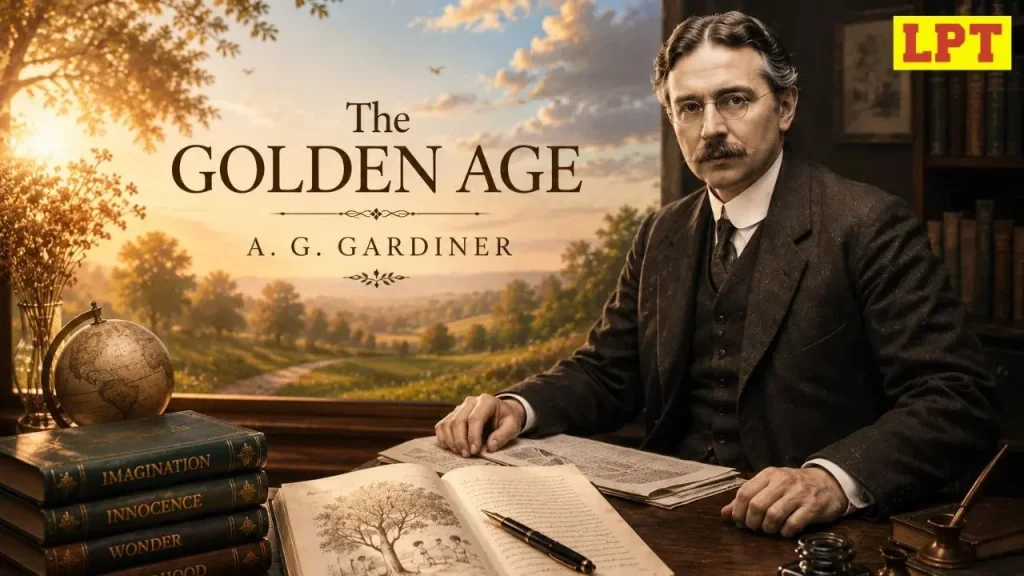
The Golden Age by AG Gardiner is a thoughtful and imaginative essay that highlights the beauty of childhood and the limitless creativity of children. In this essay, AG Gardiner explains how children live in a magical world created by imagination, curiosity, and innocence, while adults gradually lose this ability as they grow older and become practical. The essay mainly focuses on the difference between the mindset of children and adults and shows why childhood is truly the “Golden Age” of life.
Below, we have covered the summary and central idea of Golden Age essay by AG Gardiner, important characters, themes, literary devices, symbolism, moral message, important questions with answers, difficult vocabulary words, and critical analysis.
Table Of Contents
The Golden Age by AG Gardiner: Summary
In The Golden Age, A. G. Gardiner describes childhood as the happiest and most imaginative phase of life. The essay explains how children live in a magical world created by their imagination, curiosity, and innocence. According to Gardiner, children can turn ordinary objects, places, and situations into exciting adventures because they naturally possess creativity and wonder. This ability makes childhood a true “Golden Age.”
The narrator closely observes children and admires the way they enjoy simple things without worrying about practical problems or responsibilities. Children easily create imaginary kingdoms, heroes, stories, and adventures in their minds. For them, a simple room can become a castle, a stick can become a sword, and a small game can feel like a great adventure. Gardiner believes this imaginative power makes children richer in happiness than adults.
The Golden Age essay also highlights the contrast between children and adults. As people grow older, they become more practical, logical, and serious. Adults lose the imaginative freedom they once had during childhood because of responsibilities, routine life, and worldly concerns. Gardiner feels that adults often fail to understand or appreciate the magical world children live in.
Through this essay, Gardiner emphasizes the importance of imagination in human life. He suggests that childhood is special not because children possess wealth or power, but because they see the world with freshness, excitement, and endless possibility. The Golden Age essay finally leaves readers with a sense of admiration for childhood innocence and reminds adults of the joy they gradually lose as they grow older.
Explore The Complete Summaries of Novels, Stories & Essay Notes
Short Summary of The Golden Age by AG Gardiner
In The Golden Age, A. G. Gardiner explains that childhood is the happiest and most imaginative stage of life. Children live in a world full of creativity, wonder, and fantasy where ordinary things become exciting adventures. Unlike adults, children enjoy life freely without worrying about responsibilities or practical problems. Gardiner contrasts the imaginative mindset of children with the serious and logical nature of adults who gradually lose their creativity with age. The essay celebrates innocence, curiosity, and imagination, showing why childhood is truly the “Golden Age” of human life.
Read Short Story Summaries
Read concise and student-friendly summaries of famous short stories along with themes, moral lessons, literary devices, and important questions:
| A Cup of Tea by Katherine Mansfield | Upper Division Love by Manohar Malgonkar |
| The Night The Ghost In by James Thurber | Dr. Heideggers Experiment by Nathaniel Hawthorn |
The Golden Age by AG Gardiner: Themes
- Childhood Innocence: One of the main themes of the essay is the innocence of childhood. Gardiner presents children as pure, joyful, and free from the worries that trouble adults.
- Power of Imagination: The essay strongly highlights the creative imagination of children. Gardiner shows how children turn ordinary situations into exciting adventures through fantasy and creativity.
- Difference Between Children and Adults: Gardiner contrasts imaginative children with practical adults. While children enjoy life freely, adults become serious and limited by responsibilities.
- Joy in Simple Things: Children find happiness in ordinary games, objects, and activities. The essay teaches that true happiness often comes from simple experiences rather than material success.
- Loss of Creativity in Adulthood: As people grow older, they gradually lose the imaginative freedom they once enjoyed during childhood. Gardiner presents this loss as one of the saddest parts of growing up.
- Wonder and Curiosity: The essay celebrates curiosity and wonder as essential qualities that make life exciting and meaningful during childhood.
Central Idea of The Golden Age by Gardiner
The central idea of The Golden Age is that childhood is the happiest and most beautiful stage of life because of imagination, innocence, curiosity, and freedom from worldly worries. A. G. Gardiner explains that children possess a magical ability to create joy and adventure from ordinary things through their imagination. Unlike adults, children live with excitement, wonder, and emotional freedom.
The essay also highlights how adults gradually lose creativity and become practical, serious, and limited by responsibilities. Gardiner suggests that imagination is one of the greatest gifts of childhood and should be valued deeply. Through this essay, he reminds readers that the true richness of life lies not in material success but in the ability to experience joy, wonder, and creativity like children.
Download The Golden Age Summary PDF
Download PDFThe Golden Age by AG Gardiner: Literary Devices
These are the literary devices used in The Golden Age text:
| Literary Device | Example / Reference | Effect in the Essay |
|---|---|---|
| Imagery | Descriptions of children creating imaginary worlds | Helps readers visualize the magical world of childhood |
| Symbolism | “Golden Age” | Symbolizes the happiest and most imaginative phase of life |
| Contrast | Children vs adults | Highlights the difference between imagination and practicality |
| Metaphor | Childhood presented as a “Golden Age” | Suggests childhood is precious, joyful, and unforgettable |
| Humor | Light observations about children and adults | Makes the essay engaging and enjoyable |
| Personification | Imagination treated like a living force | Gives emotional depth to the essay |
| Reflection | Narrator’s thoughts about childhood | Adds philosophical meaning and emotional connection |
| Descriptive Language | Detailed description of children’s imagination | Creates warmth and emotional appeal |
| Irony | Adults losing happiness despite maturity | Shows how growing up may reduce joy and creativity |
| Emotional Appeal | Admiration for childhood innocence | Makes readers nostalgic and thoughtful |
Read Essay Summaries
Explore student-summaries of famous essays with detailed themes, moral lessons, literary devices, analysis, and important exam-focused questions.
| El Dorado by RL Stevenson | The Convalescent by Charles Lamb |
| Tight Corners By EV Lucas |
Top 10 Vocabulary Words in The Golden Age
| Word | Meaning |
| Imagination | The ability to create ideas or images in the mind |
| Innocence | Purity and freedom from guilt or corruption |
| Fantasy | Imaginary ideas or situations |
| Practical | Focused on real situations rather than imagination |
| Curiosity | Strong desire to know or learn something |
| Adventure | An exciting or unusual experience |
| Wonder | A feeling of amazement |
| Delight | Great pleasure or happiness |
| Reflection | Deep thought or careful consideration |
| Creativity | Ability to produce original ideas |
Moral Message of The Golden Age
The essay teaches that childhood is the most joyful stage of life because of imagination, innocence, and curiosity. A. G. Gardiner reminds readers that adults should not completely lose their creativity and sense of wonder while growing up. True happiness often lies in enjoying simple things with an imaginative mind.
The Golden Age by AG Gardinar: Questions and Answers
Why does A. G. Gardiner call childhood the “Golden Age”?
A. G. Gardiner calls childhood the “Golden Age” because children live in a world full of imagination, innocence, curiosity, and happiness. According to him, children can turn ordinary things into magical adventures through their creative minds. Unlike adults, they are free from serious responsibilities, stress, and practical worries. Children enjoy simple things deeply and see the world with excitement and wonder.
How are children different from adults in the essay?
In the essay, children are presented as imaginative, curious, joyful, and emotionally free, while adults are shown as practical, logical, and serious. Children can easily create magical worlds from ordinary objects and situations because of their creativity. They enjoy life without worrying too much about responsibilities or social pressures. Adults, on the other hand, become occupied with routine life, work, and practical concerns.
What role does imagination play in The Golden Age?
Imagination plays the most important role in the essay because it defines the beauty and happiness of childhood. Gardiner explains that children use imagination to transform ordinary things into exciting adventures. A simple object can become a magical treasure, and an ordinary room can become a kingdom or battlefield in their minds. This imaginative ability allows children to experience constant joy and excitement.
What does the “Golden Age” symbolize in the essay?
The “Golden Age” symbolizes the beautiful phase of childhood filled with innocence, imagination, happiness, and emotional freedom. Gardiner uses this phrase to show that childhood is the richest period of life, not because of money or power, but because of creativity and wonder.
What writing style does A. G. Gardiner use in The Golden Age?
A. G. Gardiner uses a simple, reflective, and descriptive writing style in The Golden Age. His language is easy to understand yet emotionally deep and philosophical. Gardiner combines observation with thoughtful reflection to explain the beauty of childhood imagination. He uses contrast effectively to compare children and adults.
Critical Analysis of The Golden Age by AG Gardiner
A. G. Gardiner presents The Golden Age as a thoughtful reflection on childhood imagination and the emotional difference between children and adults. The essay celebrates innocence, creativity, curiosity, and the ability of children to find happiness in ordinary things. Gardiner contrasts this imaginative world with the practical and serious mindset of adults who gradually lose their sense of wonder with age.
One of the strongest aspects of the essay is its universal appeal. Almost every reader can relate to the loss of childhood innocence and imagination. Gardiner’s simple yet descriptive writing style makes complex emotional ideas easy to understand. The essay also carries a subtle philosophical message that true happiness often lies in creativity, curiosity, and emotional freedom rather than material success. Overall, The Golden Age remains a timeless essay about the beauty of childhood and the importance of imagination in human life.
Explore the Best Novels for IPMAT Preparation
About the Author A. G. Gardiner
AG Gardiner, whose full name was Alfred George Gardiner, was a famous English journalist, editor, and essayist born in 1865 in England. He became widely known for his thoughtful and humorous essays written under the pen name “Alpha of the Plough.” Gardiner’s essays are admired for their simple language, human values, wit, and deep observations about everyday life. He often wrote about human nature, morality, childhood, society, imagination, and personal behavior.
Gardiner worked as the editor of the newspaper Daily News and became one of the most respected essayists of his time. His writing style was conversational and easy to understand, which made his essays popular among students and general readers alike. His essays continue to be appreciated for their emotional depth, wisdom, and universal appeal.
Read More Such Summaries
Explore Other Exam Preparation Resources
Prepare smarter with our dedicated coaching programs, preparation guides, mock tests, and study resources for top competitive exams in India.

Nidhi Priya
Nidhi Priya has over 6 years of experience in EdTech content and SEO. She specializes in content strategy, organic growth, and mentoring editorial teams, with previous experience at iQuanta, CollegeDekho, and Careers360.