 Talk to a Counsellor
IPM/BBA:
Talk to a Counsellor
IPM/BBA:  Support
Dream Children by Charles Lamb Summary, Analysis, PDF
Last Updated on 24 Jun 2026

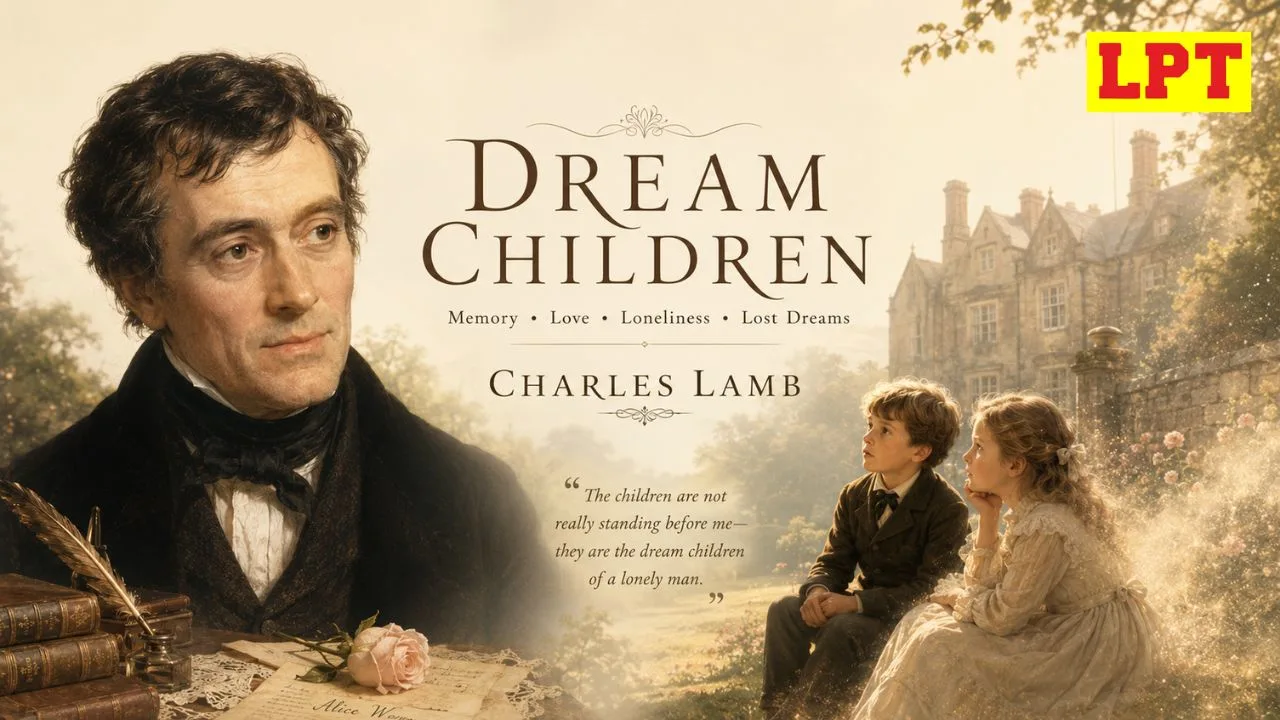
Dream Children: A Reverie is one of the most emotional and personal essays written by Charles Lamb. The essay begins with Lamb narrating stories to two children, John and Alice, about his childhood memories, his grandmother Mrs. Field, and his past experiences. As the essay progresses, it slowly reveals themes of love, loneliness, memory, dreams, and unfulfilled desires. The children listen carefully to Lamb’s stories, but in the end, readers discover that the children are imaginary and exist only in Lamb’s dreams and emotions.
Below, we have covered the summary and central idea of Dream Children essay, important characters, themes, literary devices, symbolism, difficult vocabulary words, moral message, important questions with answers, and critical analysis.
Table Of Contents
- CLAT PG: All About CLAT Postgraduate Exam for LLM
Summary of ‘Dream Children: A Reverie’ by Charles Lamb
In Dream Children, Charles Lamb narrates a deeply emotional and imaginative story in the form of a conversation with two children named John and Alice. The story begins with Lamb telling them stories about his grandmother, Mrs. Field, who was respected for her kindness, religious nature, and strong character. She lived in a large old house where Lamb spent much of his childhood. He remembers the house, its gardens, and the stories of ghosts connected with it.
Lamb also talks about his elder brother John L., describing him as brave, energetic, and caring during childhood. The children listen attentively to these memories and react emotionally to the stories. Lamb further recalls his deep love for a woman named Alice W——n, whom he could never marry despite loving her for many years. This part of the essay introduces themes of lost love and personal sadness.
As the narration continues, the atmosphere gradually becomes dream-like and emotional. Suddenly, the children begin to fade away and reveal that they are only dream children who never truly existed. They tell Lamb that they are merely representations of the children he never had. At the same moment, Lamb wakes up from his dream and realizes that he is alone.
The essay ends on a deeply emotional note, revealing Lamb’s loneliness, unfulfilled desires, and longing for family happiness. Through memory, imagination, and personal reflection, the essay beautifully blends dream and reality while expressing themes of love, loss, nostalgia, and loneliness.
Explore The Complete Summaries of Novels, Stories & Essay Notes
Short Summary of Dream Children by Charles Lamb
In Dream Children, Charles Lamb imagines himself telling stories to two children named John and Alice about his childhood, grandmother Mrs. Field, brother John, and his lost love Alice W——n. The children listen with great interest and emotion as Lamb recalls memories filled with happiness, affection, and sadness. As the essay progresses, the atmosphere becomes dream-like, and finally the children disappear, revealing that they never truly existed. Lamb wakes up alone and realizes they were only dream children representing the family life he never had. The essay beautifully explores memory, loneliness, love, and unfulfilled desires.
Download Dream Children PDF
Download PDFMain Characters in Dream Children by Charles Lamb
The Narrator / Charles Lamb
The narrator, who represents Charles Lamb himself, is emotional, reflective, affectionate, and deeply nostalgic. He remembers his childhood, family, and lost love with tenderness and sadness. His personality combines warmth with loneliness. The narrator symbolizes human memory, emotional longing, and unfulfilled desires. Through him, Lamb expresses his personal pain, loneliness, and the dream of a family life that he could never achieve in reality.
John
John is one of the dream children listening to Lamb’s stories. He is attentive, curious, emotional, and respectful toward the narrator. John symbolizes Lamb’s imagined son and represents the family happiness Lamb longed for but never experienced. His reactions during the storytelling show innocence and emotional connection. The character also reflects Lamb’s affection for his real elder brother John, whose memory remains important throughout the essay.
Alice
Alice is the second dream child in the essay and symbolizes innocence, affection, and emotional warmth. She listens carefully to Lamb’s stories and reacts with sympathy and tenderness. Alice also reminds readers of Alice W——n, the woman Lamb loved deeply but could not marry. Through this symbolic connection, the character represents lost love, emotional longing, and the imagined daughter Lamb never had. Alice adds emotional softness and sadness to the essay.
Mrs. Field
Mrs. Field, Lamb’s grandmother, is presented as a kind, religious, respected, and dignified woman. She took care of a large old house and was admired by everyone around her. Her personality reflects wisdom, discipline, morality, and affection. Mrs. Field symbolizes childhood memories, family values, and emotional security. Through her character, Lamb creates a nostalgic image of the past and shows deep respect for family traditions and relationships.
John L. (Lamb’s Brother)
John L., based on Lamb’s real brother, is described as brave, energetic, caring, and physically active during childhood. Lamb admires him for his strength and protective nature. Although the brothers later became distant in adulthood, Lamb remembers him lovingly. John L. symbolizes brotherhood, childhood companionship, and emotional attachment to family memories. His character adds realism and emotional depth to the essay.
Read Short Story Summaries
Read concise and student-friendly summaries of famous short stories along with themes, moral lessons, literary devices, and important questions:
| A Cup of Tea by Katherine Mansfield | Upper Division Love by Manohar Malgonkar |
| The Night The Ghost In by James Thurber | Dr. Heideggers Experiment by Nathaniel Hawthorn |
Themes of Dream Children: A Reverie
- Memory and Nostalgia: One of the main themes of the essay is memory. Lamb recalls his childhood, grandmother, brother, and lost love with deep emotional attachment and nostalgia.
- Dreams and Reality: The essay beautifully blends dream and reality. What begins as a real conversation is eventually revealed to be a dream, creating emotional impact.
- Loneliness: Lamb’s loneliness becomes clear at the end when the dream children disappear and he realizes he is alone without a family.
- Love and Loss: The essay reflects Lamb’s emotional pain caused by his lost love for Alice W——n and the family life he could never have.
- Family Affection: Through memories of his grandmother, brother, and imaginary children, Lamb highlights the importance of emotional family relationships.
- Childhood Memories: The essay celebrates childhood experiences, old houses, gardens, stories, and emotional connections with the past.
- Imagination: Imagination plays a major role in creating the dream children and blending Lamb’s desires with memory and fantasy.
Read Essay Summaries
Explore student-summaries of famous essays with detailed themes, moral lessons, literary devices, analysis, and important exam-focused questions.
| El Dorado by RL Stevenson | The Convalescent by Charles Lamb |
| The Golden Age by AG Gardiner | Tight Corners By EV Lucas |
Dream Children by Charles Lamb: Central Idea
The central idea of Dream Children is the emotional connection between memory, dreams, love, and unfulfilled desires. Charles Lamb uses imagination and personal memories to express his loneliness and longing for a happy family life that he never achieved. Through the dream children John and Alice, Lamb imagines the children he wished to have and shares stories from his childhood and personal life.
It also highlights how memories remain emotionally powerful even after many years. Lamb blends reality and fantasy to show the pain of lost love, separation, and loneliness. At the same time, the essay celebrates affection, family bonds, and childhood memories. Through its emotional ending, the essay reminds readers that dreams and memories often reveal the deepest desires of the human heart.
Dream Children: A Reverie: Literary Devices
| Literary Device | Example / Reference | Effect in the Essay |
|---|---|---|
| Imagery | Description of the old house, gardens, and children | Creates vivid emotional and visual scenes |
| Symbolism | Dream children John and Alice | Represent Lamb’s unrealized family life and emotional desires |
| Nostalgia | Memories of childhood and grandmother | Creates emotional warmth and sadness |
| Pathos | Emotional ending where the children disappear | Evokes sympathy and deep emotional impact |
| Irony | The happy family scene turning into loneliness | Highlights Lamb’s personal sorrow and unfulfilled desires |
| Personification | Memories and dreams presented emotionally alive | Makes the emotional experiences more powerful |
| Reflection | Narrator’s thoughts about past life and relationships | Adds philosophical and emotional depth |
| Contrast | Dream world vs reality | Emphasizes loneliness and emotional loss |
| Conversational Style | Narration directed toward the children | Makes the essay personal and intimate |
| Dream Motif | Entire structure based on a dream sequence | Blends imagination with emotional reality |
Top Vocabulary Words in Dream Children by Charles Lamb
| Word | Meaning |
|---|---|
| Reverie | A state of dreamy thinking |
| Affection | Love and care for someone |
| Melancholy | Deep sadness |
| Countenance | Facial expression |
| Pensive | Deeply thoughtful or reflective |
| Deceased | Dead |
| Tenderness | Gentleness and affection |
| Orphaned | Left without parents |
| Visionary | Related to imagination or dreams |
| Nostalgia | Emotional longing for the past |
Moral Message of Dream Children by Charles Lamb
The Dream Children teaches that memories, love, and family relationships remain emotionally powerful throughout life. Charles Lamb shows that unfulfilled desires and lost relationships can deeply affect the human heart. The essay also reminds readers to value emotional bonds, childhood memories, and the people they love while they are still present.
Dream Children by Charles Lamb: Questions and Answers
Who are the dream children in the essay?
The dream children in the essay are John and Alice, two imaginary children created by Lamb’s imagination. They symbolize the children Lamb wished to have but never did because he could not marry the woman he loved, Alice W——n. The children listen carefully and emotionally to Lamb’s stories about his childhood and family. Although they appear real at first, they eventually disappear and reveal themselves as dream figures.
Why is the essay called “A Reverie”?
The essay is called “A Reverie” because it is based on a dream-like imaginative experience filled with memories and emotions. A reverie means a state of dreamy thinking or pleasant imagination. In the essay, Lamb appears to be sitting with his children and telling them stories, but later readers discover that the entire scene is imaginary. The children are not real but part of Lamb’s emotional dream world.
How does Charles Lamb present childhood memories in the essay?
Lamb presents childhood memories with warmth, affection, and deep nostalgia. He recalls his grandmother Mrs. Field, the old house where he spent his childhood, the gardens, and the stories of ghosts connected to the house. These memories are described vividly and emotionally, showing how strongly Lamb remained attached to his past. The essay presents childhood as a period filled with innocence, wonder, and emotional security.
Through these memories, Lamb creates an atmosphere of comfort and sadness at the same time. His recollections also help readers understand his emotional attachment to family relationships and lost happiness.
What role does Mrs. Field play in the essay?
Mrs. Field, Lamb’s grandmother, represents kindness, morality, dignity, and emotional security in the essay. She was respected for her religious nature and strong character. Lamb remembers her affectionately and describes her as a loving and disciplined woman who took care of a large old house. Through her character, the essay creates a nostalgic connection with childhood and family traditions. Mrs. Field also symbolizes the warmth and stability of the narrator’s early life. Her memories become emotionally significant because they remind Lamb of a happier and more secure period from his past.
What is the significance of Alice W——n in the essay?
Alice W——n represents Lamb’s lost love and one of the deepest emotional sorrows of his life. Lamb loved her for many years but could never marry her. In the essay, the dream child Alice symbolically reminds readers of Alice W——n, connecting the themes of love and emotional loss. Her presence in the essay reflects Lamb’s unfulfilled desire for marriage and family life. The emotional impact becomes stronger when readers realize that the dream children never truly existed. Alice W——n therefore symbolizes lost opportunities, emotional longing, and the sadness caused by unrealized dreams.
How does the essay blend dream and reality?
The essay begins realistically with Lamb narrating stories to two children sitting beside him. Readers initially believe the children are real. However, as the essay progresses, the atmosphere gradually becomes dream-like and emotional. In the final moments, the children fade away and reveal that they are only dream figures representing the children Lamb never had. Lamb then wakes up alone, realizing that the entire scene was imaginary. This blending of dream and reality creates emotional surprise and deep sadness. It also allows Lamb to express personal loneliness and hidden desires in a subtle and artistic manner.
Why is the ending of Dream Children considered emotional?
The ending of Dream Children is considered emotional because it suddenly reveals the truth behind the entire story. Readers discover that John and Alice were not real children but imaginary figures created from Lamb’s desires and memories. The disappearance of the children symbolizes Lamb’s loneliness and the family happiness he could never experience. Until the final moment, the essay feels warm and comforting, but the ending transforms it into a deeply sad reflection on lost love and unrealized dreams. This sudden emotional shift creates strong sympathy for Lamb and leaves a lasting emotional impact on readers.
What writing style does Charles Lamb use in Dream Children?
Charles Lamb uses a personal, emotional, reflective, and conversational writing style in Dream Children. His language is simple but filled with emotional depth and imagination. Lamb combines storytelling with personal memories, making the essay intimate and realistic. He also uses descriptive imagery and nostalgia to create emotional warmth. The dream-like structure adds softness and mystery to the narrative. His reflective style allows readers to understand his loneliness and emotional struggles deeply. Lamb’s writing is admired because it transforms personal sorrow into beautiful literary expression filled with humanity and emotional honesty.
Critical Analysis of Dream Children: A Reverie
Charles Lamb presents Dream Children as a deeply emotional and personal essay that blends memory, imagination, dreams, and reality. The essay begins with warmth and affection as Lamb narrates stories to the dream children, but gradually develops into a reflection on loneliness, lost love, and unfulfilled desires. The emotional ending gives the essay great psychological depth and leaves a lasting impact on readers.
One of the strongest aspects of the essay is Lamb’s ability to transform personal sorrow into beautiful literary expression. His nostalgic descriptions of childhood, family, and the old house create emotional richness and realism. The dream children symbolize the family life Lamb wished for but never achieved. Lamb’s conversational style, emotional honesty, and dream-like narration make the essay highly touching and relatable. Overall, Dream Children remains one of the finest personal essays in English literature because of its emotional intensity and artistic simplicity.
Explore Our Other Summaries:
Explore Other Exam Preparation Resources
Prepare smarter with our dedicated coaching programs, preparation guides, mock tests, and study resources for top competitive exams in India.

Nidhi Priya
Nidhi Priya has over 6 years of experience in EdTech content and SEO. She specializes in content strategy, organic growth, and mentoring editorial teams, with previous experience at iQuanta, CollegeDekho, and Careers360.