 Talk to a Counsellor
IPM/BBA:
Talk to a Counsellor
IPM/BBA:  Support
Tight Corners by EV Lucas: Summary, QnA, Analysis, PDF
Last Updated on 24 Jun 2026

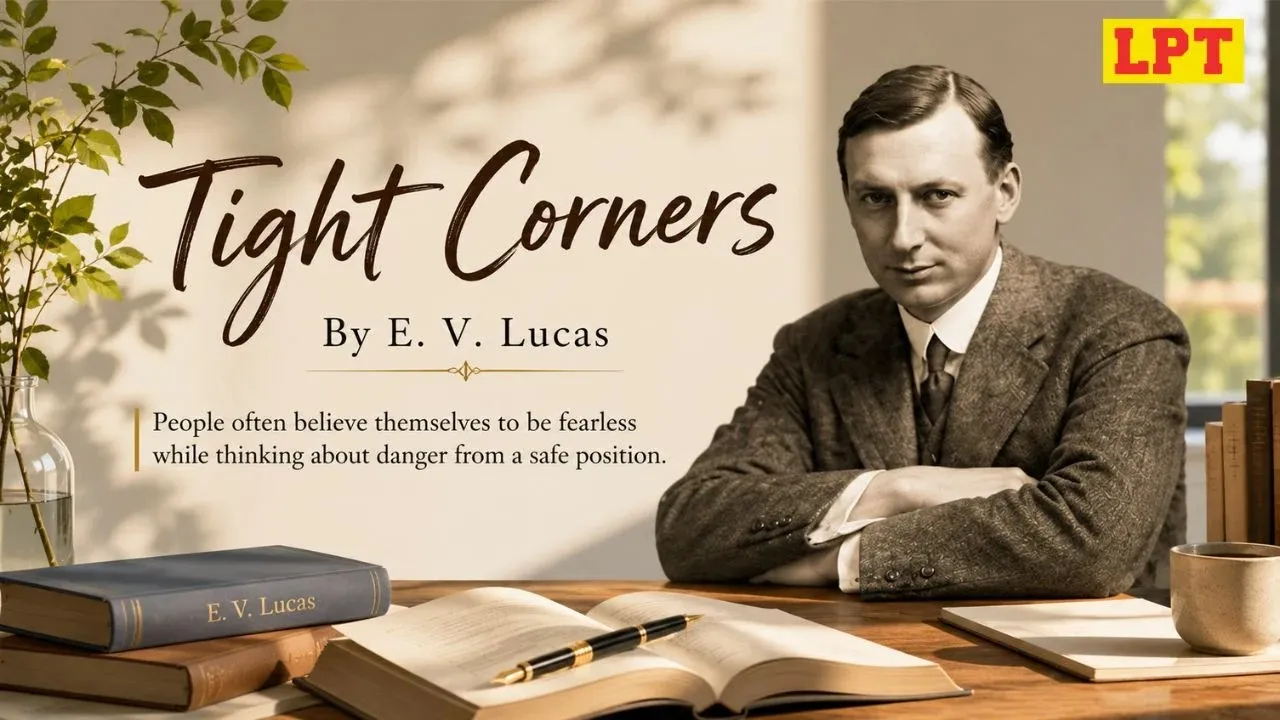
Tight Corners by EV Lucas is a humorous and thought-provoking essay that explores how people react when suddenly placed in dangerous, difficult, or uncomfortable situations. In this essay, EV Lucas discusses the difference between imagined bravery and real courage.
Through interesting examples and light humor, Lucas explains that many people consider themselves brave until they actually face a real "tight corner." The essay mainly focuses on fear, courage, survival instinct, imagination, and human psychology under pressure.
Below, we have covered the summary and central idea of Tight Corners, important characters, themes, literary devices, vocabulary words, moral message, important questions with answers, and critical analysis to help students understand Tight Corners by E. V. Lucas in simple language.
Table Of Contents
- CLAT PG: All About CLAT Postgraduate Exam for LLM
Tight Corners by EV Lucas: Summary
In Tight Corners, E. V. Lucas humorously discusses how people react when they suddenly face dangerous, difficult, or frightening situations, which he calls "tight corners." The essay mainly explores the difference between imagined courage and real courage. Lucas explains that many people believe themselves to be brave while sitting safely and imagining heroic actions, but their true nature becomes visible only when they actually encounter danger.
At the beginning of the essay, Lucas reflects on human imagination and how people often confidently predict how bravely they would behave in risky situations. However, when real danger appears unexpectedly, fear and survival instincts usually take control. Lucas humorously points out that human beings overestimate their courage because it is easy to feel brave while discussing imaginary situations.
The essay includes several examples of tight corners such as facing wild animals, accidents, unexpected dangers, or embarrassing situations. Through these examples, Lucas shows that human reactions under pressure are unpredictable. Some people remain calm and courageous, while others panic despite considering themselves brave earlier. He also suggests that true courage is discovered accidentally in moments of real danger rather than through imagination or boasting.
Throughout the Tight Corners essay, Lucas combines humor with psychological observation. He does not criticize human fear harshly but presents it as a natural human response. The essay finally suggests that bravery cannot be judged merely by words or imagination because real character is revealed only when people actually face difficult situations.
Short Summary of Tight Corners Essay
In Tight Corners, E. V. Lucas humorously explains how people react differently when placed in sudden dangerous or difficult situations. The essay highlights the difference between imagined bravery and real courage. People often believe themselves to be fearless while thinking about danger from a safe position, but their true behavior becomes visible only during actual emergencies.
Through several interesting examples, Lucas shows how fear, panic, survival instinct, and courage influence human actions under pressure. Using humor and psychological observation, the essay presents realistic truths about human nature, fear, confidence, and bravery in unexpected situations.
Tight Corners Essay by EV Lucas: Themes
- Courage and Fear: The Tight Corners essay mainly explores the relationship between courage and fear. Lucas explains that bravery is truly tested only in real dangerous situations.
- Human Psychology: Lucas studies how people think, imagine, and react under pressure. The essay presents realistic observations about human emotions and behavior.
- Imagination vs Reality: People imagine themselves brave in theory, but reality may reveal very different reactions during actual danger.
- Survival Instinct: The essay highlights how human survival instinct naturally influences behavior during emergencies and tight corners.
- Humor in Human Weakness: Lucas uses gentle humor to discuss fear, panic, and overconfidence without insulting human nature.
- Self-Awareness: The essay encourages people to understand their true nature honestly instead of overestimating their bravery.
Read Short Story Summaries
Read concise and student-friendly summaries of famous short stories along with themes, moral lessons, literary devices, and important questions:
| A Cup of Tea by Katherine Mansfield | Upper Division Love by Manohar Malgonkar |
| The Night The Ghost In by James Thurber | Dr. Heideggers Experiment by Nathaniel Hawthorn |
Central Idea of Tight Corners by EV Lucas
The central idea of Tight Corners is that true courage can only be judged in real dangerous situations, not through imagination or confident words. E. V. Lucas explains that people often consider themselves brave while thinking safely about imaginary dangers, but their actual reactions during emergencies may be very different.
The essay also explores human psychology, fear, panic, and survival instinct. Lucas humorously shows that courage and fear are natural parts of human behavior and that nobody can fully predict how they will react in difficult moments. Through realistic examples and light humor, the essay teaches readers to remain humble and self-aware about human nature and bravery.
Literary Devices Used in Tight Corners Essay
| Literary Device | Example / Reference | Effect in the Essay |
|---|---|---|
| Humor | Funny discussion of fear and bravery | Makes the essay entertaining and relatable |
| Irony | People imagining themselves brave but panicking later | Highlights difference between imagination and reality |
| Anecdotes | Examples of dangerous situations | Makes the essay realistic and engaging |
| Reflection | Narrator's thoughts on courage and fear | Adds psychological and philosophical depth |
| Contrast | Imagined courage vs real reactions | Emphasizes unpredictability of human behavior |
| Satire | Light criticism of overconfidence | Humorously exposes human weakness |
| Conversational Style | Informal narration and discussion | Makes readers feel personally connected |
| Psychological Observation | Study of fear and survival instinct | Explores human nature realistically |
| Hyperbole | Exaggerated confidence of people | Increases humor and entertainment |
| Symbolism | "Tight corners" representing crises | Broadens meaning beyond physical danger |
Top Vocabulary Words Used in Tight Corners
| Word | Meaning |
|---|---|
| Courage | Ability to face danger bravely |
| Panic | Sudden uncontrollable fear |
| Survival | Continuing to live despite danger |
| Instinct | Natural reaction without conscious thought |
| Predicament | Difficult or unpleasant situation |
| Anxiety | Feeling of worry or fear |
| Confidence | Belief in one's ability |
| Crisis | Time of serious danger or difficulty |
| Hesitation | Delay caused by uncertainty |
| Psychological | Related to the human mind |
Moral Message of Tight Corners
The essay teaches that true courage can only be tested in real difficult situations. E. V. Lucas reminds readers not to overestimate their bravery through imagination alone. Human fear and panic are natural, and real character becomes visible only when facing actual danger or pressure.
About the Author E V Lucas
Edward Verrall Lucas was a famous English essayist, humorist, editor, and travel writer born in 1868 in England. He became widely admired for his light, witty, and thoughtful essays based on everyday life and human behavior. Lucas had a remarkable ability to combine humor with deep psychological observation, making his essays both entertaining and meaningful.
He worked as a journalist and editor during his literary career and wrote numerous essays, travel books, biographies, and literary works. Lucas's writing style is conversational, simple, humorous, and highly relatable. His essays often focus on ordinary human emotions, habits, fears, and social behavior.
Some of his well-known essays include Tight Corners and other reflective pieces discussing human nature and daily experiences. E. V. Lucas remains an important figure in English literature because of his ability to present serious ideas through humor, simplicity, and realistic observation.
Read Essay Summaries
Explore student-summaries of famous essays with detailed themes, moral lessons, literary devices, analysis, and important exam-focused questions.
| El Dorado by RL Stevenson | The Convalescent by Charles Lamb |
| The Golden Age by AG Gardiner |
Download Tight Corners by EV Lucas PDF
Download PDFTight Corners: Questions and Answers
What does the term “tight corners” mean in the essay?
In the essay, the term “tight corners” refers to dangerous, difficult, embarrassing, or frightening situations where people suddenly face pressure or risk. These situations test human courage, presence of mind, and emotional control. Lucas uses the phrase symbolically to describe moments when a person’s real character becomes visible. Tight corners may involve physical danger, accidents, unexpected emergencies, or uncomfortable social situations.
How does Lucas differentiate between imagined courage and real courage?
Lucas explains that imagined courage exists only in the mind when people safely think about dangerous situations and confidently believe they would behave bravely. Real courage, however, appears only when a person actually faces danger or pressure in reality. According to Lucas, many individuals overestimate their bravery because imagining heroism is easier than acting courageously during real fear. He humorously shows that panic, survival instinct, and emotional reactions often change human behavior unexpectedly. Through this contrast, the essay highlights that true courage cannot be judged through words or imagination but only through real actions in difficult situations.
Why does Lucas use humor in the essay?
E. V. Lucas uses humor to make serious psychological observations entertaining and relatable. Instead of criticizing human fear harshly, he discusses it in a light-hearted and friendly manner. The humorous examples of people imagining themselves brave but reacting differently in real situations make readers laugh while also recognizing realistic human behavior. Humor also helps Lucas explain complicated emotional truths in a simple way.
What examples of tight corners are discussed in the essay?
Lucas discusses several examples of dangerous or difficult situations to explain how people react under pressure. These include facing wild animals, sudden accidents, risky situations, and embarrassing social moments. Through these examples, he shows that nobody can predict their exact behavior before actually facing danger. Some people remain calm unexpectedly, while others panic despite claiming to be brave earlier.
What role does fear play in Tight Corners?
Fear plays a central role in the essay because it strongly influences human behavior during dangerous situations. Lucas explains that fear is a natural human reaction and should not always be considered weakness. When people face real danger, survival instinct and panic may control their actions unexpectedly. The essay shows that even confident individuals can become frightened in actual emergencies.
How does the essay explore human psychology?
The essay explores human psychology by examining how people think and react during dangerous or uncomfortable situations. Lucas studies fear, imagination, overconfidence, panic, and survival instinct through humorous examples. He explains that human beings often create unrealistic images of their own bravery while sitting safely. However, real emergencies reveal unpredictable emotional reactions. Lucas also observes that the mind behaves differently under pressure than during normal circumstances.
Why is the essay considered humorous despite discussing danger?
The essay is considered humorous because Lucas discusses fear and danger in a light-hearted, witty, and entertaining manner. Instead of making dangerous situations frightening, he focuses on the funny contrast between what people imagine and how they actually behave. His exaggerated examples, conversational tone, and gentle satire create humor throughout the essay. Readers laugh at the overconfidence and unexpected panic of ordinary people because these situations feel realistic and relatable.
What writing style does E. V. Lucas use in Tight Corners?
E. V. Lucas uses a humorous, conversational, reflective, and psychologically insightful writing style in Tight Corners. His language is simple and easy to understand, but his observations about human nature are deep and meaningful. Lucas combines everyday examples with gentle satire and humor to explain complicated emotional reactions. His informal narration helps readers feel personally connected to the essay.
Read Novel Summaries
Expand your reading with these popular novel summaries helpful for students, competitive exam aspirants, and curious readers:
| Letters to a Law Student by Nicholas McBride | Leaders Eat Last by Simon Sinek |
| Story of My Experiments With Truth by Gandhi | My Days: A Memoir by RK Narayan |
Critical Analysis of Tight Corners by EV Lucas
E. V. Lucas presents Tight Corners as a humorous yet psychologically insightful essay about fear, courage, and human behavior during difficult situations. Through simple examples and light satire, Lucas explores the difference between imagined bravery and real courage. The essay realistically shows that people often overestimate their confidence while sitting safely but react very differently during actual danger.
One of the strongest aspects of the essay is Lucas's ability to combine humor with serious reflection on human psychology. His conversational style makes the essay engaging and relatable, while his observations about fear and survival instinct remain realistic. The phrase "tight corners" symbolically represents life's difficult moments where true character becomes visible. Lucas does not criticize human weakness harshly but presents it with sympathy and humor.
Explore Our Other Summaries:
Explore Other Exam Preparation Resources
Prepare smarter with our dedicated coaching programs, preparation guides, mock tests, and study resources for top competitive exams in India.

Nidhi Priya
Nidhi Priya has over 6 years of experience in EdTech content and SEO. She specializes in content strategy, organic growth, and mentoring editorial teams, with previous experience at iQuanta, CollegeDekho, and Careers360.