 Talk to a Counsellor
IPM/BBA:
Talk to a Counsellor
IPM/BBA:  Support
Dr. Heidegger’s Experiment: Summary, Themes, Analysis, PDF
Last Updated on 24 Jun 2026

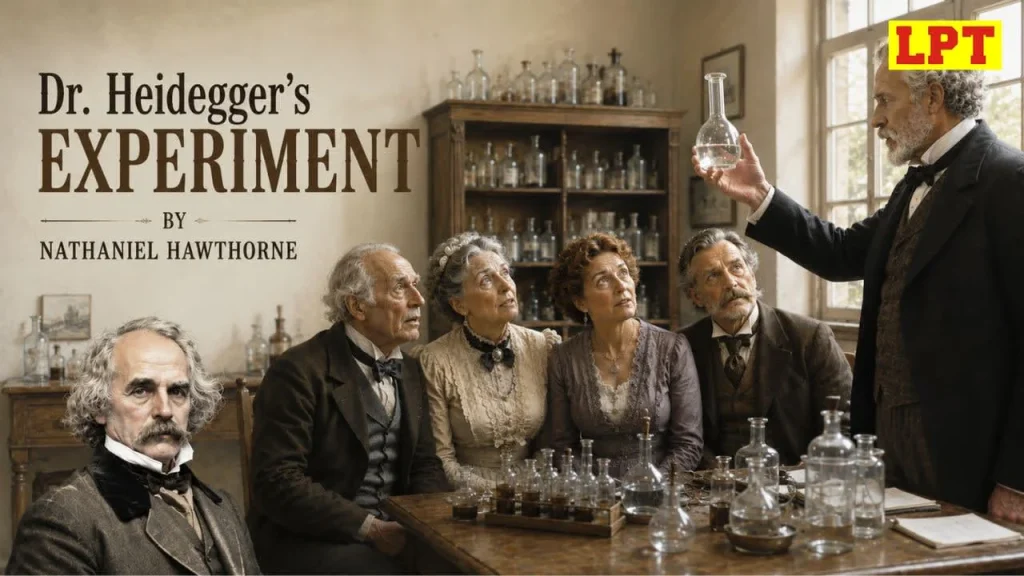
Dr. Heidegger’s Experiment by Nathaniel Hawthorne is a symbolic and philosophical short story that explores human nature, aging, greed, regret, and the desire for youth. The story revolves around Dr. Heidegger, an old scientist who invites four elderly friends to participate in a mysterious experiment involving magical water believed to restore youth temporarily.
As the experiment progresses, the characters repeat the same mistakes and selfish behavior from their younger days, revealing one of the central ideas of the story: “human nature rarely changes with age or experience”.
One of the most important aspects readers notice in the summary of Dr. Heidegger’s Experiment is the strong use of symbolism, irony, and moral reflection throughout the narrative. The story also explores themes like second chances, illusion versus reality, vanity, and wisdom.
Below, we have covered the complete summary, important characters, major themes, symbolism, literary devices, important questions and answers, quotes, moral message, and everything else students should know about Dr. Heidegger’s Experiment by Nathaniel Hawthorne.
Table Of Contents
- CLAT PG: All About CLAT Postgraduate Exam for LLM
Key Details About Dr. Heidegger’s Experiment
|
Particular |
Details |
|---|---|
|
Story Name |
Dr. Heidegger’s Experiment |
|
Author |
Nathaniel Hawthorne |
|
Genre |
Allegorical / Philosophical Short Story |
|
Main Themes |
Aging, Human Nature, Greed, Regret, Second Chances |
|
Central Idea |
Human nature does not easily change |
|
Important Literary Elements |
Symbolism, Irony, Allegory, Imagery |
|
Best For Students |
Literary Analysis, Symbolism & Interpretation |
Dr. Heidegger’s Experiment Summary
This is the summary of Dr Heidegger’s Experiment short story:
Beginning
Dr. Heidegger’s Experiment begins inside the mysterious and old-fashioned study room of a strange scientist and philosopher known for his interest in unusual experiments. The room itself creates a mysterious atmosphere filled with symbolic objects connected with death, memory, and the passage of time. Dr Heidegger invites four elderly friends: Mr. Medbourne, Colonel Killigrew, Mr. Gascoigne, and Widow Wycherly, to participate in a special experiment. All four guests have experienced failure, regret, or personal downfall during their lives.
Dr. Heidegger introduces a magical vase containing water believed to possess the power of restoring youth temporarily. To prove its magical effect, he drops an old withered rose into the water, and the flower surprisingly becomes fresh and beautiful again. The guests become excited and hopeful after witnessing this transformation. The beginning of the story establishes themes like aging, regret, desire for youth, and curiosity about second chances.
Middle
As the experiment progresses, the four elderly guests drink the magical water and slowly begin regaining youthful energy, appearance, and excitement. Their behavior changes dramatically as they start acting like young people once again. Instead of becoming wiser or more mature because of age and life experience, they immediately return to old habits, selfish desires, vanity, and emotional foolishness.
Colonel Killigrew becomes flirtatious again, Widow Wycherly becomes concerned about beauty and attraction, and the others become equally obsessed with youthful excitement and ambition.
The guests begin arguing and competing with one another, especially over Widow Wycherly, revealing jealousy, greed, pride, and immaturity beneath their temporary youth. The room that once appeared calm and reflective turns chaotic and emotionally uncontrolled.
Dr. Heidegger quietly observes their behavior without interfering much. Through this part of the story, Nathaniel Hawthorne shows that physical youth cannot automatically bring wisdom, emotional maturity, or moral improvement.
The magical water becomes a symbol of second chances and human desire to escape aging and mortality. However, the guests fail to learn from their past mistakes and simply repeat the same behavior from earlier stages of life. This section strongly highlights themes like human weakness, vanity, illusion, and the inability of people to truly change.
Ending
Towards the ending, the magical effect of the water gradually disappears, and the four guests slowly return to their old age once again. The temporary excitement, beauty, and youthful energy vanish completely. Despite experiencing the consequences of their foolish behavior during the experiment, the guests still fail to gain wisdom or self-awareness. Instead of understanding the lesson, they become obsessed with finding a permanent source of the magical water so they can remain young forever.
Dr. Heidegger, however, behaves differently from the others throughout the story. He never drinks the magical water himself because he already understands an important truth about human nature and life. He realizes that repeating youth without gaining wisdom would only lead to repeating the same mistakes again.
The ending delivers a strong moral message about aging, human nature, greed, and the importance of learning from experience. Through subtle irony and symbolism, the story suggests that people desire second chances but rarely use them wisely because their inner nature remains unchanged.
Download PDFShort Summary of Dr. Heidegger’s Experiment
Dr. Heidegger’s Experiment is a symbolic and philosophical story about four elderly people who are given magical water that temporarily restores their youth. Dr. Heidegger conducts this strange experiment to observe human behavior and wisdom. Although the guests regain youthful energy and appearance, they quickly return to the same selfishness, vanity, greed, and foolishness from their earlier lives.
Instead of learning from experience, they repeat old mistakes again. Through irony and symbolism, Nathaniel Hawthorne explores themes like aging, human nature, second chances, regret, illusion, and the inability of people to truly change despite experience and growing older.
About the Author Nathaniel Hawthorne
Nathaniel Hawthorne was one of the most important American writers of the nineteenth century and is widely known for his symbolic and philosophical storytelling. Born in 1804, Hawthorne became famous for exploring themes like guilt, sin, morality, human weakness, pride, and psychological conflict in his works. His stories contain allegory, symbolism, and moral lessons hidden beneath simple narratives and mysterious situations.
Hawthorne’s writing style is descriptive, reflective, and deeply symbolic. Instead of directly explaining ideas, he used characters, objects, and situations to represent larger human truths and moral questions. Many of his works focus on how human beings repeat mistakes despite experience and wisdom.
His stories remain highly valuable for students because they improve interpretation skills, analytical thinking, comprehension of symbolism, and understanding of philosophical themes through engaging and meaningful storytelling.
Main Characters in Dr. Heidegger’s Experiment Story
These are the main characters:
Dr. Heidegger
Dr. Heidegger is the mysterious scientist and philosopher who conducts the experiment. He is calm, observant, intelligent, and emotionally detached throughout the story. Unlike the other characters, he understands human nature deeply and does not become tempted by the magical water himself.
His character symbolizes wisdom, experience, and rational thinking. He acts more like an observer of human behavior than an active participant in the emotional chaos created by the experiment.
Mr. Medbourne
Mr. Medbourne was once a wealthy businessman who lost his fortune because of greed and poor decisions. During the experiment, he immediately becomes excited about wealth and business opportunities again after regaining youth. His character symbolizes greed, financial ambition, and humanity’s tendency to repeat mistakes despite past failure and experience.
Colonel Killigrew
Colonel Killigrew is a pleasure-loving man obsessed with enjoyment, romance, and youthful excitement. Even after growing old, he quickly returns to flirtation and emotional foolishness once he regains youth temporarily. His character symbolizes vanity, desire, emotional immaturity, and uncontrolled passion that continue even with age and experience.
Mr. Gascoigne
Mr. Gascoigne is a politician whose career and reputation declined over time. During the experiment, he once again dreams about power, influence, and political success after becoming youthful. His character represents ambition, pride, and the endless human desire for status and recognition despite previous disappointment and failure.
Widow Wycherly
Widow Wycherly is an elderly woman once known for beauty and attractiveness. After regaining youth temporarily, she immediately becomes concerned with appearance, attention, and romantic admiration again. Her character symbolizes vanity, emotional insecurity, and society’s obsession with youth and physical beauty.
Read Short Story Summaries
Read concise and student-friendly summaries of famous short stories along with themes, moral lessons, literary devices, and important questions:
| Upper Division Love by Manohar Malgonkar | A Cup of Tea by Katherine Mansfield |
| The Night The Ghost In by James Thurber | The Tell Tale Heart by Edgar Allan Poe |
Themes of Dr. Heidegger’s Experiment Short Story
- Human Nature Never Changes: The story shows that people often repeat the same mistakes even after gaining experience and growing older.
- Desire for Youth: The guests desperately want to become young again, showing humanity’s fear of aging and mortality.
- Second Chances and Regret: The experiment gives the characters another opportunity, but they fail to use it wisely or learn from the past.
- Vanity and Greed: The characters quickly become obsessed with beauty, wealth, pleasure, and status after regaining youth.
- Aging and Mortality: The story reflects on the temporary nature of youth and the unavoidable reality of growing old.
- Illusion vs Reality: The magical youth creates temporary excitement, but reality eventually returns, exposing human weakness and emotional foolishness.
- Wisdom and Experience: The story suggests that true wisdom comes from learning from mistakes, not merely from becoming older.
- Improves Symbolic Reading Skills: The story trains readers to understand hidden meanings behind objects, actions, and situations through strong symbolism and allegory.
- Develops Analytical Thinking: The philosophical themes and ironic ending improve interpretation, reasoning, and deeper analytical reading ability naturally.
- Helps in Understanding Human Psychology: The characters reveal greed, vanity, ambition, and emotional weakness realistically despite their age and experience.
- Improves Literary Interpretation: The story is excellent for learning symbolism, irony, allegory, characterization, and moral storytelling in literature.
- Encourages Reflection About Human Nature: The narrative makes readers think deeply about aging, regret, second chances, wisdom, and the tendency to repeat mistakes.
Literary Devices Used in Dr. Heidegger’s Experiment
| Literary Device | How It Is Used in the Story |
|---|---|
| Symbolism | The water of youth, rose, mirror, and study room all represent deeper philosophical and moral ideas. |
| Allegory | The entire story functions as an allegory about human nature, aging, greed, and wisdom. |
| Irony | The guests receive a second chance but immediately repeat the same mistakes from their past lives. |
| Imagery | Detailed descriptions of the room, characters, and magical transformations create strong visual atmosphere. |
| Foreshadowing | Early descriptions and symbolic objects hint that the experiment will not end positively. |
| Characterization | Each guest represents a different human weakness such as greed, vanity, ambition, or emotional foolishness. |
| Moral Commentary | The narrative indirectly teaches lessons about wisdom, aging, and human behavior through symbolic storytelling. |
Why Read Dr. Heidegger’s Experiment Story?
Explore the Best Novels for IPMAT Preparation
Important Questions and Answers From Dr Heidegger’s Experiment Story
Who wrote Dr. Heidegger’s Experiment?
Dr. Heidegger’s Experiment was written by Nathaniel Hawthorne, a famous American writer known for symbolic, philosophical, and morally reflective stories. His works often explore human weakness, guilt, pride, greed, and psychological conflict through allegory and symbolism.
What is the main theme of Dr. Heidegger’s Experiment?
The main theme of the story is that human nature rarely changes even when people are given second chances. The story also explores aging, vanity, greed, regret, illusion, wisdom, and the human desire to regain youth and escape mortality.
What does the water of youth symbolize?
The magical water symbolizes second chances, human desire for youth, temptation, and the illusion that physical youth can solve emotional and moral weaknesses. It also represents humanity’s fear of aging and death.
Why does Dr. Heidegger not drink the water himself?
Dr. Heidegger does not drink the water because he already understands that human beings often repeat the same mistakes regardless of age or opportunity. He values wisdom and observation more than temporary physical youth and emotional excitement.
What lesson do the four guests fail to learn?
The guests fail to learn from their past mistakes and life experiences. After regaining youth temporarily, they immediately return to greed, vanity, ambition, jealousy, and emotional foolishness instead of becoming wiser or more mature.
What does the rose symbolize in the story?
The withered rose that becomes fresh again symbolizes temporary youth, beauty, revival, and illusion. It also foreshadows the larger experiment and suggests that external change does not necessarily create emotional or moral transformation.
What is the significance of the study room?
Dr. Heidegger’s study room creates a mysterious and symbolic atmosphere connected with memory, death, wisdom, and the passage of time. The objects inside the room help foreshadow the moral and philosophical themes of the story.
How does Nathaniel Hawthorne use symbolism in the story?
Nathaniel Hawthorne uses symbolism throughout the narrative. The water symbolizes youth and temptation, the rose symbolizes temporary beauty, and the guests symbolize different human weaknesses and emotional flaws.
Why is Dr. Heidegger’s Experiment important for students?
The story improves interpretation, symbolic reading, analytical thinking, literary analysis, and understanding of philosophical themes. It also helps students learn important literary devices like allegory, irony, symbolism, and characterization.
Why do the guests want more magical water at the end?
Even after witnessing their foolish behavior during the experiment, the guests remain obsessed with youth and excitement. Their desire for more magical water proves that they still fail to understand the deeper lesson about human nature and wisdom.
Lessons From Dr. Heidegger’s Experiment (Moral)
Dr. Heidegger’s Experiment teaches that people often repeat the same mistakes even after gaining experience and second chances. The story also shows that true wisdom comes from self-awareness and learning from the past, not from physical youth, beauty, or temporary excitement.
Dr. Heidegger’s Experiment PDF
Download the free PDF of Dr Heidegger’s Experiment story:
Download PDFRead More Such Summaries
Explore Other Exam Preparation Resources
Prepare smarter with our dedicated coaching programs, preparation guides, mock tests, and study resources for top competitive exams in India.

Nidhi Priya
Nidhi Priya has over 6 years of experience in EdTech content and SEO. She specializes in content strategy, organic growth, and mentoring editorial teams, with previous experience at iQuanta, CollegeDekho, and Careers360.