
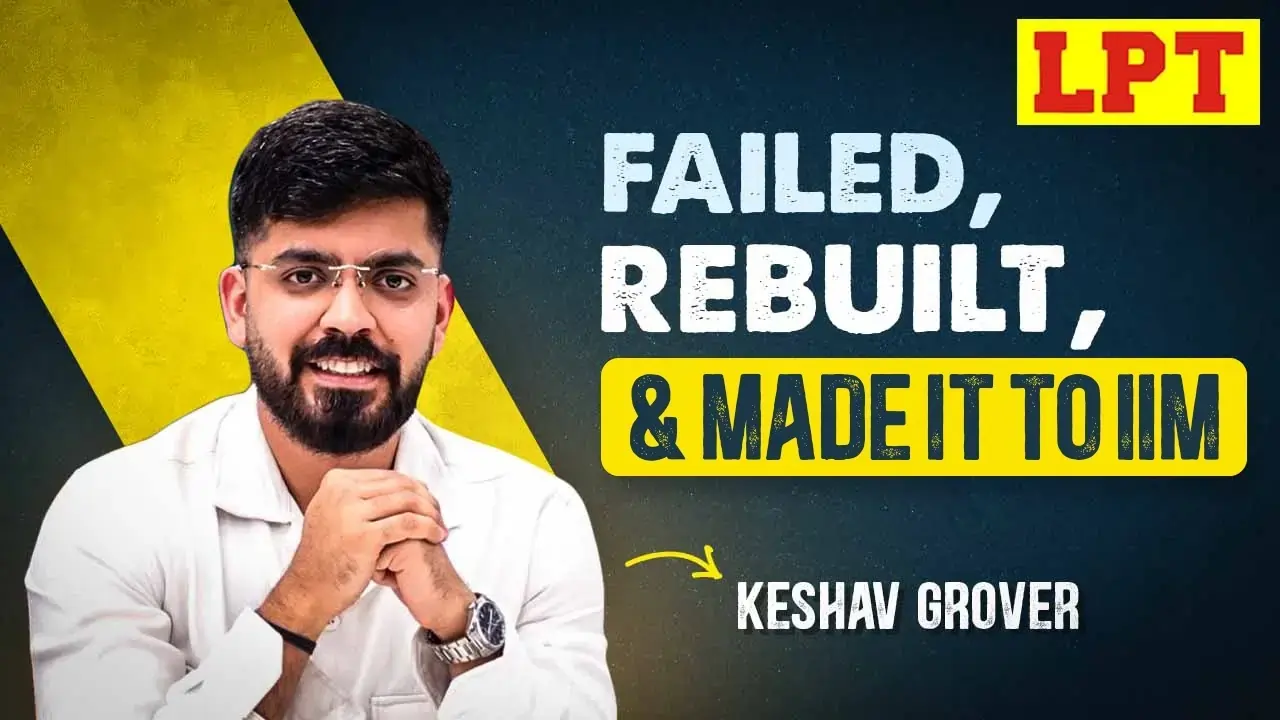
Keshav Grover comes from a small town in Punjab where most students chose traditional paths like CA or banking. He became the first from his area to appear for the CAT exam, starting with a humble 65 percentile in his first attempt and later transforming his journey to achieve a 91 percentile in his second attempt — earning admission into IIM Jammu.
Today, Keshav is an MBA graduate, a working professional, and a mentor to his younger brother, who recently scored 98.3 percentile in CAT 2024. His story reflects what determination, self-belief, and continuous learning can achieve.
In this exclusive interview with LPT, CAT topper Keshav Grover opens up about his journey from small-town beginnings to an IIM campus, the lessons he learned through setbacks, and his advice for future CAT aspirants.

Upcoming CAT Exams:
Interview With CAT Topper Keshav Grover
LPT: Hi Keshav! Welcome to LPT. It’s great to have you with us. How has life changed after CAT and IIM Jammu?
Keshav: Thank you! Life has changed completely. Back in my B.Com days, even earning ₹20,000–₹25,000 a month felt like a dream. But today, I’m working on multiple projects, earning well, and collaborating with talented people across industries. The transformation has been worth every bit of effort.
LPT: Placements are always a hot topic among MBA aspirants. What’s the side of placements people don’t usually talk about?
Keshav: The biggest myth is that placements are entirely the college’s responsibility. That’s not true. The college gives you a platform and opportunities – but you must be prepared to grab them. Building your profile, learning practical skills, and standing out from your batchmates is equally important.
LPT: That’s a great point. For students worried about weak academics, what can they do to strengthen their profile before joining an IIM?
Keshav: There’s so much you can do today. Learn AI tools that are used across industries, especially in marketing and analytics. Build a personal brand – for me, LinkedIn made a big difference. And focus on real-world skills like Excel, PowerPoint, communication, and internships. Every small skill adds value.
LPT: If you could change one thing about your journey at IIM Jammu, what would it be?
Keshav: I’d tell my younger self to focus more on profile-building before joining. Inside an IIM, technical skills and internships matter as much as academics. If you work on certifications, soft skills, and communication early, it makes your MBA experience smoother.
LPT: There’s often a debate around Tier 1 vs Tier 2 IIMs. What’s your take?
Keshav: Honestly, success doesn’t depend on the tag – it depends on you. I’ve met people from Tier 3 colleges earning ₹40–50 LPA because of their work ethic. Even Tier 2 or Tier 3 IIMs can be excellent platforms if you put in consistent effort. If you’re lazy, even IIM Ahmedabad can’t save you.
LPT: Let’s go back to your CAT journey. How did it all begin?
Keshav: My first attempt in CAT 2019 was rough. I had no guidance, so I moved to Chandigarh for coaching, but managing everything alone like food, classes, and studies, was tough. I ended up with 65 percentile.
Then COVID happened. I decided to give it another shot in CAT 2020 — this time with full focus. I studied seriously for six months, expecting around 95–97 percentile. But that year, LRDI, my strongest section, turned out unexpectedly tough. I scored 91 percentile, which got me into IIM Jammu.
LPT: That’s impressive progress. Your brother also appeared for CAT recently, right?
Keshav: Yes! He gave CAT 2024 and scored 98.3 percentile. We built a complete preparation strategy together based on what I learned from my own journey. It included:
- 30–40 full-length CAT mocks with detailed analysis
- 70% self-study and 30% coaching support
- Strength–weakness mapping for each section
- Focused practice on VARC – our weak area
LPT: You mentioned VARC was your weakest section. How did you improve it?
Keshav: Coming from a small town where English wasn’t spoken much, VARC was my biggest challenge. I started with one or two RCs daily and gradually increased the number. But the real improvement came when I started analyzing every RC – spending 30–40 minutes after each to identify mistakes and question types. That habit alone boosted my accuracy massively.
LPT: And what about LRDI, your strong area?
Keshav: LRDI was my strength, but I underestimated it in my second attempt – and it cost me. Now, I tell everyone to keep revising even their strongest topics. My brother practices LRDI on alternate days using previous year questions, categorized as easy, medium, and hard. It helps in understanding the real CAT exam pattern.
LPT: How many mocks do you think are enough before the exam?
Keshav: I took around 15–20 CAT mocks in the last three months. At first, it was demotivating because my scores fluctuated. Even my brother scored just 35 marks in his first mock after months of study! But mocks are not about marks. They’re about trial and error. Each one teaches you something new.
LPT: How did you stay consistent through your preparation?
Keshav: We made a huge chart paper plan. Week-by-week goals, syllabus, revision, mock schedule, everything was listed and stuck on the wall. It sounds simple, but tracking progress visually keeps you accountable.
Explore important resources for CAT exam preparation:
LPT: What would you do differently if you had to appear for CAT again?
Keshav: Three things:
- Balance strengths and weaknesses equally.
- Prioritize self-study over dependency on classes.
- Give at least 30 mocks and spend equal time analyzing each one.
LPT: You’ve emphasized mock analysis several times. Why is it so critical?
Keshav: Because mock + analysis = real learning. If a mock takes 2 hours, spend another 2 analyzing it. CAT isn’t about solving everything; it’s about selecting the right questions. Mock analysis helps you identify:
- Which questions to skip
- Where you waste time
- Alternate solving methods
That’s how you grow your percentile.
LPT: Lastly, what are your top three tips for CAT 2025 aspirants?
Keshav: I’ll say:
- Give more mocks and analyze them deeply.
- Maintain a revision notebook – list all question types by topic (Arithmetic, Geometry, Algebra, etc.).
- Stay consistent. Self-practice defines your CAT performance more than anything else.
LPT: That’s excellent advice, Keshav. Thank you for sharing your journey with us!
Keshav: Thanks a lot! I hope my story inspires students from smaller towns to dream bigger and realize that IIMs are achievable with the right mindset.
Explore additional free resources for CAT Exam:
Keshav Grover Interview (IIM Jammu): Watch Video Interview
LPT wishes Keshav Grover continued success in his professional journey. His story is a reminder that no background or setback can limit your growth when you stay disciplined and determined.
Practice with CAT PYQs:
| CAT Previous Year Papers | CAT 2025 Question Paper |
| CAT 2024 Question Paper | CAT 2023 Question Paper |
| CAT 2022 Question Paper | CAT 2021 Question Paper |
| CAT 2020 Question Paper | CAT 2019 Question Paper |
India’s Top CAT/MBA Prep Programs:
Best Offline Coaching Programs for CAT: