
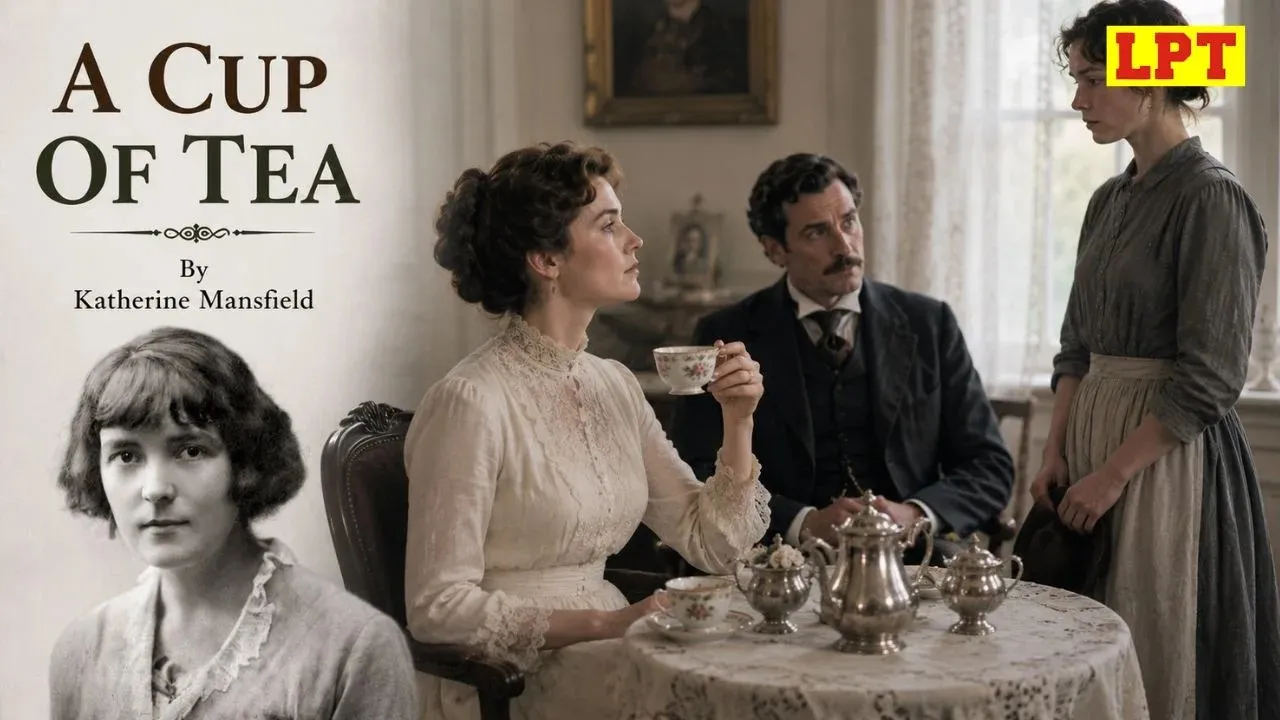
A Cup of Tea by Katherine Mansfield is a psychological and socially reflective short story that explores class difference, beauty, jealousy, kindness, insecurity, and human behavior through a simple but emotionally layered narrative. The story revolves around Rosemary Fell, a wealthy woman who impulsively brings a poor girl named Miss Smith to her home after hearing her request for a cup of tea.
What begins as an act of generosity gradually reveals deeper emotions connected with social image, vanity, emotional insecurity, and appearance. One of the most interesting aspects readers notice in the summary of Cup of Tea story is how quickly human behavior changes when ego, beauty, and jealousy become involved. The central themes of the story focus on superficial kindness, social privilege, psychological conflict, and the difference between genuine compassion and emotional self-interest.
Below, we have covered the complete summary, major characters, themes, literary devices, symbolism, important questions and answers, quotes, moral message, and everything else students should know about Cup of Tea story by Katherine Mansfield.
Explore The Complete Summaries of Novels, Stories & Essay Notes
Key Details About A Cup of Tea by Katherine Mansfield
These are the most important things to know about A Cup of Tea short story by Katherine Mansfield:
| Particular | Details |
|---|---|
| Story Name | A Cup of Tea |
| Author | Katherine Mansfield |
| Genre | Psychological / Social Short Story |
| Main Themes | Class Difference, Jealousy, Beauty, Kindness |
| Setting | London |
| Writing Style | Psychological, Descriptive, Realistic |
| Tone | Reflective and Ironical |
| Central Idea | Human kindness can sometimes be influenced by ego and insecurity |
| Main Conflict | Compassion versus jealousy and self-interest |
| Important Literary Elements | Irony, Symbolism, Characterization, Contrast |
| Main Focus | Human Psychology and Social Privilege |
| Narrative Style | Character-Driven Psychological Story |
| Reading Level | Easy to Moderate |
A Cup of Tea by Katherine Mansfield: Summary
Below is the summary of A Cup of Tea story:
Beginning
A Cup of Tea begins by introducing Rosemary Fell, a wealthy, fashionable, and socially privileged young woman living a luxurious life in London. Rosemary enjoys expensive shopping, elegant social gatherings, and the attention that comes with her beauty and status. She sees herself as modern, generous, sensitive, and different from ordinary wealthy women.
One day, after visiting an antique shop, Rosemary encounters a poor young girl named Miss Smith outside in the cold weather. Miss Smith timidly asks Rosemary for enough money to buy a cup of tea because she has not eaten properly.
Instead of simply giving her money, Rosemary becomes emotionally fascinated by the situation. She imagines herself performing an extraordinary act of kindness similar to stories she has read in books. Wanting to feel generous and emotionally important, she invites Miss Smith to her luxurious home. The beginning of the story establishes themes like wealth, social class, appearance, kindness, and emotional self-image.
Middle
As the story progresses, Rosemary brings Miss Smith into her beautiful and comfortable house. Miss Smith appears nervous, weak, and emotionally overwhelmed by the sudden kindness. Rosemary treats her kindly, offers food, warmth, and conversation, and begins enjoying the emotional satisfaction of helping someone from a completely different social background. At first, Rosemary feels proud of her generosity and imagines herself as compassionate and noble.
However, the emotional atmosphere changes when Rosemary’s husband, Philip, enters the room and notices Miss Smith. Philip quietly comments that the girl is extremely pretty. This simple observation immediately affects Rosemary emotionally. Her earlier confidence and generosity slowly turn into jealousy and insecurity. She begins viewing Miss Smith not as a helpless girl needing support but as a potential threat to her beauty, attention, and emotional position.
The middle section reveals one of the central psychological conflicts of the story. Rosemary’s kindness starts weakening once her ego and insecurity become involved. Katherine Mansfield carefully shows how quickly human emotions can shift beneath social politeness and moral behavior. The contrast between genuine compassion and emotional self-interest becomes increasingly visible.
Ending
Towards the ending, Rosemary decides to send Miss Smith away from the house. Although she gives the girl money before leaving, the emotional warmth and excitement she initially felt completely disappear. Her decision is no longer guided by compassion but by insecurity and jealousy after hearing Philip praise the girl’s appearance.
After Miss Smith leaves, Rosemary becomes emotionally disturbed and uncertain about herself. She seeks reassurance from Philip by asking him if he truly finds her attractive. This moment reveals the deeper emotional reality behind her earlier generosity. The story ends quietly but powerfully, exposing the fragile nature of social kindness when mixed with vanity and insecurity.
Through irony, psychological observation, and emotional subtlety, the story explores class privilege, appearance, jealousy, emotional selfishness, and the complexity of human behavior beneath outward politeness and generosity.
Short Summary of A Cup of Tea by Katherine Mansfield
A Cup of Tea is a psychological story about Rosemary Fell, a wealthy woman who invites a poor girl named Miss Smith to her home after hearing her request for money to buy a cup of tea. Initially, Rosemary feels proud and emotionally satisfied by her act of kindness. However, when her husband Philip comments on Miss Smith’s beauty, Rosemary becomes jealous and insecure.
Her generosity quickly changes, and she decides to send the girl away. Through subtle irony and psychological realism, Katherine Mansfield explores themes like class difference, beauty, vanity, insecurity, superficial kindness, and human self-interest.
About the Author Katherine Mansfield
Katherine Mansfield was one of the most influential modern short story writers in English literature. Born in 1888, she became famous for her psychological storytelling, emotional subtlety, and realistic portrayal of human relationships and social behavior. Her stories often focused on emotions, insecurities, class differences, loneliness, and hidden psychological conflicts within ordinary situations.
Mansfield’s writing style is descriptive, delicate, and deeply character-focused. Instead of relying on dramatic action, she explored human psychology through small conversations, observations, and emotional reactions. Her stories frequently reveal how people think and behave beneath social appearances.
She also used irony and symbolism effectively to expose emotional insecurity and social pretension. Her works remain highly valuable for students because they improve comprehension, interpretation, psychological analysis, and understanding of subtle literary themes through realistic and emotionally layered narration.
A Cup of Tea by Katherine Mansfield: Character Sketch
Rosemary Fell
Rosemary Fell is the central character of the story. She is wealthy, fashionable, emotionally sensitive, and socially privileged. At first, she appears generous and compassionate, but her behavior changes when jealousy and insecurity affect her emotions. Rosemary’s character symbolizes social privilege, vanity, emotional insecurity, and the difference between genuine kindness and self-centered compassion.
Miss Smith
Miss Smith is a poor young girl who asks Rosemary for enough money to buy a cup of tea. She appears weak, nervous, quiet, and emotionally vulnerable throughout the story. Her character symbolizes poverty, innocence, social inequality, and the uncomfortable reality that exists outside wealthy social circles.
Philip
Philip is Rosemary’s husband. He is calm, practical, observant, and emotionally straightforward. His simple remark about Miss Smith’s beauty unintentionally changes Rosemary’s attitude completely. Philip’s character symbolizes realism and acts as the trigger that exposes Rosemary’s hidden insecurity and emotional selfishness.
Read Short Story Summaries
Read concise and student-friendly summaries of famous short stories along with themes, moral lessons, literary devices, and important questions:
Themes of A Cup of Tea Short Story
- Class Difference: The story strongly highlights the emotional and social gap between wealthy individuals and poor people within society.
- Kindness vs Self-Interest: Rosemary’s generosity appears genuine initially, but later reveals emotional selfishness and insecurity beneath her kindness.
- Jealousy and Insecurity: The story shows how quickly jealousy and fear can influence human behavior and emotional decisions.
- Appearance and Beauty: Physical beauty plays an important psychological role in the story and directly affects Rosemary’s emotions and confidence.
- Social Privilege and Wealth: The narrative explores how wealth creates emotional distance and shapes people’s understanding of kindness and social reality.
- Human Psychology: The story carefully examines emotional insecurity, ego, self-image, and changing human emotions within ordinary situations.
- Irony of Human Behavior: The ironic shift in Rosemary’s behavior reveals how easily outward compassion can disappear under emotional pressure.
A Cup of Tea Literary Devices
The literary devices used in A Cup of Tea by Katherine Mansfield are irony, symbolism, characterization, contrast, imagery, social commentary, etc.
| Literary Device | How It Is Used in the Story |
|---|---|
| Irony | Rosemary’s kindness disappears once she feels emotionally insecure and jealous of Miss Smith’s beauty. |
| Symbolism | The “cup of tea” symbolizes comfort, class difference, temporary kindness, and emotional connection. |
| Characterization | Katherine Mansfield develops Rosemary’s psychology and emotional changes through detailed observation and dialogue. |
| Contrast | Strong contrast exists between wealth and poverty, confidence and insecurity, compassion and selfishness. |
| Psychological Narration | The story focuses deeply on emotions, thoughts, insecurity, and hidden psychological conflict. |
| Imagery | Detailed descriptions of clothing, rooms, appearance, and atmosphere create emotional and social realism. |
| Social Commentary | The narrative subtly criticizes superficial kindness, class privilege, and social vanity. |
Explore the Best Novels for IPMAT Preparation
A Cup of Tea: Questions and Answers
Who wrote A Cup of Tea?
A Cup of Tea was written by Katherine Mansfield, one of the most influential modern short story writers known for psychological storytelling and emotional realism. Her stories often explore human emotions, social relationships, insecurity, class difference, and subtle psychological conflict.
What is the main theme of A Cup of Tea?
The main theme of the story is the conflict between genuine kindness and emotional self-interest. The story also explores class difference, jealousy, beauty, insecurity, social privilege, and human psychology through Rosemary’s changing behavior toward Miss Smith.
Who is Rosemary Fell?
Rosemary Fell is the central character of the story. She is wealthy, fashionable, socially privileged, and emotionally sensitive. Initially, she appears kind and compassionate, but later her insecurity and jealousy reveal the selfish side of her personality. Her character symbolizes social privilege, vanity, and emotional insecurity.
Why did Rosemary invite Miss Smith home?
Rosemary invited Miss Smith home because she felt emotionally fascinated by the idea of helping a poor stranger. She wanted to experience the excitement of performing an unusual act of kindness and imagined herself as generous and compassionate.
Who is Miss Smith in the story?
Miss Smith is a poor young girl who asks Rosemary for enough money to buy a cup of tea. She appears weak, quiet, nervous, and emotionally vulnerable. Her character symbolizes poverty, innocence, and the harsh reality that exists outside wealthy social life.
Why did Rosemary change her behavior later?
Rosemary’s attitude changes after her husband Philip comments that Miss Smith is very pretty. This creates jealousy and insecurity within Rosemary, causing her earlier compassion to disappear. Her emotional reaction reveals that her kindness was partly influenced by ego and self-image.
What role does jealousy play in the story?
Jealousy becomes the turning point of the narrative. Rosemary initially enjoys helping Miss Smith, but once she feels emotionally threatened by the girl’s beauty, her behavior changes completely. The story uses jealousy to expose hidden insecurity beneath social politeness and generosity.
What does the cup of tea symbolize?
The “cup of tea” symbolizes temporary comfort, emotional connection, social privilege, and superficial kindness. It also represents the contrast between wealthy social life and the struggles of poverty experienced by Miss Smith.
What is the irony in A Cup of Tea?
The irony lies in Rosemary’s changing behavior. She initially presents herself as compassionate and generous, but later reveals insecurity and selfishness when her ego becomes involved. Her kindness disappears the moment she feels emotionally threatened.
What does the story say about social class?
The story highlights the emotional and social distance between rich and poor people. Rosemary treats Miss Smith almost like an interesting social experience rather than understanding her true hardship completely. The narrative subtly criticizes upper-class attitudes toward poverty and charity.
What literary devices are used in A Cup of Tea?
The story mainly uses irony, symbolism, contrast, imagery, psychological narration, social commentary, and characterization. These literary devices help present emotional conflict, class difference, and hidden insecurity realistically and effectively.
What is the central idea of A Cup of Tea?
The central idea is that human kindness can sometimes be influenced by vanity, ego, insecurity, and social image rather than pure compassion. The story also explores how quickly emotions can change under psychological pressure.
What message does Katherine Mansfield give readers?
Katherine Mansfield shows that human emotions are often complex and contradictory. The story reminds readers that outward kindness does not always come from genuine compassion and may sometimes hide insecurity or self-interest.
How does the story portray human psychology?
The narrative carefully examines Rosemary’s emotional transformation from generosity to insecurity and jealousy. Through small conversations and reactions, the story realistically portrays how ego, beauty, and emotional fear influence human behavior.
Moral Message of A Cup of Tea
A Cup of Tea teaches that human kindness is sometimes influenced by ego, insecurity, and social appearance rather than pure compassion. The story also reminds readers not to judge emotional generosity too quickly because human behavior can change rapidly when jealousy, vanity, and self-interest become involved.
A Cup of Tea: Katherine Mansfield PDF
Download the free PDF of A Cup of Tea story:
Explore Other Exam Preparation Resources
Prepare smarter with our dedicated coaching programs, preparation guides, mock tests, and study resources for top competitive exams in India.