
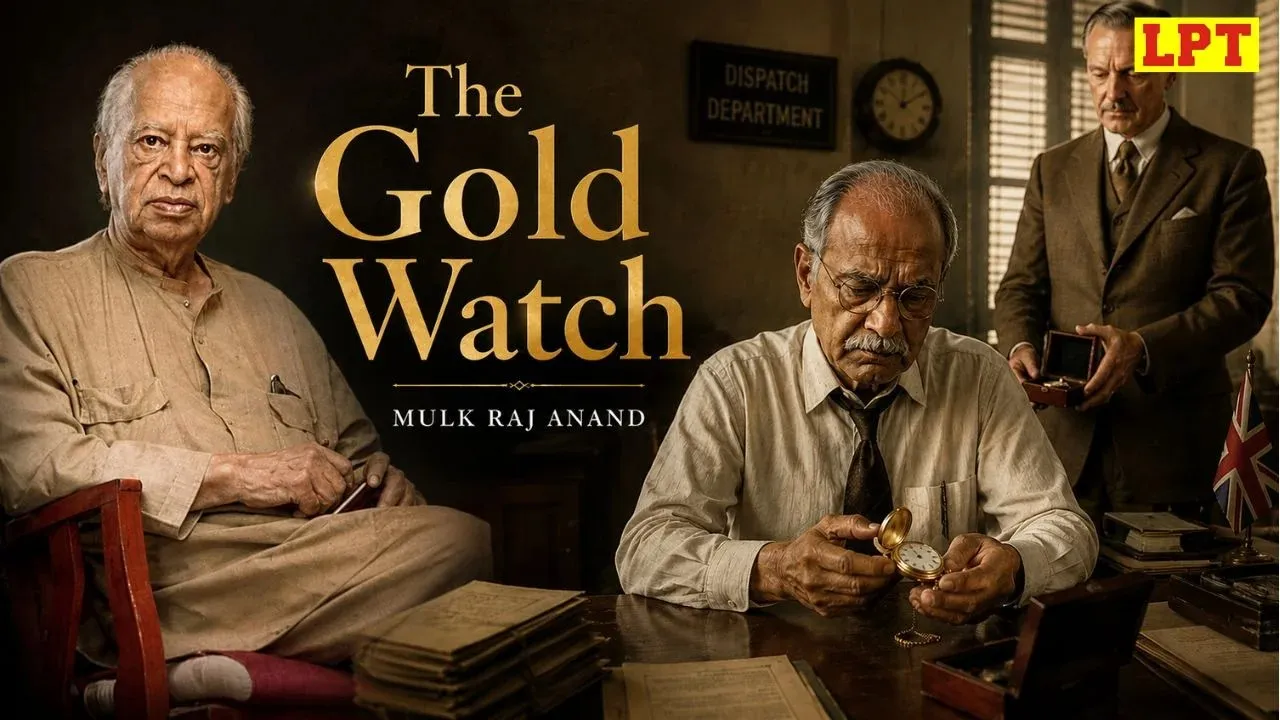
The Gold Watch by Mulk Raj Anand is a powerful and emotional short story that explores themes like dignity of labor, emotional neglect, social inequality, recognition, and middle-class struggles. The story focuses on the emotional condition of a worker who dedicates years of service and loyalty but receives very little genuine appreciation in return.
Through realistic narration and subtle emotional depth, the author highlights how ordinary employees are valued more for their work than for their humanity. One of the most important aspects readers notice in the summary of The Gold Watch short story is the emotional contrast between expectation and reality.
The story also reflects human loneliness, social hierarchy, and the desire for respect and recognition. Below, we have covered the complete summary, important characters, major themes, literary devices, writing style, moral message, important questions and answers, quotes, and more about The Gold Watch story by Mulk Raj Anand.
Explore The Complete Summaries of Novels, Stories & Essay Notes
Key Details About The Gold Watch by Mulk Raj Anand
These are the most important things to know about The Gold Watch story by Mulk Raj Anand:
| Particular | Details |
| Story Name | The Gold Watch |
| Author | Mulk Raj Anand |
| Genre | Short Story / Social Realism |
| Main Themes | Dignity of Labor, Recognition, Social Inequality, Loneliness |
| Setting | Workplace / Office Environment |
| Writing Style | Realistic, Emotional, Socially Reflective |
| Tone | Emotional and Thoughtful |
| Main Focus | Human Emotions & Worker Struggles |
| Important Literary Elements | Irony, Symbolism, Realism, Characterization |
| Central Idea | Desire for Respect and Emotional Recognition |
| Type of Narrative | Character-Driven Social Story |
The Gold Watch by Mulk Raj Anand: Summary
Below is the summary of The Gold Watch story by Mulk Raj Anand:
Beginning
The Gold Watch by Mulk Raj Anand begins in the office of Henry King & Co., where Srijut Sudarshan Sharma works as an old and loyal dispatch clerk. Sharma has spent nearly twenty years serving the company with honesty and discipline despite not being highly educated. One day, the General Manager, Mr. Acton, unexpectedly approaches Sharma with a strange smile and tells him that he has brought something special for him from London.
This unusual attention immediately creates fear and confusion in Sharma’s mind because senior British officers rarely interacted personally with Indian clerks. Throughout the day, Sharma becomes anxious and obsessed with understanding the hidden meaning behind Mr. Acton’s words.
After chasing Mr. Acton outside the office, he finally learns that the gift is a gold watch with an inscription. At that moment, Sharma realizes that the watch is probably connected to forced retirement.
Middle
The middle part of the story focuses on Sharma’s growing emotional struggle and helplessness. He spends the weekend hiding his fear from his wife and son while internally worrying about his future. Sharma understands that the gold watch is not a reward but a polite way of removing him from the company before his official retirement age. His financial situation troubles him deeply because his son has not yet completed his studies, and the provident fund will not be enough to support the family properly.
Even during family conversations, Sharma’s anxiety remains visible beneath his forced smiles and artificial calmness. On Monday, Sharma is called into Mr. Acton’s office, where the General Manager formally praises his loyalty and efficiency before gently informing him about his retirement.
Mr. Acton presents the gold watch as a token of appreciation, but Sharma feels humiliated, emotionally broken, and powerless. Unable to protest openly against the decision, he silently accepts the gift while controlling his tears and frustration.
Ending
Towards the end of the story, Sharma leaves Mr. Acton’s office emotionally shattered. His colleagues gather around him and read the inscription on the watch aloud, confirming his retirement publicly. Some employees show sympathy, while others sarcastically criticize the company’s treatment of loyal workers.
Sharma feels deeply humiliated by the pity of others and struggles to maintain his dignity. Later, while returning home, he discovers that the gold watch has stopped working properly because it was damaged when he accidentally dropped it in Mr. Acton’s office. The broken watch becomes a powerful symbol of Sharma’s own condition — worn out, discarded, and emotionally damaged after years of loyal service.
The story ends on a tragic and reflective note as Sharma accepts that his life has completely changed. Overall, The Gold Watch presents themes of colonial power, job insecurity, aging, dignity, emotional suffering, and the harsh realities faced by ordinary workers in a deeply unequal system.
Short Summary of The Gold Watch by Mulk Raj Anand
The Gold Watch by Mulk Raj Anand tells the emotional story of Srijut Sharma, an old and loyal dispatch clerk working in a British company. When his boss, Mr. Acton, presents him with a gold watch, Sharma realizes that it is actually a symbol of forced retirement before his official retirement age.
Though praised for his loyalty, he feels humiliated, helpless, and fearful about his family’s future and financial security. The broken gold watch later becomes a symbol of Sharma’s own emotional and professional condition. The story highlights themes of colonialism, aging, job insecurity, dignity, and exploitation of loyal workers.
About the Author Mulk Raj Anand
Mulk Raj Anand was one of the most important writers in Indian English literature and is widely known for portraying the struggles of ordinary people through realistic storytelling. Born in 1905, Anand became famous for writing about workers, poor communities, social inequality, exploitation, and human dignity. His stories and novels often focused on people who were ignored or treated unfairly by society, making his writing emotionally powerful and socially relevant.
Anand’s writing style is simple, realistic, and deeply human-centered. Instead of using complicated language, he focused on emotions, human suffering, and social realities in a direct and relatable way. He believed literature should reflect real life and expose injustice within society.
Through his stories, readers not only understand characters emotionally but also become aware of social structures and human struggles. His works remain highly valuable for students because they improve comprehension, interpretation, empathy, and understanding of realistic literary themes naturally.
The Gold Watch by Mulk Raj Anand: Character Sketch
The Employee / Worker
The central employee in the story represents hardworking middle-class individuals who dedicate their lives to professional duty and discipline. He is sincere, emotionally sensitive, loyal, and deeply hopeful about receiving respect and recognition for his years of service. His character symbolizes the emotional struggles of ordinary workers whose sacrifices and loyalty often remain emotionally undervalued despite formal appreciation and rewards.
The Employer / Office Authority
The workplace authority represents institutional systems that function more mechanically than emotionally. While formal recognition is given to the employee, the emotional connection and genuine appreciation remain limited. This character symbolizes bureaucracy, emotional distance, and professional structures where human emotions are often secondary to routine and hierarchy.
Co-Workers and Office Environment
The office atmosphere and supporting employees reflect routine professional culture and middle-class workplace life. They symbolize social structure, hierarchy, discipline, and emotional isolation within professional systems. Their presence helps create the realistic environment where the main character’s emotional expectations and loneliness become more visible.
Read Short Story Summaries
Read concise and student-friendly summaries of famous short stories along with themes, moral lessons, literary devices, and important questions:
Themes of The Gold Watch Short Story
- Dignity of Labor: The story highlights the emotional and social value of honest work and lifelong dedication performed by ordinary employees.
- Desire for Recognition: The employee wants not only formal rewards but also genuine appreciation, respect, and emotional acknowledgment for his service.
- Emotional Loneliness: Despite spending years in a workplace, the main character experiences emotional isolation and lack of meaningful human connection.
- Social Inequality: The story reflects the emotional and social gap between institutions and the ordinary workers who serve them faithfully.
- Reality vs Expectations: The employee’s emotional hopes and expectations gradually clash with the practical reality of professional recognition.
- Middle-Class Struggles: The narrative realistically portrays insecurity, emotional pressure, and unfulfilled aspirations common in middle-class professional life.
- Human Emotions in Professional Life: The story shows how workplaces often ignore the emotional side of workers while focusing only on service and productivity.
The Gold Watch by Mulk Raj Anand: Literary Devices
The literary devices used in The Gold Watch story by Mulk Raj Anand include irony, symbolism, realism, social commentary, characterization, and more.
| Literary Device | How It Is Used in the Story |
| Symbolism | The Gold Watch symbolizes recognition, loyalty, dignity, and emotional expectations connected with lifelong service. |
| Irony | The formal reward appears valuable externally but emotionally feels incomplete and unsatisfying for the employee. |
| Realism | The story realistically portrays middle-class office life, worker struggles, and emotional isolation without exaggeration. |
| Characterization | The emotional condition, expectations, and personality of the employee are developed through detailed observation and narration. |
| Social Commentary | The story indirectly criticizes professional systems that value service mechanically instead of emotionally. |
| Emotional Contrast | The contrast between expectation and reality creates emotional depth and sadness within the narrative. |
| Satire | Subtle satire is used to expose emotional emptiness hidden within formal workplace recognition and hierarchy. |
Explore the Best Novels for IPMAT Preparation
The Gold Watch by Mulk Raj Anand: Questions and Answers
Who is the author of The Gold Watch?
The Gold Watch was written by Mulk Raj Anand, one of the most important writers in Indian English literature. He became famous for portraying social inequality, worker struggles, emotional suffering, and middle-class life through realistic storytelling. His stories often focus on ordinary people whose emotional and social struggles are ignored by society and institutions.
What is the main theme of The Gold Watch?
The main theme of the story is dignity of labor and the human desire for recognition and emotional appreciation. The story also explores loneliness, emotional neglect, middle-class struggles, social inequality, and the difference between formal recognition and genuine human respect. Through the employee’s emotional experience, the story highlights how institutions often value workers mechanically rather than emotionally.
Why is the story called The Gold Watch?
The title symbolizes recognition, loyalty, service, and emotional expectation. The Gold Watch is not just a retirement or service reward; it represents the employee’s hope for appreciation and dignity after years of dedication. However, the emotional reality behind the reward creates irony because the formal gesture fails to provide the emotional fulfillment and genuine recognition the employee desires.
What does The Gold Watch symbolize in the story?
The Gold Watch symbolizes professional recognition, loyalty, dignity, and emotional validation. At the same time, it also symbolizes the emotional emptiness behind formal institutional appreciation. The object becomes important because it reflects the gap between external reward and internal emotional satisfaction experienced by ordinary workers after years of service.
What type of story is The Gold Watch?
The Gold Watch is a realistic and socially reflective short story. It belongs to the tradition of social realism because it portrays ordinary workplace life, emotional struggles, middle-class insecurity, and institutional behavior realistically without exaggeration or fantasy. The story focuses more on emotions and social reality than dramatic action.
How does the story portray emotional loneliness?
The employee spends years working honestly within the workplace but still experiences emotional isolation and lack of meaningful recognition. His emotional expectations reveal a deep human desire for appreciation and connection. The story shows how routine professional life can leave individuals emotionally empty despite years of discipline and loyalty.
What role does irony play in The Gold Watch?
Irony is one of the most important literary devices in the story. The Gold Watch appears valuable and honorable externally, but emotionally it feels incomplete and hollow for the employee. The contrast between formal recognition and emotional dissatisfaction creates subtle but powerful irony throughout the narrative.
How does Mulk Raj Anand portray middle-class struggles?
Mulk Raj Anand portrays middle-class struggles through the employee’s emotional expectations, insecurity, routine life, and dependence on institutional validation. The story reflects how ordinary workers seek dignity, stability, and recognition while living within rigid professional systems that often ignore emotional needs.
What is the central idea of The Gold Watch?
The central idea of the story is that genuine human respect and emotional appreciation are more meaningful than formal rewards and mechanical recognition. The narrative highlights how people emotionally invest themselves in institutions but often receive only symbolic acknowledgment instead of real human understanding.
What message does The Gold Watch give readers?
The story teaches readers to value human dignity, emotional appreciation, and genuine respect more than formal rewards or material recognition. It also reminds society that workers are human beings with emotions, expectations, and emotional needs beyond professional productivity and service.
How does the story reflect workplace culture?
The workplace in the story reflects hierarchy, routine, discipline, emotional distance, and institutional formality. It shows how professional environments can become emotionally mechanical, where workers are valued more for service and productivity than for their humanity and personal struggles.
Is The Gold Watch a social commentary story?
Yes, the story acts as a strong social commentary on worker treatment, middle-class emotional struggles, and institutional behavior. Through realistic narration, the author indirectly criticizes systems that fail to emotionally value ordinary employees despite years of loyalty and contribution.
Moral Message of The Gold Watch Short Story
The Gold Watch teaches that human dignity, emotional respect, and genuine appreciation matter far more than formal rewards or symbolic recognition. The story reminds readers that ordinary workers also carry emotions, hopes, and personal sacrifices that deserve meaningful acknowledgment rather than mechanical appreciation from society and institutions.
The Gold Watch by Mulk Raj Anand PDF
Download the free PDF of The Gold Watch story:
Explore Other Exam Preparation Resources
Prepare smarter with our dedicated coaching programs, preparation guides, mock tests, and study resources for top competitive exams in India.