Talk to a Counsellor
IPM/BBA:
 Support
10 IPMAT Preparation Mistakes: Are You Making These Errors?
Last Updated on 10 Nov 2026

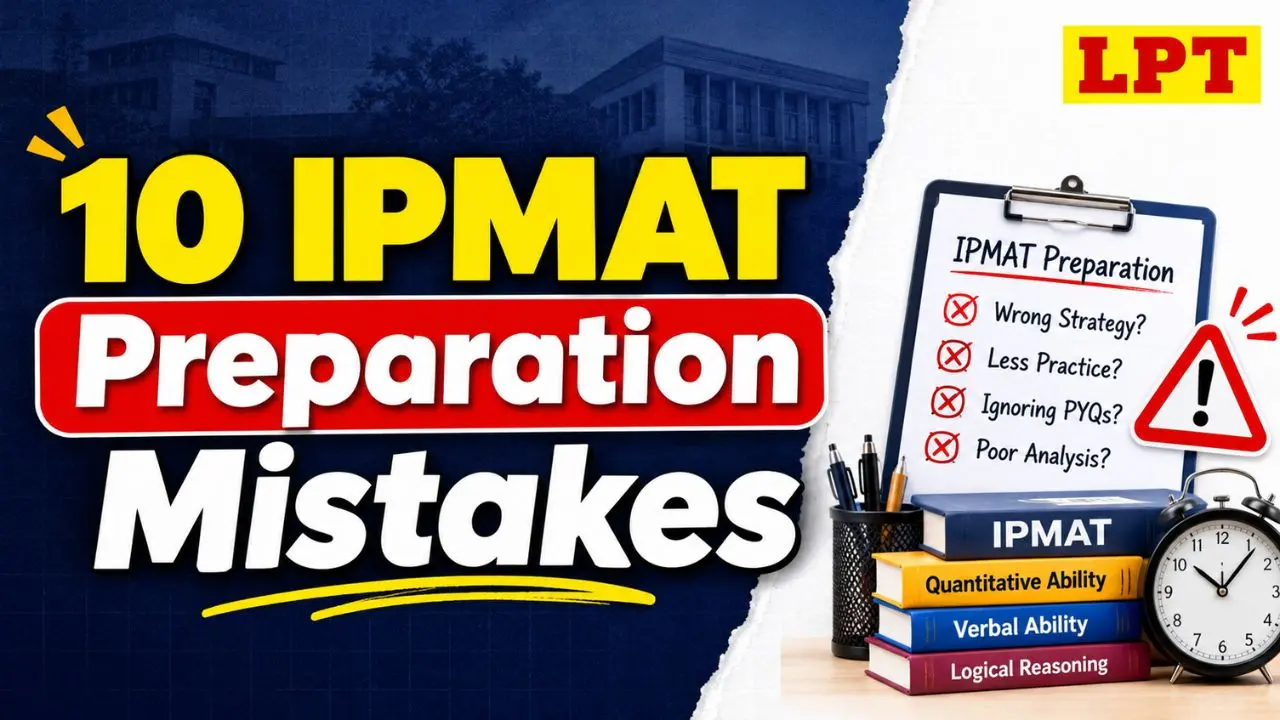
You spend hours preparing for IPMAT, solve hundreds of questions and still lose marks because of a few common mistakes. Skipping mock test analysis and poor revision can hurt your exam performance.
These IPMAT preparation mistakes often go unnoticed but can create problems when you attempt the actual paper. Your preparation strategy should also match your target exam, as IPMAT Indore and IPMAT Rohtak follow different exam patterns.
Identifying these mistakes early can help you avoid wasted effort, improve accuracy and use your preparation time better. Here are 10 common IPMAT preparation mistakes and how you can avoid them.
Table Of Contents
1. Starting IPMAT Preparation Without Understanding the Exam Pattern
You may start preparing without checking the exam pattern of your target institute. However, IPMAT Indore and IPMAT Rohtak have different section-wise requirements and question formats.
IPMAT Indore includes Quantitative Ability (MCQ), Quantitative Ability (Short Answer) and Verbal Ability. IPMAT Rohtak includes Quantitative Ability, Logical Reasoning and Verbal Ability.
How to avoid this mistake:
- Check the latest exam pattern and syllabus of your target institute.
- Understand the marking scheme, question formats and time limits.
- Identify topics common to both exams if you are preparing for multiple institutes.
- Practise institute-specific mock tests and previous-year questions.
Understanding the exam pattern helps you plan your preparation and allocate time to the right topics.
Practice with IPMAT Quant Mock Test
2. Ignoring Mathematics Fundamentals
You may find Quantitative Ability challenging if you did not study Mathematics in Classes 11 and 12. It is even harder if you have forgotten basic concepts. If you jump straight to difficult questions without strong fundamentals, your preparation can slow down.
Topics such as percentages, ratios, averages, algebra and number systems form the foundation for many questions.
How to avoid this mistake:
- Revise basic mathematical concepts before attempting advanced questions.
- Practise topic-wise questions to understand how formulas work.
- Maintain a formula notebook for quick revision.
- Start with easy questions and gradually increase the difficulty level.
- Revisit concepts that repeatedly cause errors.
Focus on understanding the logic behind a solution rather than memorising formulas. Strong fundamentals help you solve unfamiliar questions more confidently.
Download IPMAT Previous Year Question Paper PDF
3. Covering Too Many Topics Without Conceptual Clarity
You may try to complete the entire IPMAT syllabus quickly. You might switch between chapters, online lectures and study materials without mastering individual topics.
This approach often leaves gaps in your understanding. You may recognise a question type but struggle to solve it on your own.
How to avoid this mistake:
Follow a topic-wise IPMAT preparation plan. For each topic, understand the concepts and solve basic and advanced questions. Then attempt a timed practice set and review your mistakes before moving on.
For example, while preparing for Arithmetic, learn the formulas and their applications first. Then solve basic questions, move to exam-level problems and finish with a timed test.
Measure your preparation by how accurately you can solve questions, not just by the number of chapters completed.
Prepare for the IPMAT Interview with Expert Guidance
4. Neglecting Verbal Ability
You may spend most of your IPMAT preparation time on Quantitative Ability and leave Verbal Ability for the final weeks. However, reading comprehension, vocabulary and grammar also require consistent practice.
You may understand English well and still struggle with long passages and closely matched answer choices. This happens when you rarely solve exam-level questions.
How to avoid this mistake:
- Read one newspaper editorial every day and summarise its main argument in two lines.
- Practise reading comprehension and identify the main idea, tone and supporting arguments.
- Learn vocabulary through context instead of memorising isolated word lists.
- Revise grammar rules and practise sentence correction and para jumbles.
- Maintain a vocabulary notebook and revise it weekly.
Even 30 minutes of daily Verbal Ability practice can help improve your reading speed and accuracy. Treat English as a regular part of your preparation, not a subject to study at the last minute.
5. Taking Mock Tests Without Analysing Performance
IPMAT mock tests help you assess your preparation, but taking several tests without reviewing your mistakes limits their usefulness.
A mock test can reveal your weak topics, time-management issues, calculation errors and unnecessary guesswork. Two students with similar scores may have different weaknesses, so base your strategy on your own analysis.
How to avoid this mistake:
After every IPMAT mock test:
- Review incorrect answers and understand the correct approach.
- Identify questions you left unanswered despite knowing the concepts.
- Check which questions consumed too much time.
- Separate conceptual mistakes from calculation errors and guesswork.
- Record your sectional scores, accuracy and recurring problem areas.
6. Poor Time Management During the Exam
IPMAT tests your ability to solve questions accurately under time pressure. Even with strong conceptual knowledge, you may lose marks if you spend too long on a single question.
Trying to solve every question in sequence is a common mistake. A difficult Mathematics problem can take several minutes, while easier questions go unanswered.
How to avoid this mistake:
- Practise timed sectional tests regularly.
- Identify questions you can solve quickly and accurately.
- Set a time limit per question during practice. In IPMAT Indore’s Quant MCQ section, that’s about 1 minute 20 seconds.
- Move on from lengthy questions and return to them if time permits.
- Review your question selection after every mock test.
If your target exam has sectional time limits, practise within them. Effective time management is about using the available time to maximise your score, not solving every question.
7. Ignoring Logical Reasoning for IPMAT Rohtak
If you are preparing for both IPMAT Indore and IPMAT Rohtak, you may follow the same study schedule for both exams. This can leave gaps in your preparation, particularly in Logical Reasoning.
IPMAT Rohtak includes Logical Reasoning, which may cover arrangements, series, blood relations, syllogisms, directions and analytical reasoning.
How to avoid this mistake:
- Check the specific syllabus and pattern of IPMAT Rohtak.
- Practise Logical Reasoning questions topic by topic.
- Use diagrams and tables to solve arrangements and puzzles.
- Attempt timed practice sets to improve speed and accuracy.
- Review incorrect answers to identify gaps in your reasoning.
If you are preparing for more than one exam, create a common plan for overlapping topics. Then set aside extra time for institute-specific sections.
Start Your IPMAT Preparation from Class 11
8. Using Too Many Books and Online Resources
So many videos, question banks, and study materials are available that you may feel you need them all. You might switch between teachers, download multiple PDFs and collect more books than you can realistically complete.
This creates confusion and reduces the time you have for practice and revision.
How to avoid this mistake:
- Select one reliable primary resource for learning concepts.
- Use a question bank for topic-wise practice.
- Choose mock tests that match your target exam pattern.
- Refer to additional resources only when a concept remains unclear.
- Complete and revise existing material before adding new resources.
Your preparation depends on how well you understand and apply concepts, not on how many books you own. A limited set of resources is easier to revise and track.
Explore the Best Books for IPMAT Preparation
9. Not Revising Regularly
You may focus on learning new concepts but forget to revise topics you have already covered. After a few weeks, you may forget formulas, confuse grammar rules or take too long to solve familiar questions.
Regular revision is particularly important if you are balancing IPMAT preparation with your Class 12 board examinations.
How to avoid this mistake:
- Fix one day each week, such as Sunday, for revision only.
- Maintain a formula sheet for Quantitative Ability.
- Record difficult questions and revisit them regularly.
- Revise vocabulary, grammar rules and important question types.
- Reattempt previously incorrect questions without looking at the solutions.
Review topics at regular intervals instead of waiting until the final weeks. When revising a difficult question, try solving it independently before checking the solution. This helps you see whether you understand the concept.
Enroll now for IPMAT Online Coaching
10. Neglecting Board Exams and Interview Preparation
You may focus entirely on IPMAT and neglect your Class 12 board examinations. Or you may assume that a good entrance test score guarantees admission.
Selection processes vary by institute and admission year. Additional stages may include a Personal Interview or Written Ability Test, depending on the institute.
How to avoid this mistake:
- Create a timetable that balances IPMAT preparation with school studies.
- Give sufficient attention to board exam subjects and practical examinations.
- Read about current affairs, business and economic developments.
- Practise introducing yourself and explaining your academic interests.
- Prepare to discuss your hobbies, achievements and reasons for choosing management.
- Check the latest selection criteria for each target institute.
Final Note
Cracking IPMAT requires strong fundamentals, consistent practice and a clear preparation strategy. Completing the syllabus is not enough. You must also manage your time, revise regularly and understand the requirements of your target institutes.
Focus on your Quantitative Ability and Verbal Ability regularly, and prepare for Logical Reasoning if you are targeting IPMAT Rohtak. Use reliable study materials and track your performance through mock tests.
More important resources for IPMAT exam:
| IPMAT Cut Off | IPMAT Indore Cut Off |
| IPMAT Rohtak Cut Off | IPMAT Rohtak Admit Card |
| IPMAT Indore Admit Card | IPMAT Rohtak Admit Card |
| IPMAT Indore Seats | IPMAT Indore Selection Process |
| IPMAT Indore Result |
Frequently Asked Questions (FAQs)

Virendra Soni
Virendra heads SEO & Content at LPT. A writer at heart, he focuses on building exam-focused content that informs, guides, and supports aspirants in their preparation journey.
Also Read : Online IPMAT Coaching , IPMAT Mock Tests , IPMAT Study Material
IPMAT Trending Blogs
- IPMAT Syllabus 2027: Subject-Wise Detailed Syllabus (PDF)
- IPMAT Registration 2027: Date, Application Form, Fee, Process
- IPMAT Previous Year Question Papers (2019-2026): FREE PYQs
- IPMAT Cut Off 2027: Category-wise Rohtak and Indore Cut Off
- IPMAT Books 2027, Best Preparation Books for Indore, Rohtak
- IPMAT Exam Date 2027, Complete Schedule and Important Dates
Other Related Blogs