 Talk to a Counsellor
IPM/BBA:
Talk to a Counsellor
IPM/BBA:  Support
CMAT 2027 Syllabus: Exam Pattern, Books & Question Paper
Last Updated on 18 Aug 2026

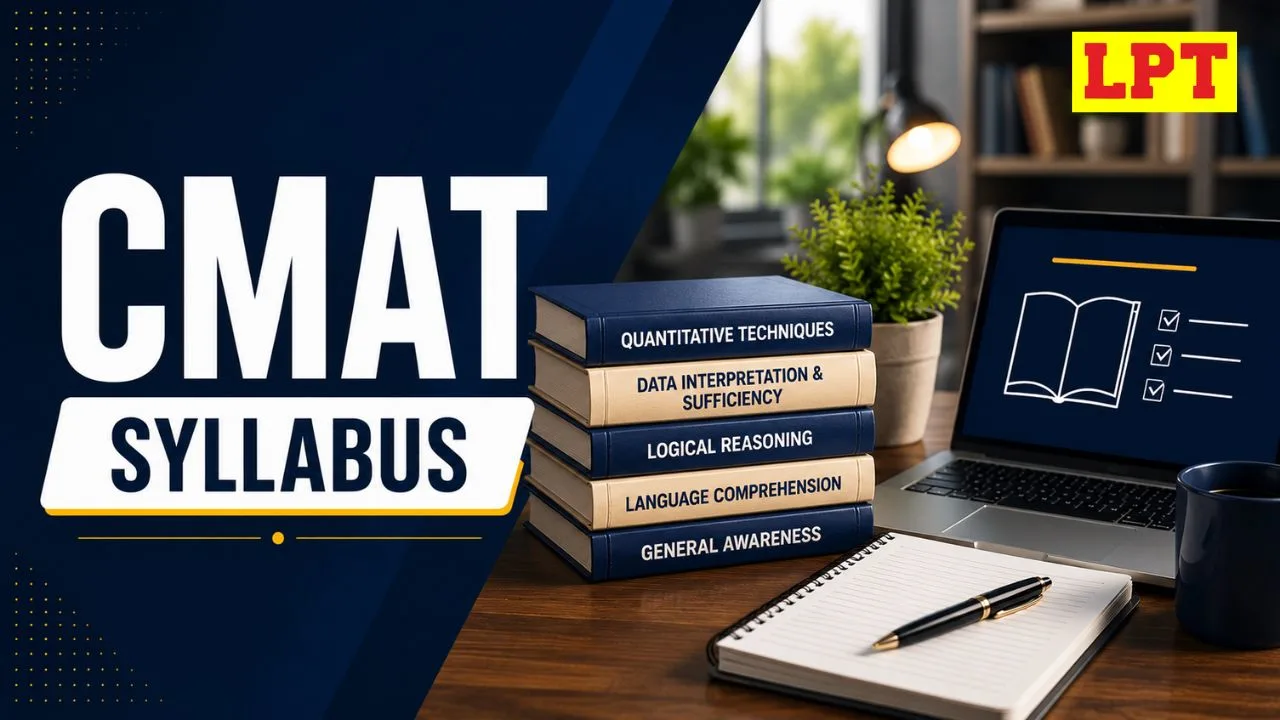
CMAT syllabus includes five divisions of sections: Logical Reasoning, General Awareness, Language Comprehension, Quantitative Techniques and Data Interpretation and Innovation & Entrepreneurship. NTA added Innovation and Entrepreneurship back in 2022 and is considered a scoring section of the exam. This section covers major concepts related to innovation and business startups. The topics in the CMAT syllabus are prescribed by the National Testing Agency (NTA), the exam's conducting body.
Common Management Aptitude Test (CMAT) is generally of a moderate level. But students sometimes find the General Awareness and Quantitative Techniques and Data Interpretation sections to be difficult. Therefore, analysing the CMAT previous year's question paper is crucial for understanding which chapters carry more weightage in the syllabus and how to cover them. Verbal Reasoning, basic Arithmetic, Reading Comprehension, and fundamentals of Entrepreneurship are highly important for CMAT 2027. Covering these sections would help you scale up your overall score and secure a seat at your desired college.
Table Of Contents
- CLAT PG: All About CLAT Postgraduate Exam for LLM
CMAT Syllabus 2027: Highlights
| Particulars | Details |
|---|---|
| Number of Sections | 5 |
| Name of the Section | - Language Comprehension- Logical Reasoning- Quantitative Techniques and Data Interpretation- General Awareness- Innovation and Entrepreneurship |
| CMAT Books | - Wren and Martin for English- A Modern Approach to Logical Reasoning - Newspaper or Manorama Yearbook for General Knowledge- Objective Computer Awareness by Arihant. |
| High-Weightage Topics | Reading Comprehension, Basic Arithmetic, Critical Reasoning, Current Affairs and Static GK |
| Difficulty Level |
Moderate |
Check the comparison between the CMAT V/s MAT
CMAT Syllabus 2027: Section-Wise Chapters
The section-wise CMAT syllabus is discussed below. Each topic should begin with basic concepts first, followed by advanced topics.
Note: The National Testing Agency (NTA) has not released the section-wise topics for CMAT. NTA has just listed the section names based on which questions will be framed. The following section-wise syllabus is based on the past questions. The questions are drawn from the following chapters in each section.
Quantitative Techniques and Data Interpretation
The quant section also includes questions based on Data Interpretation. At first, candidates should cover basic Arithmetic chapters such as Percentage, Profit & Loss, Averages, etc. Once done, students can cover advanced topics and solve DI-based questions.
| CMAT Quantitative Techniques and Data Interpretation Syllabus | |
|
Pie Chart |
Bar Graph |
|
Number System |
Percentages |
|
Ratio and Proportion |
Fractions and Decimals |
|
Permutation & Combination |
Simple & Compound Interest |
|
Algebra |
Tabulation |
|
Allegations & Mixtures |
Averages |
|
Pipes and Cisterns |
Probability |
|
Work and Time |
Time-Speed and Distance |
|
Allegations & Mixtures |
Profit and Loss |
|
Mensuration |
Partnership |
|
Quadratic & Linear Equations |
Geometry |
Logical Reasoning
For this section, students need to develop critical thinking ability. Whether inference-based questions or statement-and-argument questions, solving these chapters requires rigorous practice and an understanding of each concept. Cover each of the following sections and practice questions from PYQs to track your CMAT preparation and understanding of each chapter.
| CMAT Logical Reasoning Syllabus | ||
|
Statement and Arguments |
Statement and Assumptions |
Analytical Reasoning |
|
Cause and Effects |
Non-Verbal Reasoning |
Direction and Distance |
|
Symbol Based Problems |
Linear Arrangements |
Coding and Decoding |
|
Analogies |
Number Series |
Arrangements |
|
Inferences |
Blood Relationship |
Ranking Tests |
Language Comprehension
The Reading Comprehension is the soul of the Language Comprehension section in CMAT. Developing the reading skill and solving at least 1 RC every day is sufficient. Around 50% of the questions are based on the RC passages; if prepared well, you can easily score 65+ marks. However, to score these marks, you need to prepare the other chapters listed below.
| CMAT Language Comprehension Syllabus | |
| Reading Comprehension | Para Completion |
| Errors in English Usage | Sentence Completion |
| Grammar-based Questions | Antonym/Synonyms |
| Para Jumbles | Idioms and Phrases |
| Parts of Speech | One-Word Substitution |
| Sentence Improvement/Correction | Cloze Test |
General Awareness
You can refer to NCERTs for the static parts like History, Polity, and Geography to tackle based questions. Other than this, refer to newspapers to cover current affairs. Check the topics you need to cover below.
| CMAT General Awareness Syllabus | |
| National and International Importance | Business-related Issues |
| Recent Government Schemes | International Affairs |
| Geography | Sports |
| Awards | Books & Authors |
| Arts & Culture | National & Global Economy |
| Geography | Trade Awareness |
| Polity | Science |
| Literature | Politics |
| Static & Current GK | History |
| History | Economics |
| Politics | Sports |
| Indian Constitution | Important Personalities |
Start Practice with CMAT GK Questions
Innovation and Entrepreneurship
The Innovation and Entrepreneurship section focuses on a basic understanding of entrepreneurship and business-related concepts. You may refer to Entrepreneurship & Innovation Management by R Gopal or any other standard book. In addition, solve the past questions to better understand the type of questions asked in the exam.
| CMAT Innovation and Entrepreneurship Syllabus | ||
| Overview of Entrepreneurship | Evolution of Entrepreneurship in India | Concepts of Entrepreneurship |
| Role of Entrepreneurship in Economic Development | Dimensions of Entrepreneurship | Emerging Models of Corporate Entrepreneurship |
| Entrepreneurial Culture | Rural Entrepreneurship | Women Entrepreneurship |
| Theories and Models of Entrepreneurship | Framework of Entrepreneurship Theories | Entrepreneurial Society |
| Emerging Trends in Social Entrepreneurship | Principles of Business Organisation | Motivation, Communication and Leadership |
Key Information About CMAT Exam
| CMAT Marking Scheme | CMAT Cut Off |
| CMAT Registration | CMAT Exam Pattern |
| CMAT Admit Card | CMAT GK Questions |
| CMAT Exam Analysis | CMAT Answer Key |
| CMAT Result |
CMAT Exam Pattern 2027
CMAT is held online for 3 hours, with no sectional time limit. The total number of questions included in the CMAT question paper is 100, each allotted 4 marks. Check the CMAT Exam Pattern and marking scheme below.
| Pattern | Details |
|---|---|
| Number of Sections | 5 sections-- Quantitative Techniques and Data Interpretation- Logical Reasoning- Language Comprehension- General Awareness- Innovation and Entrepreneurship |
| Total Number of Questions | 100 questions |
| Total Marks | 400 |
| Marks Distribution | 80 marks in each section |
| Total Number of Questions | 20 questions in each section |
| Medium of CMAT Question Paper | English |
| Marks Per Question | 4 marks |
| Negative Marking | 1 mark for each incorrect answer |
Recommended CMAT Books
Here is the list of recommended books for the CMAT 2027 preparation. Initially, you may refer to NCERTs, followed by standard books and PYQs, to solve questions and identify your weak and strong spots. Check the CMAT books for all sections below.
Quantitative Techniques and Data Interpretation
To study the quant section from scratch, you should refer to NCERTs first. Apart from this, understand the concepts and practice questions from the given books:
- How to Prepare for Quantitative Aptitude for CAT by Arun Sharma
- The Pearson Guide to Quantitative Aptitude for Competitive Exams
- How to Prepare for Data Interpretation for CAT by Arun Sharma
Logical Reasoning
For this section, study blood relation, number series, statement and argument, coding and decoding, etc. These are well covered in the following books.
- How to Prepare for Logical Reasoning for the CAT by Arun Sharma
- Logical Reasoning and Data Interpretation for the CAT by Nishit K Sinha
Language Comprehension
The Language section judges how well students comprehend passages. With this, having strong vocabulary and grammar knowledge would be an added advantage in maximising your score.
- Wren & Martin English Grammar
- Word Power Made Easy by Norman Lewis
- How to Prepare for Verbal Ability and Reading Comprehension for the CAT by Arun Sharma
General Awareness
Reading newspapers daily benefits in several ways. You improve your reading skills and vocabulary and keep track of current events in sectors such as the economy, sports, and government development schemes. For static parts like History, Polity and Geography, read the NCERTs first and practice questions from the PYQ. For current affairs, stick to newspapers and make notes of the important areas you find relevant.
Innovation and Entrepreneurship
This section requires understanding of the fundamental topics of entrepreneurship, its evolution, and related theories. You may refer to these chapters and other related topics from the following books.
- Innovation & Entrepreneurship by Peter F. Drucker
- Entrepreneurship & Innovation Management by R Gopal
- Entrepreneurship - Robert D. Hisrich
Important Resources for MBA Aspirants
| CAT 2026 Details | FMS Delhi Ranking |
| CAT Cut Off | ISB Hyderabad Eligibility |
| FMS Delhi Cut off |
Important Topics for CMAT 2027
After analysing past question papers, we have listed the key topics below for the upcoming Common Management Aptitude Test (CMAT).
| CMAT Sections | Important Chapters (Expected) |
|---|---|
| Language Comprehension | Reading Comprehension, Vocabulary, Para Jumbles, Grammar, Cloze Test and Idioms and Phrases. |
| Logical Reasoning | Verbal Reasoning, Non-Verbal Reasoning and Critical Reasoning |
| Quantitative Techniques | Arithmetic, Geometry, Mensuration, DI, Number System |
| General Knowledge | Business, Economy, Current Affairs and Static GK |
| Innovation and Entrepreneurship | Fundamentals of Entrepreneurship, Startup Ecosystem, Business Models, Government Initiatives. |
CMAT Chapter-Wise Weightage
Based on the CMAT analysis of past question papers, here are the important chapters and their weightage.
| CMAT Sections | Chapters | Weightage (in %) |
|---|---|---|
| Language Comprehension | Reading Comprehension | 50 to 55 per cent |
| Grammar-based questions, Idioms and Phrases, and Cloze Test | 25 to 30 per cent | |
| Vocabulary and Para Jumble-based questions | 15 to 30 per cent | |
| Quantitative Techniques | Arithmetic | 30-40% |
| Geometry & Mensuration | 15-20% | |
| Modern Mathematics | 10-15% | |
| Number System | 10-15% | |
| Data Interpretation | 15-20% | |
| Logical Reasoning | Verbal Reasoning | 40-50% |
| Non-verbal Reasoning | 30-40% | |
| Critical Reasoning | 10-15% | |
| General Knowledge | Current Affairs | 40-50% |
| Static GK | 25-30% | |
| Business & Economy | 15-20% | |
| Innovation & Entrepreneurship | Entrepreneurship Fundamentals & Concepts | 25-30% |
| Startup Ecosystem & Business Models | 20-25% | |
| Government Initiatives & Policies | 15-20% | |
| Business & Economic Awareness | 15-20% | |
| Funding, Venture Capital & Finance | 10-15% | |
| Innovation, Creativity & Case-based Questions | 10-15% |
CMAT Previous Years’ Question Paper
Practice CMAT Previous Year Papers from at least the last 4-5 years. Having done this, you will easily understand which topic to focus more on and how to cover the syllabus before the exam.
| Year-wise Question Paper | Question Paper PDF | Answer Key Solutions |
|---|---|---|
| CMAT 2026 Question Paper | Download Paper | Check Solutions |
| CMAT 2025 Question Paper | Download Paper | Check Solutions |
| CMAT 2024 Question Paper | Download Paper | Check Solutions |
| CMAT 2023 Question Paper | Download Paper | Check Solutions |
| CMAT 2022 Question Paper | Download Paper | Check Solutions |
Explore MBA College Comparisons
FAQs On CMAT 2027 Syllabus

Nidhi Priya
Nidhi Priya has over 6 years of experience in EdTech content and SEO. She specializes in content strategy, organic growth, and mentoring editorial teams, with previous experience at iQuanta, CollegeDekho, and Careers360.
CMAT Trending Blogs
- CMAT Result 2027: Dates, Scorecard Download Link, Cut-off
- CMAT Previous Year Papers: Year-wise Question Papers PDFs
- CMAT Registration 2027: Dates, Direct Link, Fees, Documents
- CMAT Preparation Tips 2027 - Section Wise Detailed Strategy
- CMAT Admit Card 2027: Dates, Direct Link, Exam Day Guidelines
- CMAT Exam Pattern 2027: Sections, Marks and Duration