Talk to a Counsellor
IPM/BBA:
 Support
How Many Mocks Are Enough for IPMAT 2027? Frequency & Tips
Last Updated on 12 Nov 2026

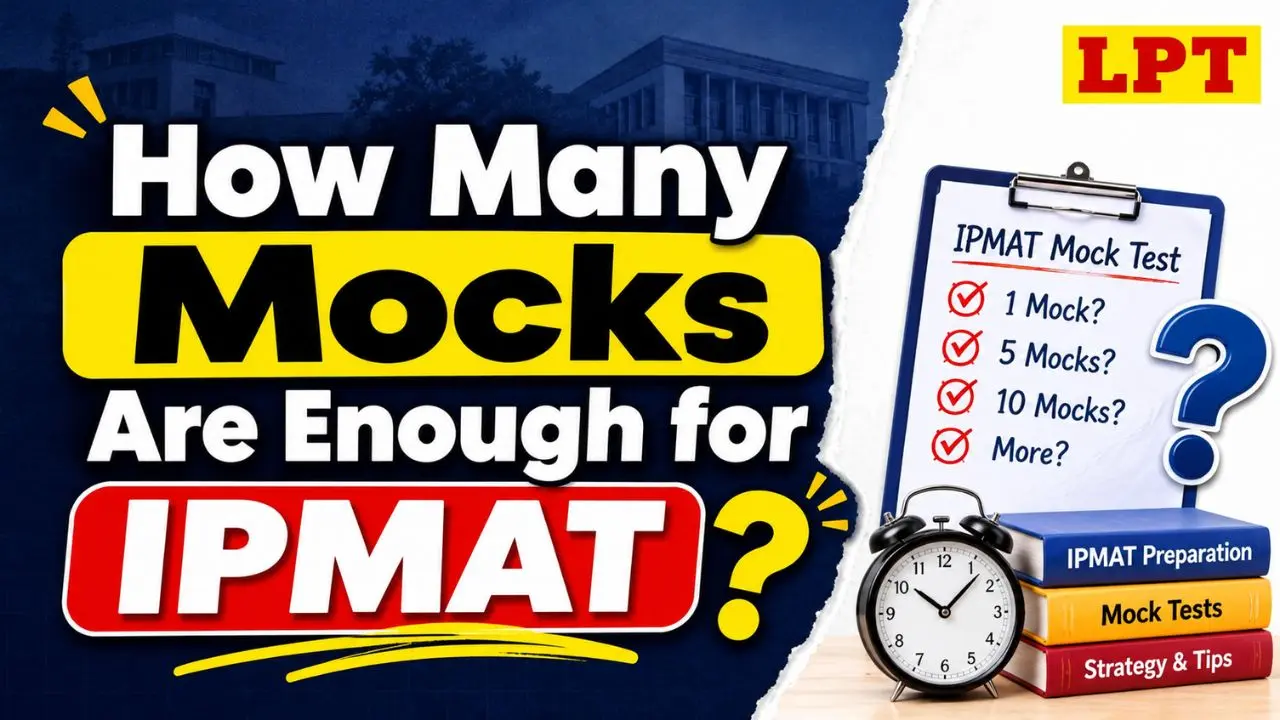
An IPMAT mock test can tell you more about your preparation than another three hours of solving questions, provided you know what to look for. You might finish a mock feeling confident, only to find that you lost marks on easy questions.
It may also show you spent too long on one Quantitative Ability problem or rushed through the Verbal Ability section. These patterns matter because they show where your preparation is falling short.
So the real question isn't how many mocks you can complete before IPMAT exam day. Rather, it's about how much you learn from each one. Taking 20 mocks without reviewing them may be less useful than taking 10 and working on every mistake.
So, let's look at how many IPMAT mocks you should attempt and when to start. We have also discussed the ways to analyse your performance for IPMAT Indore and other IPM entrance exams.
Table Of Contents
How Many Mock Tests Should You Take for IPMAT 2027?
As a practical target, aim for 15–25 full-length mock tests if you have around four to five months to prepare. You can attempt more if you have enough time to review each paper and work on your weak areas.
If you are starting late, focus on fewer mocks with detailed analysis instead of rushing through several tests.
| Preparation stage | Suggested mock frequency | Main objective |
|---|---|---|
| Foundation stage | Topic-wise and sectional tests | Build concepts and improve accuracy |
| Early mock stage | 1 full-length mock per week | Understand the paper and identify weak areas |
| Intensive preparation | 1 or 2 full-length mocks per week | Improve question selection and time management |
| Final month | Two or three mocks per week, depending on readiness | Practise under exam-like conditions |
| Final week | Avoid heavy new testing; revise mistakes and key concepts | Stay prepared without unnecessary pressure |
Check Out IPMAT Ki Taiyari Kaise Kare in Hindi
When Should You Start Taking IPMAT Mock Tests?
The right time to start depends on how much of the syllabus you have covered. You do not need to finish the entire IPMAT syllabus before attempting your first mock.
But you should know enough to make the results useful.
1. Foundation Stage
During the initial months, focus on learning concepts and solving topic-wise questions. For Quantitative Ability, work on areas such as arithmetic, algebra, number systems and geometry.
For Verbal Ability, practise reading comprehension, grammar, vocabulary and other question types relevant to your target exam.
You can take short sectional tests to check whether you understand a topic. A low score at this stage is not a reason to worry; use it to identify what you need to revise.
2. Early Mock Stage
Once you have covered a reasonable part of the syllabus, attempt your first full-length mock. Treat it as a test, not a measure of your final potential.
Use this test to understand:
- Which sections feel comfortable and which take more time.
- Whether you can complete questions within the time limit.
- Which topics cause the most errors.
- Whether you spend too long on questions you eventually leave.
Do not expect a high score in your first mock. Its purpose is to show you where your preparation stands.
3. Intensive Practice Stage
As your concepts improve, increase the frequency of full-length mocks. Attempt each test under timed conditions and follow it with a detailed review.
At this stage, focus on making better decisions during the exam. Learn when to attempt a question, when to skip it and when to return to it if time permits. Also, check whether your accuracy improves as you increase your speed.
4. Final Month
Use the final month to practise with a consistent schedule. Attempt two or three full-length mocks per week only if you can analyse them properly and still have time for revision.
In the final few days, prioritise your error log, important concepts and ipmat previous-year questions instead of trying to complete as many new mocks as possible.
Enroll Now IPMAT Online Course to Boost your Preparation
Sectional Tests vs Full-Length Mocks for IPMAT: Which Should You Attempt?
Both types of tests have a role in IPMAT preparation, but they serve different purposes.
| Feature | Sectional mocks | Full-length mocks |
|---|---|---|
| Coverage | One section or a specific topic | The complete test |
| Best time to use | During concept-building and revision | Once you have covered a reasonable part of the syllabus |
| Main purpose | Improve topic knowledge, speed and accuracy | Practise time management and question selection across the paper |
| Analysis focus | Errors within a topic or question type | Section-wise performance, timing, accuracy and overall strategy |
| Frequency | Based on your weak topics | Gradually increase as the exam approaches |
For example, if you repeatedly struggle with algebra, take a sectional test on algebra and review every mistake. If you know the concepts but cannot finish the paper on time, a full-length mock will help you understand how you use time across sections.
IPMAT Previous-year question papers are also important. Attempt them under timed conditions to become familiar with the style and level of questions asked in earlier exams.
Make sure your mock test matches your target exam. IPMAT Indore, IPMAT Rohtak and JIPMAT do not necessarily follow the same pattern. Check the latest official information for the exam you plan to take before choosing a mock series.
How to Analyse an IPMAT Mock Test: A Step-by-Step Framework
Attempting a ipmat mock is only the first part of the process. The next step is to understand what your performance tells you. Set aside enough time after each test to review your answers, identify recurring problems and plan your next practice session.
Step 1: Review Your Overall Score and Section-Wise Performance
Start by recording your total score and the marks you obtained in each section. Do not look at the total score alone. Two students with the same score may have very different problems: one may struggle with concepts, while the other may lose marks through poor time management.
Record the following details:
- Total score and section-wise scores.
- Number of questions attempted.
- Number of correct and incorrect answers.
- Number of questions left unanswered.
- Time spent on each section, where available.
- Accuracy in each section.
You can calculate accuracy using this formula:
Accuracy = (Number of correct answers ÷ Total questions attempted) × 100
For example, if you attempt 40 questions and answer 32 correctly, your accuracy is 80%.
Use these figures to identify your main problem. If your accuracy is low, focus on concepts, calculation and question selection. If your accuracy is good but your score remains low, check whether you are attempting too few questions or spending too much time on difficult ones.
Always consider the marking scheme of your target exam when reviewing scores. Don't compare raw scores across mock tests without considering their difficulty and question pattern.
Step 2: Analyse Every Incorrect Answer
Go through each incorrect answer and determine why you made the mistake. Simply checking the correct option is not enough. You need to understand what caused the error.
Classify each mistake into one of these categories:
| Error type | What it means | How to fix it |
|---|---|---|
| Concept gap | You did not know the concept or method required | Revise the concept and solve basic questions before trying harder ones |
| Calculation error | You knew the method but made an arithmetic or algebraic mistake | Rework the solution carefully and practise accurate calculations |
| Misreading | You missed a condition, sign, unit or key word in the question | Read the question carefully and underline important information while practising |
| Time pressure | You rushed and made a mistake because time was running out | Practise timed sets and improve your question selection |
| Wrong question selection | You spent too long on a difficult question or attempted one you were not ready for | Learn to recognise time-consuming questions and move on when necessary |
| Guesswork | You selected an answer without sufficient reasoning | Review the concept and check the risks of guessing under the exam's marking scheme |
Step 3: Review Questions You Skipped
Questions you left unanswered can reveal gaps in your preparation, even if they did not reduce your score.
Check each skipped question and ask:
- Did I know how to solve it but run out of time?
- Did I avoid it because I did not understand the concept?
- Did I spend too much time on an earlier question?
- Could I have solved it more quickly?
- Was skipping it the right decision given its difficulty and the marking scheme?
If you skipped a question because you lacked the required concept, add that topic to your revision list. If you knew how to solve it but could not manage the time, practise similar questions in a timed set.
Also review questions you answered correctly by guessing. A correct answer does not always mean you understand the concept. Rework the solution to make sure you can solve a similar question independently.
Step 4: Check Your Time Management
Your score depends not only on what you know but also on how you use the time available—review where you spent too long and whether that time was worth it.
Look for patterns such as:
- Spending several minutes on one difficult Quantitative Ability question.
- Rushing through easier questions near the end.
- Reading a passage too slowly or returning to it. repeatedly
- Switching between questions without completing the ones you can solve.
- Spending too much time on one section at the expense of another.
Do not assume that solving every question is the best strategy. Aim to maximise your score by attempting questions you can solve accurately within the available time.
In your next mock, test one specific change. For example, set a time limit for difficult questions and move on when you reach it. After the test, check whether this helped you attempt more questions without lowering your accuracy.
Step 5: Maintain an Error Log
An error log helps you track mistakes across several mocks. Without one, you may keep making the same errors without noticing the pattern.
Use a simple table like this:
| Mock | Topic | Error type | Reason | Action to take |
|---|---|---|---|---|
| Mock 1 | Algebra | Concept gap | Could not form the equation | Revise the concept and solve 15 practice questions |
| Mock 1 | Arithmetic | Calculation error | Made a mistake while calculating a percentage | Practise calculations and show intermediate steps |
| Mock 2 | Reading comprehension | Misreading | Missed a key detail in the passage | Practise identifying evidence before selecting an answer |
| Mock 2 | Number system | Time pressure | Spent too long on one question | Solve a timed set and practise skipping difficult questions |
Update the log after every mock. Before taking the next test, review the previous entries and choose two or three areas to work on. Revisit older mistakes after a few days to check whether you have corrected them.
Step 6: Turn the Analysis into an Action Plan
Analysis is useful only when it changes what you do next. After reviewing a mock, write a short action plan instead of making a long list of everything you need to improve.
For example:
- Concept: Revise quadratic equations and solve 15 related questions.
- Accuracy: Rework calculation-based questions without rushing.
- Time management: Practise a 20-minute timed set and skip questions that take too long.
- Verbal Ability: Complete one reading comprehension passage and review the evidence for each answer.
Complete these tasks before taking the next mock, where possible. Then check whether the same errors occur again. If they do, change your practice method rather than simply taking more tests.
More important resources for IPMAT exam:
| IPMAT Score V/S Percentile | IPMAT Seats |
| IPMAT Result | IPMAT Exam Analysis |
How to Improve Your IPMAT Mock Scores
Once you have analysed several mocks, use the results to decide where to focus your preparation. The following methods can help you improve steadily.
1. Prioritise Repeated Weak Areas
One mistake may be a one-off error, but the same mistake across three or four mocks points to a pattern. Give these topics priority in your study plan.
If you repeatedly lose marks in arithmetic, revise the relevant concepts and solve topic-wise questions. Once your accuracy improves, test yourself under time pressure.
2. Improve Accuracy Before Chasing Attempts
Attempting more questions will not always improve your score, particularly if incorrect answers carry a penalty. Check the marking scheme for your target exam and see whether extra attempts help or hurt your result.
Focus on solving questions correctly before trying to increase your speed. Once you are comfortable with a method, practise applying it within a reasonable time.
3. Learn When to Skip a Question
Do not let one difficult question take time away from several questions you could solve. If you cannot see a clear approach after a reasonable amount of time, move on and return to it later if time permits.
Use mock tests to practise this decision. After each test, review the questions where you spent too long and identify the signs that should have prompted you to skip them.
4. Compare Performance Across Mocks
Don't judge your preparation by one score. Compare your last three to five mocks and look for changes in accuracy, section-wise scores, attempts and time management.
A lower score on a harder mock does not automatically mean your preparation has worsened. Consider the test's difficulty and the mistakes you made before deciding what needs to change.
5. Revise Before Taking Another Mock
If your analysis identifies a weak topic, revise it before the next test. Otherwise, you may repeat the same mistake without giving yourself a chance to improve.
Balance full-length mocks with topic-wise practice, revision and previous-year papers. The goal is to learn from each test, not to complete a certain number of tests as quickly as possible.
Discover More Useful Information Related to the IPMAT Exam
| IPMAT Full Form | |
| IPMAT Indore Answer Key | IPMAT Indore Seats |
| IPMAT Indore Subjects | Novels for IPMAT |
| IPMAT Rohtak Passing Marks | IPMAT Rohtak Answer Key |
FAQs

Virendra Soni
Virendra heads SEO & Content at LPT. A writer at heart, he focuses on building exam-focused content that informs, guides, and supports aspirants in their preparation journey.
Also Read : Online IPMAT Coaching , IPMAT Mock Tests , IPMAT Study Material
IPMAT Trending Blogs
- IPMAT Syllabus 2027: Subject-Wise Detailed Syllabus (PDF)
- IPMAT Registration 2027: Date, Application Form, Fee, Process
- IPMAT Previous Year Question Papers (2019-2026): FREE PYQs
- IPMAT Cut Off 2027: Category-wise Rohtak and Indore Cut Off
- IPMAT Books 2027, Best Preparation Books for Indore, Rohtak
- IPMAT Exam Date 2027, Complete Schedule and Important Dates
Other Related Blogs