Talk to a Counsellor
IPM/BBA:
 Support
Best Books for JIPMAT Preparation 2027: Expert Picks
Last Updated on 10 Nov 2026

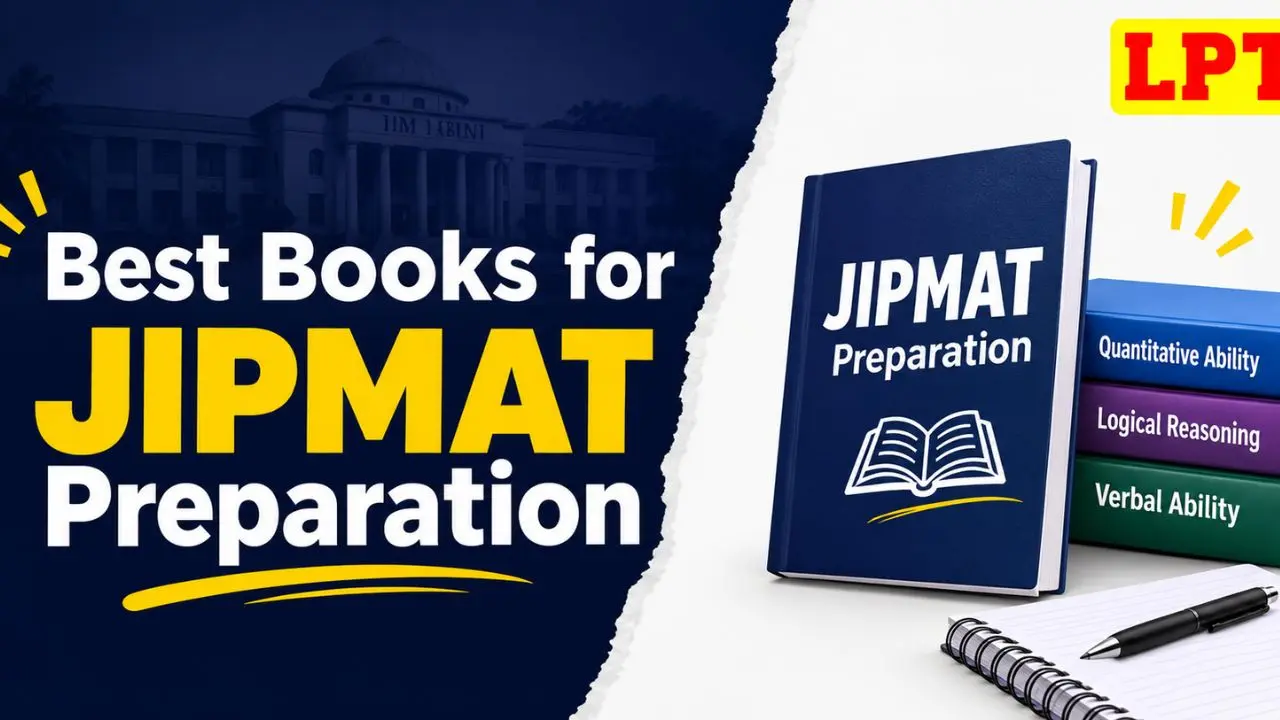
Choosing the right JIPMAT preparation books helps you avoid unnecessary resources and focus on effective preparation. For Quantitative Aptitude, R.S. Aggarwal’s Quantitative Aptitude for Competitive Examinations is a popular choice. Arun Sharma’s How to Prepare for Data Interpretation and Logical Reasoning for the CAT is widely used for DILR.
For Verbal Ability, Norman Lewis’s Word Power Made Easy and Wren & Martin’s grammar book are common picks. You can start with one or two reliable JIPMAT books per section instead of buying multiple resources.
The article also explains how to use these books for JIPMAT preparation with previous-year papers, sample papers and mock tests to strengthen concepts, practise questions and assess your preparation before the examination.
Table Of Contents
JIPMAT Preparation Books for Quantitative Ability
Quantitative Ability requires a clear understanding of arithmetic, algebra, number systems, percentages, ratios and averages. Students should choose books that explain concepts clearly and provide enough practice questions to improve speed and accuracy.
| Book Name | Author | USP |
|---|---|---|
| Quantitative Aptitude for Competitive Examinations | R.S. Aggarwal | Covers fundamental mathematical concepts with solved examples and extensive practice questions. |
| How to Prepare for Quantitative Aptitude for CAT | Arun Sharma | Offers graded exercises that progress from basic concepts to challenging problems. |
| Fast Track Objective Arithmetic | Rajesh Verma | Focuses on arithmetic techniques, calculation shortcuts and objective questions. |
| Quantitative Aptitude Quantum CAT | Sarvesh K. Verma | Provides detailed concept explanations and practice exercises for quantitative problem-solving. |
| The Pearson Guide to Quantitative Aptitude for Competitive Examinations | Pearson publication; verify the selected edition | Offers topic-wise explanations and practice material for aptitude examinations. |
Check Out Complete CAT Quants Syllabus
JIPMAT Preparation Books for Verbal Ability
Verbal Ability and Reading Comprehension cover vocabulary, grammar, sentence formation and passage comprehension. Students should select books that strengthen their understanding of English grammar, improve vocabulary and provide practice in interpreting passages.
| Book Name | Author | USP |
|---|---|---|
| Word Power Made Easy | Norman Lewis | Builds vocabulary through word roots, prefixes, suffixes and related words. |
| High School English Grammar and Composition | Wren and Martin | Explains grammar rules, sentence construction and common grammatical errors with exercises. |
| Objective General English | S.P. Bakshi | Provides grammar explanations, vocabulary exercises and objective questions. |
| Verbal Ability and Reading Comprehension for CAT | Arun Sharma and Meenakshi Upadhyay | Covers reading comprehension, verbal reasoning and question-solving techniques. |
| Verbal Ability and Reading Comprehension for CAT | Nishit K. Sinha | Offers concept explanations and practice exercises for verbal ability and comprehension. |
Practise with Top 100 CAT Reading Comprehension Questions with Answers
JIPMAT Preparation Books for Logical Reasoning
Logical Reasoning tests the ability to identify patterns, analyse relationships, draw conclusions and solve problems using the information provided. Students should practise arrangements, coding-decoding, series, syllogisms, blood relations and other relevant reasoning topics.
|
Book Name |
Author |
USP |
|---|---|---|
|
A Modern Approach to Logical Reasoning |
R.S. Aggarwal |
Covers a wide range of reasoning questions with explanations and practice exercises. |
|
How to Prepare for Logical Reasoning for CAT |
Arun Sharma |
Provides structured practice for analytical reasoning, with progressively challenging questions. |
|
Logical Reasoning and Data Interpretation for the CAT |
Nishit K. Sinha |
Combines logical reasoning and data interpretation practice to develop analytical skills. |
|
Verbal Reasoning |
R.S. Aggarwal |
Focuses on statements, arguments, conclusions and logical relationships. |
|
Shortcuts in Reasoning |
Disha Experts |
Covers quick-solving techniques and practice questions for common reasoning topics. |
Get All Details About JIPMAT 2027 Exam
Additional Books for JIPMAT
Apart from section-specific books, students can use mathematics textbooks, analytical reasoning resources and previous-year question papers to strengthen their preparation. These resources help students revise fundamental concepts, practise different question formats, and assess their readiness for the examination.
| Book Name | Author | USP |
|---|---|---|
| NCERT Mathematics Textbooks (Classes 9 and 10) | NCERT | Helps revise mathematical fundamentals, including number systems, algebra, geometry and mensuration. |
| Analytical Reasoning | M.K. Pandey | Focuses on analytical thinking, logical deductions and structured problem-solving methods. |
| A New Approach to Reasoning: Verbal, Non-Verbal and Analytical | B.S. Sijwal and Indu Sijwal | Provides practice across verbal, non-verbal and analytical reasoning question types. |
Get Complete Details about JIPMAT Subjects
How to Use JIPMAT Books to Prepare for the Exam?
Use JIPMAT preparation books topic by topic and follow a fixed study schedule. Focus on understanding concepts, practising questions and revising mistakes instead of completing multiple books at once.
1. Start with the JIPMAT Syllabus
Check the JIPMAT syllabus and divide topics into Quantitative Ability, Verbal Ability, Reading Comprehension, and Data Interpretation and Logical Reasoning. Match each topic with the relevant chapters in your preparation books.
2. Complete Concepts Before Solving Questions
Read the explanations and solved examples before attempting exercises. Start with basic questions and move to difficult ones once you understand the concepts.
3. Practise Questions Daily
Set aside time for each section and solve questions regularly. Use your books to practise different question types and identify topics that require more attention.
4. Revise Mistakes and Important Formulas
Maintain a notebook for incorrect answers, calculation shortcuts, formulas, grammar rules and unfamiliar vocabulary. Review these notes regularly to avoid repeating mistakes.
5. Solve Mock Tests and Previous-Year Papers
Attempt JIPMAT mock tests and previous-year question papers regularly. Analyse your performance after each test, identify weak areas and return to the relevant book chapters for revision.
Other Resources to Use for JIPMAT Preparations
Candidates preparing for the examination should also use the following resources, in addition to JIPMAT books, to improve their scores.
JIPMAT Previous Year Papers
JIPMAT previous year papers help candidates understand the examination pattern, question types and difficulty level. Solving these papers allows students to identify frequently tested topics across Quantitative Ability, Verbal Ability, Reading Comprehension, and Data Interpretation and Logical Reasoning. Candidates can also assess their preparation, identify weak areas and practise time management.
JIPMAT Sample Paper
JIPMAT sample papers provide additional practice across different topics covered in the examination. Candidates can use them to test their understanding of concepts and practise question types they have not attempted before. Sample papers also help students identify gaps in their preparation and improve their approach to unfamiliar questions.
JIPMAT Mock Test
JIPMAT mock tests help candidates evaluate their preparation under timed examination conditions. They let you practise all sections in one sitting, manage time across questions, and improve accuracy. Mock tests also help students identify sections that require more practice and determine whether they spend too much time on particular questions.
Key important resources for JIPMAT exam:
| JIPMAT Eligibility | JIPMAT Admit Card |
| JIPMAT Selection Process | JIPMAT Result |
| JIPMAT Full Form |
FAQs About Best Books for JIPMAT

Virendra Soni
Virendra heads SEO & Content at LPT. A writer at heart, he focuses on building exam-focused content that informs, guides, and supports aspirants in their preparation journey.
Also Read : Online IPMAT Coaching , IPMAT Mock Tests , IPMAT Study Material
JIPMAT Trending Blogs
- All about JIPMAT 2027 Exam: Registration, Eligibility, Syllabus
- JIPMAT Sample Papers 2027 – Download Free PDF Now
- JIPMAT Eligibility Criteria 2027 Age Limit, Marks and Qualification
- JIPMAT Admit Card 2027: Check Dates, Direct Link, Exam Centres, Documents to Carry
- JIPMAT Result 2026 (Out): Direct Link to Check Score & Rank
- JIPMAT Previous Year Papers (PYQs PDF) with Solutions
Other Related Blogs