Talk to a Counsellor
IPM/BBA:
Talk to a Counsellor
IPM/BBA:  Support
JIPMAT Exam Pattern 2027: Paper Pattern, Marking Scheme
Last Updated on 21 Aug 2026

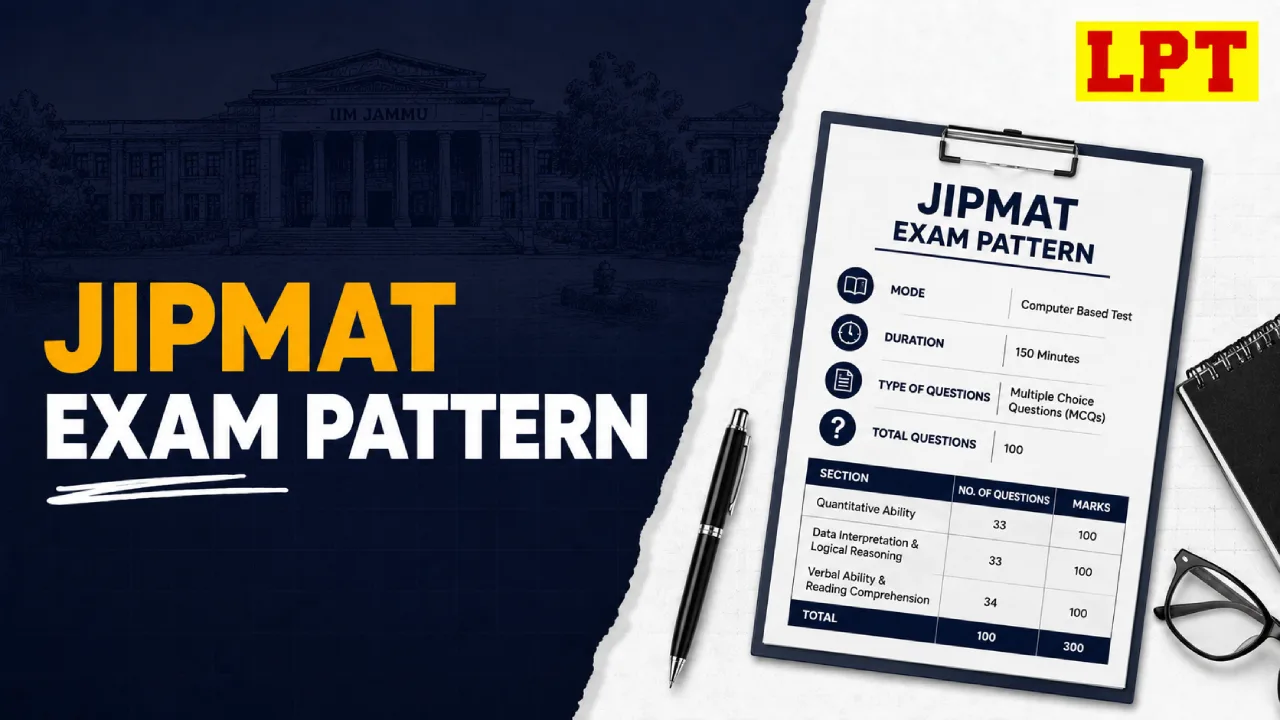
The latest JIPMAT exam pattern 2027 comprises a total of 100 questions in a MCQ format. The exam follows a computer-based format and is conducted over a duration of 150 minutes (2 hours 30 minutes) for admission into the Integrated Programme in Management at IIM Jammu and IIM Bodh Gaya. The exam paper includes 100 multiple-choice questions (MCQs) carrying a total of 400 marks.
As per the JIPMAT 2027 exam format, the test is divided into three sections; Quantitative Aptitude, Data Interpretation & Logical Reasoning, and Verbal Ability & Reading Comprehension. Each correct answer is awarded +4 marks, while each incorrect response results in a -1 mark deduction. With no sectional time limits, candidates have the flexibility to manage their time across all three areas according to their preparation strategy.
Table Of Contents
- CLAT PG: All About CLAT Postgraduate Exam for LLM
JIPMAT Exam Pattern 2027: Overview
JIPMAT 2027 is tentatively scheduled for the first week of June 2027. Candidates should note key conduct details, such as the exam mode, medium, timing, date, and official website.
The table below presents the essentials of the JIPMAT 2027 exam pattern in a clear, direct format.
| Category of JIPMAT 2027 Exam Pattern | Details of JIPMAT 2027 Exam |
|---|---|
| Exam Name | Joint Integrated Programme in Management Admission Test – JIPMAT 2027 |
| Conducting Body | National Testing Agency (NTA) |
| Mode of Exam | Computer-Based Test (CBT) |
| Medium of Question Paper | English |
| Pattern of Exam | Multiple Choice Questions (MCQs) |
| Duration of Examination | 150 minutes (2 hours 30 minutes) |
| Timing | 03:00 PM to 05:30 PM |
| Date of Examination | June 2027 |
| Sections of JIPMAT Exam | Quantitative Aptitude, Data Interpretation & Logical Reasoning, Verbal Ability & Reading Comprehension |
| Total Questions | 100 |
| Total Marks | 400 |
| Marking Scheme | +4 marks for each correct answer; -1 mark for each incorrect answer |
| Official Websites | exams.nta.nic.in/jipmat / nta.ac.in |
Read Detailed JIPMAT Exam Analysis
JIPMAT Question Paper Pattern 2027: Section-Wise Breakdown
The JIPMAT 2027 exam pattern is designed to test candidates across three core areas, with each section carrying 33 to 34 questions. A balanced distribution ensures that quantitative, logical, and verbal abilities are assessed in a structured way. While the marking scheme remains uniform across sections, variation in the number of questions leads to a slight difference in total marks.
The table below presents a clear section-wise view of the question type, marking, and total marks distribution.
| Particulars | Quantitative Aptitude | Data Interpretation & Logical Reasoning | Verbal Ability & Reading Comprehension |
|---|---|---|---|
| Type of Questions | MCQ | MCQ | MCQ |
| Number of Questions | 33 | 33 | 34 |
| Marks per Question | +4 | +4 | +4 |
| Negative Marking | -1 | -1 | -1 |
| Total Marks | 132 | 132 | 136 |
Check out the JIPMAT 2026 Question paper
JIPMAT Marking Scheme 2027
The JIPMAT Marking Scheme 2027 sets the rules for how your answers are scored across all sections of the exam. Each question carries a fixed value of 4 marks, but incorrect attempts result in a penalty of 1 mark, which directly affects your total score. Since all 100 questions follow the same scoring rule, your final result depends on how accurately you attempt the paper rather than how many questions you attempt.
Unattempted questions do not reduce your score, giving you the option to skip uncertain questions. Final marks are calculated based on the revised answer key released by the National Testing Agency after the challenge process.
The table below summarises the key rules for calculating scores in the examination.
| Criteria for JIPMAT Marking Scheme | Details of the Marking Scheme |
|---|---|
| Marks for Correct Answer | +4 per question |
| Negative Marking | -1 for each incorrect answer |
| Marks for Unattempted Questions | 0 (no penalty) |
| Total Questions | 100 |
| JIPMAT Total Marks | 400 |
| Answer Selection | One option must be selected per question |
| Final Evaluation | Based on the revised answer key by the National Testing Agency |
Must Check JIPMAT Answer Key
Section-Wise JIPMAT Exam Pattern Analysis
The JIPMAT 2027 exam pattern is divided into three sections, each testing a different skill area. Understanding the section-wise structure helps you focus on important topics, manage time better, and plan your attempts with clarity.
Section 1: Quantitative Aptitude
Quantitative Aptitude in JIPMAT 2027 assesses understanding of basic mathematical concepts, primarily at the Class 10 level. It is a scoring section for candidates with clear fundamentals and the ability to maintain accuracy under time pressure.
| Parameters for Quantitative Aptitude in JIPMAT 2027 | Details of Quantitative Aptitude in JIPMAT 2027 |
|---|---|
| Section Overview | Quantitative Aptitude evaluates Class 10-level mathematics. Strong fundamentals and accuracy under time pressure make it a scoring section. |
| Key Areas | Arithmetic, Algebra, Geometry & Mensuration, Number System, Modern Mathematics |
| Topic Weightage | Arithmetic carries the highest share, followed by Geometry and Algebra. Number System and Modern Mathematics have comparatively fewer questions. |
| Difficulty Level | Moderate |
| Good Attempt Range | 20 to 22 questions with high accuracy |
Explore the JIPMAT Registration Process
Section 2: Data Interpretation & Logical Reasoning
Data Interpretation & Logical Reasoning in JIPMAT 2027 focuses on analytical thinking and problem‑solving ability. It is generally the most time‑consuming section, as candidates must interpret data sets and solve logical patterns efficiently under time pressure.
| Parameters for Data Interpretation & Logical Reasoning | Details of Data Interpretation & Logical Reasoning in JIPMAT 2027 |
|---|---|
| Section Overview | Data Interpretation & Logical Reasoning evaluates analytical thinking and problem‑solving skills. It requires efficiency in handling data sets and logical structures. |
| Key Areas | Data Interpretation sets, Arrangements, Puzzles, Blood Relations, Syllogisms, Coding‑Decoding, Series |
| Topic Weightage | Balanced distribution between Data Interpretation and Logical Reasoning |
| Difficulty Level | Moderate with time pressure |
| Strategy | Solve manageable data sets first, avoid spending excessive time on complex puzzles |
| Good Attempt Range | 18 to 20 questions |
Section 3: Verbal Ability & Reading Comprehension
Verbal Ability & Reading Comprehension in JIPMAT 2027 carries the highest weightage. The section evaluates reading, understanding, and language skills. Consistent practice improves both speed and accuracy, making it a decisive part of the exam.
| Parameters of Verbal Ability & Reading Comprehension | Details of Verbal Ability & Reading ComprehensionIn JIPMAT 2027 |
|---|---|
| Section Overview | Verbal Ability & Reading Comprehension tests reading, interpretation, grammar, vocabulary, and verbal logic. It has the highest weightage in JIPMAT 2027. |
| Key Areas | Reading Comprehension, Grammar, Vocabulary, Verbal Logic |
| Topic Weightage | Reading Comprehension contributes the maximum number of questions, followed by Vocabulary and Grammar. |
| Difficulty Level | Moderate, with focus on interpretation |
| Strategy | Concentrate on understanding passages, practice inference‑based questions regularly, and strengthen vocabulary through consistent reading. |
| Good Attempt Range | 24 to 26 questions |
Key important resources for JIPMAT exam:
| JIPMAT Eligibility | JIPMAT Admit Card |
| JIPMAT Selection Process | JIPMAT Result |
| JIPMAT Subjects |
JIPMAT Exam Format: Time Management Strategy
The JIPMAT Exam Pattern 2027 does not include sectional timers, which makes effective time allocation critical. A planned time split across sections helps candidates balance accuracy, maximise attempts, and reserve time for review before submission.
| Time Slot for JIPMAT Exam 2027 | Section | Questions to Attempt |
|---|---|---|
| To be updated | Quantitative Aptitude (QA) | 22 to 25 |
| To be updated | Data Interpretation & Logical Reasoning (DILR) | 18 to 22 |
| To be updated | Verbal Ability & Reading Comprehension (VARC) | 24 to 28 |
| To be updated | Review and Mark | 0 to 2 |
A total attempt range of around 65 to 75 questions is generally considered competitive, provided you maintain strong accuracy.
Know the JIPMAT Exam Date
3-Round Time Management Strategy for JIPMAT 2027
The JIPMAT Exam Pattern 2027 can be tackled effectively with a three-round approach. A structured strategy ensures systematic coverage of easy, medium, and difficult questions while leaving time for review.
| 3-Round Strategy for JIPMAT 2027 | Time Allocation | Focus of 3-Round Strategy | Target Outcome |
|---|---|---|---|
| Round 1 | First 90 Minutes | Attempt all easy questions across sections | Secure quick marks |
| Round 2 | Next 45 Minutes | Solve medium‑difficulty questions with careful calculation | Balanced scoring with accuracy |
| Round 3 | Last 15 Minutes | Review marked questions and attempt a few difficult ones if time allows | Error check and 2 to 4 extra attempts |
More important resources for IPMAT exam:
| IPMAT Registration | IPMAT Indore Registration |
| IPMAT Rohtak Registration | IPMAT Cut Off |
| IPMAT Rohtak Cut Off | IPMAT Indore Cut Off |
| IPMAT Indore Seats | IPMAT Indore Colleges |
JIPMAT Exam Pattern: Difficulty Level & Cutoff Trends
JIPMAT paper pattern 2027 has generally ranged from easy to moderate difficulty across years, with certain shifts in toughness depending on the section. JIPMAT Cut off trends show that competitive attempts and raw scores vary annually, influenced by exam difficulty and candidate performance.
| Year | Overall Difficulty | Good Attempts | 99 Percentile Score |
|---|---|---|---|
| 2021 | Moderate | 65–70 | 240+ |
| 2022 | Moderate‑Difficult | 60–65 | 220+ |
| 2023 | Moderate | 68–72 | 250+ |
| 2024 | Moderate | 70–75 | 265+ |
| 2025 | Moderate‑Difficult | 65–70 | 255+ |
| 2026 | Moderate | 75 to 88 | 255+ |
Practice with JIPMAT Previous Year Papers
Changes in JIPMAT Exam Pattern 2027: What’s New?
The JIPMAT Exam Pattern 2027 remains unchanged compared to previous years (2021–2026). The National Testing Agency (NTA) has not introduced any structural modifications, ensuring continuity in the exam format.
Start your practice now with Best IPMAT Mock Tests:
| IPMAT Quant Mock Test | IPMAT Logical Reasoning Mock Test |
| IPMAT Rohtak Mock Test | IPMAT Indore Mock Test |
| IPMAT VARC Mock Test | Free IPMAT Mock Test PDF |
Final 30-Day Plan Based on JIPMAT Exam Pattern 2027
For JIPMAT 2027 preparation, the last 30 days should be structured to balance JIPMAT syllabus completion, mock practice, targeted analysis, and light revision.
Following the JIPMAT Exam Pattern 2027, this plan ensures candidates enter the exam with confidence and accuracy.
| Time Period for JIPMAT Exam | Focus Area | What You Should Do in The Time Period |
|---|---|---|
| Days 1 to 10 | Concept Strengthening | Revise core topics in Quantitative Aptitude, Data Interpretation, Logical Reasoning, and Verbal Ability; focus on weak areas |
| Days 11 to 20 | Practice and Mock Tests | Attempt 1 mock test daily or on alternate days; analyse mistakes and improve time management |
| Days 21 to 25 | Intensive Revision | Revise formulas, concepts, and frequently asked question types; focus on accuracy |
| Days 26 to 30 | Final Revision and Strategy | Attempt 2 to 3 full-length mocks, review errors, and refine your exam strategy |
The JIPMAT Exam Pattern 2027 remains unchanged, with a 150‑minute computer‑based test carrying 100 MCQs for 400 marks across three sections; Quantitative Aptitude, Data Interpretation & Logical Reasoning, and Verbal Ability & Reading Comprehension. With no sectional time limits and negative marking, success depends on accuracy, speed, and balanced attempts. A clear understanding of the pattern helps aspirants plan effectively, focus on fundamentals, and maximise scores through consistent practice and JIPMAT mock tests.
FAQs On JIPMAT Exam Pattern

Nidhi Priya
Nidhi Priya has over 6 years of experience in EdTech content and SEO. She specializes in content strategy, organic growth, and mentoring editorial teams, with previous experience at iQuanta, CollegeDekho, and Careers360.
Also Read : Online IPMAT Coaching , IPMAT Mock Tests , IPMAT Study Material
JIPMAT Trending Blogs
- All about JIPMAT 2027 Exam: Registration, Eligibility, Syllabus
- JIPMAT Sample Papers 2027 – Download Free PDF Now
- JIPMAT Eligibility Criteria 2027 Age Limit, Marks and Qualification
- JIPMAT Admit Card 2027: Check Dates, Direct Link, Exam Centres, Documents to Carry
- JIPMAT Result 2026 (Out): Direct Link to Check Score & Rank
- JIPMAT Previous Year Papers (PYQs PDF) with Solutions
Other Related Blogs