
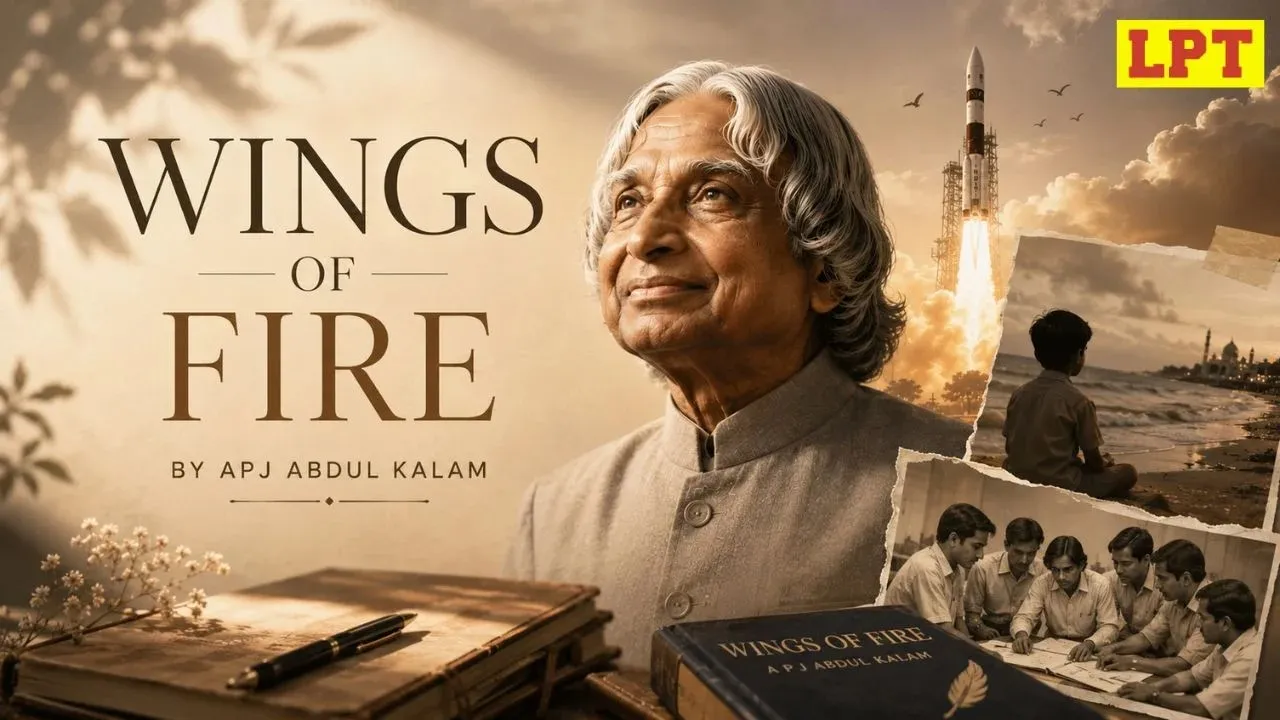
Wings of Fire is the inspiring autobiography of A. P. J. Abdul Kalam that tells the story of his journey from a small town in Rameswaram to becoming one of India’s most respected scientists and the President of India. The autobiography mainly revolves around Kalam himself, along with important people like his parents, teachers, mentors, and scientific colleagues who shaped his thinking and career.
The central idea of the Wings of Fire book is that hard work, discipline, education, dreams, and perseverance can help ordinary people achieve extraordinary success. Major themes in the Abdul Kalam autobiography include ambition, leadership, patriotism, teamwork, innovation, simplicity, and learning from failures.
Below, we have covered the summary of Wings of Fire novel, chapter-wise summary, themes, central idea, important characters, literary devices, important quotes, moral message, and why students should read this autobiography.
Wings of Fire by APJ Abdul Kalam: Key Details
These are the most important things to know about Wings of Fire novel by APJ Abdul Kalam:
| Detail | Information |
|---|---|
| Book Name | Wings of Fire |
| Author | A. P. J. Abdul Kalam |
| Co-Author | Arun Tiwari |
| Genre | Autobiography |
| First Published | 1999 |
| Major Themes | Hard Work, Dreams, Leadership, Discipline, Innovation, Patriotism |
| Central Idea | Determination, education, and perseverance can help anyone achieve success |
| Setting | Rameswaram, ISRO, DRDO, and different parts of India |
| Writing Style | Simple, motivational, reflective, and inspiring |
| Key Lesson | Dreams and consistent hard work can transform life completely |
Explore The Complete Summaries of Novels, Stories & Essay Notes
Wings of Fire Summary
This is the summary of Wings of Fire by APJ Abdul Kalam:
Beginning
Wings of Fire begins with A. P. J. Abdul Kalam describing his childhood in the small town of Rameswaram in Tamil Nadu. He belonged to a humble family where his father, Jainulabdeen, was known for simplicity, wisdom, and discipline. Despite financial limitations, Kalam’s parents ensured that he received education and strong moral values.
As a child, Kalam was curious, hardworking, and deeply interested in learning. His teachers played an important role in shaping his interest in science and encouraging him to dream big. The beginning of the autobiography mainly focuses on Kalam’s family background, school life, early struggles, and the gradual development of his ambition to become a scientist.
Middle
The middle section of the autobiography focuses on Kalam’s educational journey and scientific career. After studying aerospace engineering, he started working in defense and space research organizations. Kalam faced many failures and challenges during the early stages of his career, but he remained committed to learning and improving.
He later joined ISRO, where he worked on important satellite launch vehicle projects under the guidance of scientists like Vikram Sarabhai and Satish Dhawan. The autobiography of APJ Abdul Kalam explains how teamwork, discipline, leadership, and innovation helped India make progress in science and technology.
Kalam also discusses the emotional pressure, setbacks, and responsibilities involved in major scientific missions. Despite failures in some projects, he learned valuable lessons about patience, resilience, and leadership.
Ending
Towards the end of Wings of Fire, Kalam reflects on his achievements, experiences, and life lessons. He describes India’s successful missile development programs and the pride he felt in contributing to the nation’s progress.
However, the autobiography does not focus only on success. Kalam repeatedly emphasizes humility, continuous learning, discipline, and dedication towards national service. He explains that failures should never stop people from pursuing their goals because every setback provides an opportunity to learn and improve.
The ending of the autobiography inspires readers to dream big, work consistently, and remain grounded despite achievements.
Short Summary of Wings of Fire by APJ Abdul Kalam
Wings of Fire is the autobiography of APJ Abdul Kalam that tells the inspiring story of his journey from a small town in Rameswaram to becoming one of India’s greatest scientists and the President of India. The book covers his childhood, education, struggles, scientific career, missile projects, leadership experiences, and personal values.
Kalam explains how hard work, discipline, teamwork, and determination helped him overcome challenges and achieve success. The autobiography mainly teaches lessons about dreaming big, learning from failures, staying humble, and dedicating oneself towards personal growth and national service.
Download Wings of Fire Summary PDF
Get the complete summary PDF of Wings of Fire by A.P.J. Abdul Kalam.
Main Characters in Wings of Fire by Abdul Kalam
Wings of Fire, autobiography of APJ Abdul Kalam, features these characters:
A.P.J. Abdul Kalam
A. P. J. Abdul Kalam is the central character and narrator of the autobiography. He is hardworking, disciplined, humble, curious, and deeply dedicated to science and national service. Through his journey, readers see his struggles, failures, achievements, and leadership growth. He symbolizes determination, ambition, simplicity, perseverance, and lifelong learning.
Jainulabdeen
Jainulabdeen, Kalam’s father, was wise, disciplined, spiritual, and simple in lifestyle. Despite limited financial resources, he taught Kalam important values like honesty, humility, patience, and self-control. He symbolizes moral strength, simplicity, and the importance of strong family values in shaping a child’s personality.
Ashiamma
Ashiamma, Kalam’s mother, was caring, generous, and emotionally supportive. She ensured that Kalam and his family were raised with love, compassion, and discipline despite hardships. Her character symbolizes unconditional support, emotional warmth, sacrifice, and the nurturing role of mothers in personal growth and success.
Vikram Sarabhai
Vikram Sarabhai was one of the most influential mentors in Kalam’s scientific career. He encouraged innovation, teamwork, and independent thinking among young scientists. Sarabhai symbolizes visionary leadership, scientific progress, mentorship, and India’s ambition to become technologically advanced.
Satish Dhawan
Satish Dhawan played an important role in shaping Kalam’s understanding of leadership and teamwork. He supported his team during failures and shared success collectively. Dhawan symbolizes calm leadership, responsibility, emotional intelligence, and trust in team members.
Kalam’s Teachers
Kalam’s school teachers inspired him to pursue education, science, and ambitious goals despite his modest background. Their encouragement built his confidence and curiosity. They symbolize the powerful influence teachers can have in shaping students’ dreams, thinking ability, and future direction in life.
Read Short Story Summaries
Read concise and student-friendly summaries of famous short stories along with themes, moral lessons, literary devices, and important questions:
| A Cup of Tea by Katherine Mansfield | Upper Division Love by Manohar Malgonkar |
| The Night The Ghost In by James Thurber | Dr. Heideggers Experiment by Nathaniel Hawthorn |
Wings of Fire: Themes
- Hard Work and Perseverance: The autobiography strongly emphasizes that dedication, patience, and continuous effort are necessary for achieving success despite difficulties and failures.
- Dreams and Ambition: Kalam repeatedly encourages readers to dream big and work consistently towards their goals regardless of background or limitations.
- Discipline and Simplicity: The book highlights how simple living, self-control, discipline, and focus helped Kalam achieve extraordinary success in life.
- Science and Innovation: Scientific thinking, creativity, and technological development play a major role throughout Kalam’s journey as a scientist and leader.
- Leadership and Teamwork: The autobiography explains how trust, teamwork, and supportive leadership are essential for success in large projects and organizations.
- Patriotism and Service to Nation: Kalam’s dedication towards India’s scientific and defense development reflects strong patriotism and commitment towards national progress.
- Learning from Failures: The book teaches that failures are valuable learning experiences that help people improve and become stronger mentally and professionally.
- Importance of Teachers and Mentors: Kalam repeatedly acknowledges the role of teachers, mentors, and senior scientists in guiding his growth and career journey.
Wings of Fire: Central Idea
The central idea of Wings of Fire by APJ Abdul Kalam is that determination, education, discipline, and hard work can help ordinary people achieve extraordinary success. Through his life journey, A.P.J. Abdul Kalam shows that failures should never stop individuals from pursuing their dreams. The autobiography also emphasizes the importance of humility, teamwork, leadership, continuous learning, and dedication towards serving society and the nation.
Explore the Best Novels for IPMAT Preparation
Wings of Fire Literary Devices
These are the literary devices used in Wings of Fire book:
| Literary Device | Usage in the Autobiography |
|---|---|
| First-Person Narration | Kalam narrates his own life experiences directly, making the autobiography personal, realistic, and inspiring. |
| Anecdotes | Real-life incidents and experiences are used to explain lessons about leadership, discipline, and perseverance. |
| Imagery | Simple descriptions of places, people, laboratories, and experiences help readers visualize situations clearly. |
| Symbolism | “Wings of Fire” symbolizes dreams, ambition, growth, and the power of determination to achieve success. |
| Reflective Tone | Kalam often reflects on his failures, achievements, mentors, and life lessons thoughtfully and honestly. |
| Inspirational Language | The autobiography frequently uses motivational and encouraging language to inspire readers towards hard work and ambition. |
| Realism | Kalam honestly discusses struggles, failures, pressure, and challenges instead of showing only achievements and success. |
Why Should You Read Wings of Fire?
- Inspires Students to Dream Big: The autobiography motivates readers to believe that even ordinary people can achieve extraordinary success through dedication and effort.
- Teaches Discipline and Hard Work: Kalam’s journey shows how consistency, discipline, and focus help overcome failures and achieve long-term goals successfully.
- Develops Leadership Understanding: The book explains teamwork, responsibility, innovation, and leadership qualities through real experiences from scientific projects and missions.
- Improves Motivation During Difficult Times: Kalam’s struggles and failures inspire students to stay positive, patient, and determined even during challenging phases of life.
- Helpful for Personality Development: The autobiography improves communication, thinking ability, emotional maturity, and understanding of values like humility and national service.
Famous Quotes from Wings of Fire by APJ Abdul Kalam
“Dream is not that which you see while sleeping, it is something that does not let you sleep.”
“If you want to shine like a sun, first burn like a sun.”
“Small aim is a crime; have great aim.”
“Failure will never overtake me if my determination to succeed is strong enough.”
“Excellence is a continuous process and not an accident.”
“Confidence and hard work are the best medicine to kill the disease called failure.”
“Great dreams of great dreamers are always transcended.”
“Man needs difficulties because they are necessary to enjoy success.”
“We should not give up and we should not allow the problem to defeat us.”
“Thinking should become your capital asset, no matter whatever ups and downs you come across in your life.”
Moral Message of Wings of Fire
Wings of Fire teaches that hard work, discipline, determination, and continuous learning can help anyone achieve success regardless of background or limitations. The autobiography also highlights the importance of humility, teamwork, leadership, and staying committed to one’s dreams despite failures and challenges in life.
FAQs About Wings of Fire
Wings of Fire is the autobiography of A. P. J. Abdul Kalam that describes his journey from a small town boy in Rameswaram to becoming India’s Missile Man and President. The book covers his childhood, education, struggles, scientific achievements, leadership experiences, and life lessons.
The autobiography was written by A. P. J. Abdul Kalam along with co-author Arun Tiwari.
Kalam repeatedly explains how teachers inspired his curiosity, confidence, and interest in science. Their guidance played a major role in shaping his ambitions and career direction.
Students can learn discipline, perseverance, leadership, teamwork, humility, time management, and the importance of staying committed to goals despite failures.
Yes, the autobiography uses simple and motivational language, making it beginner-friendly and suitable for students and young readers.
Kalam is called the Missile Man of India because of his major contributions to India’s missile development and defense research programs.
Yes, Wings of Fire is a true autobiographical account of A.P.J. Abdul Kalam’s life experiences, struggles, achievements, and contributions to India.
Explore Other Exam Preparation Resources
Prepare smarter with our dedicated coaching programs, preparation guides, mock tests, and study resources for top competitive exams in India.