Talk to a Counsellor
IPM/BBA:
Talk to a Counsellor
IPM/BBA:  Support
AIR 3 IPMAT Indore Topper - Vidushi Shandilya from LPT
Last Updated on 31 Jul 2026

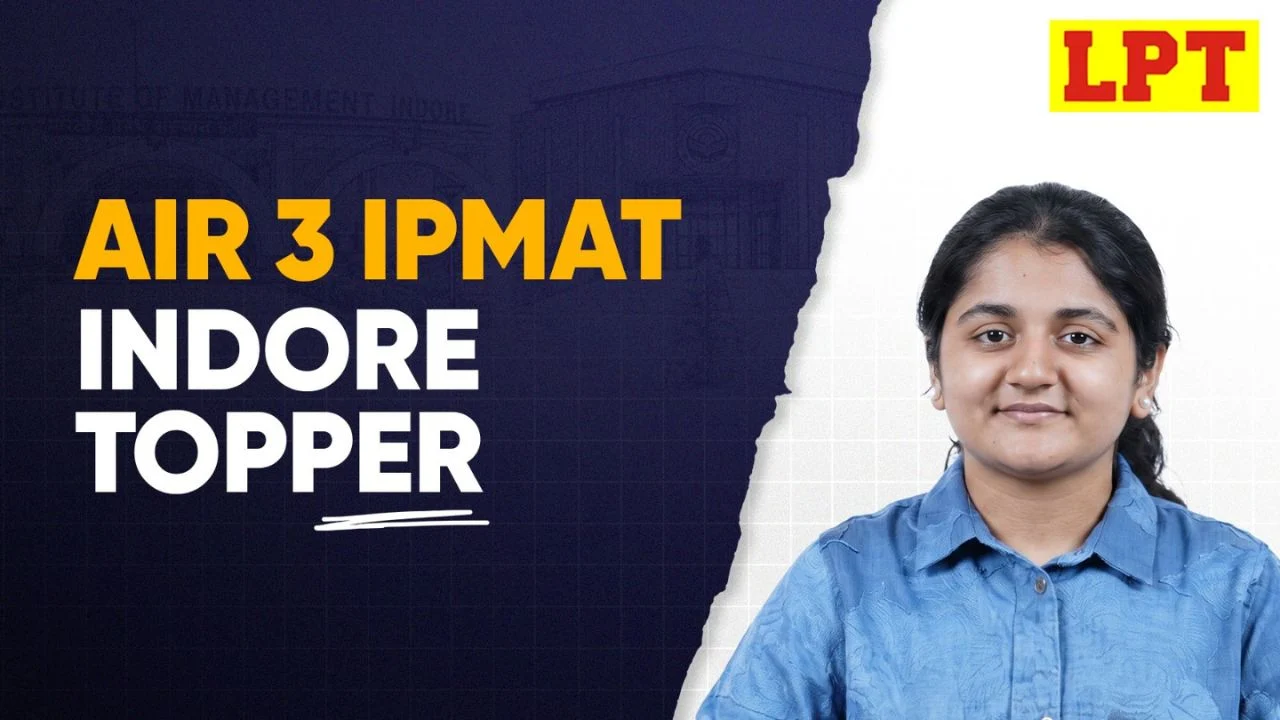
Vidushi Shandilya from LPT secured AIR 3 in IPMAT Indore 2026. She proved that the right mindset and consistent effort matter more than following a conventional path.
From preparing for JEE to choosing IPMAT and securing admission to India's top IPM institute, IIM Indore, her journey is both inspiring and relatable.
In this exclusive conversation with LPT Edtech, Vidushi opens up about the decision to switch careers, preparing for IPMAT through self-study, balancing school with exam preparation, tackling mock tests, and acing the personal interview. She also shares practical strategies for maths and non-maths students, explains why academics and extracurricular activities matter, and talks about the emotional side of preparation that many aspirants often overlook.
If you're preparing for IPMAT, her honest experiences and actionable tips can help you approach the exam with greater clarity, confidence, and purpose.
Table Of Contents
Vidushi Shandilya: AIR 3, IPMAT Indore 2026 Topper
| Highlight | Details |
|
Name |
Vidushi Shandilya |
|
Achievement |
AIR 3, IPMAT Indore 2026 |
|
Institute Joined |
IIM Indore |
|
Background |
JEE to IPMAT |
|
Preparation |
Self-study + Mocks + Right Study Material |
|
Mock PIs |
20+ |
|
Key Advice |
Stay consistent, be honest and keep moving |
IPMAT Topper Interview 2026: Vidushi Shandilya, AIR 3202
Here is the detailed IMPAT topper strategy along with the preparation journey.
LPT: Welcome to another exclusive IPMAT success story!
Today, we're joined by someone whose journey is as inspiring as her achievement. From preparing for JEE to making a bold switch to IPMAT and securing AIR 3 in IPMAT Indore 2026, Vidushi Shandilya has shown what determination and smart preparation can achieve.
In this conversation, she shares her preparation strategy, mock test approach, interview experience, time management tips, and the lessons she learned throughout her journey. If you're preparing for IPMAT, you're sure to take away valuable insights from her experience.
Let's get started!
Vidushi: Thank you so much. I'm really happy to be here. It's a pleasure to share my experience, and I hope it helps every student preparing for IPMAT.
Journey from JEE to IPMAT: Decision That Changed Vidushi's Career Forever
LPT: Before we discuss your preparation strategy and success in IPMAT, I want to talk about your journey. Many people don't know that you initially prepared for engineering but later switched to IPMAT. What's even more interesting is that you kept this a secret from your family for quite some time. Tell us about that journey.
Vidushi: I was originally a JEE aspirant. After Class 10, I wasn't very aware of the career options available. In India, most students are encouraged to prepare for exams like JEE, NEET, or CET. Many parents are still unaware of alternatives like CLAT or IPMAT.
Without exploring much, I followed the usual path and started preparing for JEE in Class 11. After about a year of preparation, I got a glimpse of what my future as an engineering student would look like. Honestly, I didn't enjoy it. It didn't match my interests or personality, and I felt I wouldn't be able to give my best in that field.
That's when I started looking for other options. I researched extensively and eventually discovered IPMAT.
Since it was still a relatively new exam and I wasn't sure how my parents would react, I decided to prepare for it on my own. I studied independently and also prepared for other exams, including IIM Bangalore's UGAT.
When I received a call from IIM Bangalore, I finally shared everything with my parents. Seeing my performance gave them confidence that I had made this decision after careful thought. If I had simply told them that I wanted to quit JEE for a new and unfamiliar exam, they might have felt it was an impulsive decision.
At that time, not many people knew about IPMAT, so it definitely felt like a risky move. But once my parents saw my scores, my dedication, and my genuine interest, they understood my decision and appreciated the effort I had put in on my own.
So yes, you could say it remained a little secret until I had something concrete to show them.
Why She Chose IPMAT Over Engineering and Never Looked Back
LPT: That's amazing. My next question is — why IPMAT?
You were preparing for engineering, and IPMAT is a completely different field. They're almost like two opposite worlds. What attracted you towards management?
Vidushi: Honestly, my original plan was always to pursue B.Tech followed by an MBA, which is quite common among middle-class Indian families. I always knew I wanted to move into management eventually, but I wasn't aware that there was another pathway.
For me, B.Tech followed by CAT and then an MBA seemed like the only option.
Once I discovered IPMAT, everything changed. I realized engineering wasn't something I genuinely wanted to pursue for the next four or five years. After that, preparing for CAT and then an MBA would make the journey even longer.
Since I already knew I was interested in management, I thought, why not study it right from the undergraduate level? Getting the opportunity to learn management at an IIM itself was a huge advantage. After all, an IIM carries immense prestige and offers excellent exposure.
That's when I decided to switch.
Although JEE and IPMAT are very different exams, I believe they complement each other in certain ways. The mathematics I studied for JEE helped me significantly in IPMAT. At the same time, I worked hard to improve my English as well.
I feel IPMAT is an exam where students from any stream can succeed. If you're disciplined, determined, and willing to put in consistent effort, your background doesn't become a limitation.
More helpful resources for the IPMAT Indore exam:
| IPMAT Indore Marking Scheme | IPMAT Indore Selection Process |
| IPMAT Indore Registration | IPMAT Indore Exam Pattern |
Your Academic Background Doesn't Decide Your Rank; Rather, Your Strategy Does
LPT: That's a great point. Since you secured AIR 3, I'm sure many students must have said that it was easier for you because you came from a JEE background and were already strong in mathematics.
What would you like to say to students who come from non-maths backgrounds? Can you give them a reality check?
Vidushi: Absolutely.
First of all, I wasn't born good at mathematics. I became better because I worked hard for it. My JEE preparation didn't magically make maths easy for me. The effort I put into JEE later helped me perform well in IPMAT.
For students from non-maths backgrounds, I'd like to say this — don't get intimidated by the exam.
IPMAT is not like your board exams, where you need 100 out of 100. For example, I personally scored 249 out of 360.
Even if you're aiming for a safe score in the General category, somewhere between 220 and 240 marks is often considered competitive. That's roughly around 66%, which is absolutely achievable.
Even if you're a non-maths student and decide to leave around 40% of the maths questions, you can still secure a single-digit rank.
So please don't get discouraged or fear the mathematics section.
Every IPMAT paper has three types of questions: easy, moderate, and difficult. The key is to learn how to identify them quickly and skip the difficult ones without hesitation. That skill is just as important as solving questions.
Whenever you attempt a IPMAT mock test or the actual exam, your first priority should be to solve all the easy questions. This applies to both maths and non-maths students. Those questions alone can help you comfortably clear the IPMAT cutoff.
Once you're done with the easy ones, move on to the moderate-level questions. Try to solve as many of them as possible to improve your score and build a safe margin.
If there are certain topics that you find extremely difficult or feel require a lot of effort with very little return, don't stress about mastering every single one. Instead, focus more on high-weightage topics that can fetch you better marks.
At the same time, make sure you're highly accurate in the topics you do prepare. Accuracy matters more than trying to complete the entire syllabus.
I believe the ability to select the right questions and reject the wrong ones plays a huge role in IPMAT. That strategy works regardless of whether you're from a maths or a non-maths background. Along the way, you'll also discover your strengths and weaknesses, which helps you improve further.
A Good IPMAT Score Isn't Enough, Here's What IIMs Really Evaluate?
LPT: That's a great strategy.
Many students later realise that IIMs don't just evaluate your entrance exam score. Your academics, profile, and extracurricular activities also play an important role.
Vidushi, could you share your thoughts on extracurricular activities and how much they matter?
Vidushi: Definitely. IIMs appreciate students who have a well-rounded profile.
The reality is quite simple. If you have strong academics and meaningful extracurricular activities, they create a positive first impression.
Many students believe that professors judge them only during the interview. But before you even enter the interview room, they've already gone through your SOP and resume. By then, they've already formed an initial impression about you.
If your academic scores are consistently low, professors may naturally wonder whether you're someone who works hard or maintains consistency. They might also question whether you'll be able to cope with the rigorous curriculum at IIM Indore.
Getting into the institute is only one part of the journey. Surviving and performing well there is equally important.
That's why I always recommend maintaining strong academics. Regardless of your board or background, aiming for 90% or above is a good benchmark. Of course, the higher your score, the better.
Strong academics also help during the personal interview because you're more confident while answering subject-related questions and leave a better impression.
When it comes to extracurricular activities, I would especially encourage students in Classes 9 and 10 to explore their interests. Pursue hobbies, earn relevant certifications, participate in internships whenever possible, and gain meaningful experiences.
All these activities strengthen your profile and give interviewers interesting topics to discuss.
For example, I play chess and the piano. I also enjoy reading books. During my interview, the panel asked several questions related to these interests, and since they were genuinely part of my life, I was comfortable answering them.
On the other hand, if you don't have extracurricular activities, interviewers may ask you almost anything under the sun. They may shift towards random current affairs, general knowledge, or ask more challenging academic questions because they don't have much else to discuss with you.
Apart from helping in interviews, extracurricular activities also contribute to your overall personality development.
I strongly believe that participating in school events, taking up leadership roles, and interacting with different people played a major role in building my confidence. Those experiences ultimately helped me during my personal interviews.
So yes, extracurricular activities are definitely a worthwhile investment.
Even in Class 11, you should continue pursuing them as much as your schedule allows.
However, once you reach Class 12, your written IPMAT preparation and personal interview preparation should naturally become your top priority.
That said, don't think extracurricular activities are a make-or-break factor. Many students have successfully converted to IIM Indore with excellent IPMAT scores and strong interviews, even without an extensive extracurricular profile like mine.
So they aren't compulsory, but they certainly add value.
Your Hobbies Could Become Your Biggest PI Strength
LPT: That's a very balanced perspective.
You mentioned a few of your extracurricular activities earlier. Could you tell us more about them?
Vidushi: Sure.
I've participated in several nature clubs, environmental initiatives, and conferences at both the national and international levels.
In school, I also took part in fundraising activities and served as a House Captain, which gave me valuable leadership experience and positions of responsibility.
I've completed various certifications as well. Apart from that, I enjoy reading. I've read many classic books, and being able to discuss them thoughtfully during interviews is a valuable skill.
I create mandala art, which is another creative activity that became a positive talking point during my interview.
The point is, no student studies 24 hours a day. Everyone has hobbies or interests outside academics.
If you think about it carefully, you'll probably realise that you already have extracurricular activities. You simply need to recognise them, develop them further, and present them confidently during your interview.
Check the IPMAT previous year question papers:
| IPMAT Previous Year Papers | IPMAT Rohtak Previous Year Papers |
| IPMAT Indore Previous Year Papers |
How to Balance Board Exams and IPMAT Together?
LPT: One question every student has is how to balance school with IPMAT preparation. How did you manage both?
Vidushi: If you're in Class 11, consider it your golden period.
This is the best time to build your fundamentals and cover as much of the syllabus as possible. You also have comparatively more time to participate in extracurricular activities and strengthen your overall profile.
Once you enter Class 12, your schedule becomes much more hectic with pre-boards, boards, practicals, and viva examinations.
So, make the most of Class 11.
Whenever you have free time, use it wisely. There will be days when you have to study for long hours. There will also be moments when your friends are going out or enjoying their holidays while you're at home preparing.
Those are small sacrifices that can shape your future.
If you give your best during these two years, you'll have the opportunity to study at an excellent institution, and in the long run, those sacrifices will be worth it.
One thing I would strongly advise is not to create backlogs. Many students think, "I still have two years. I'll cover it later." But that's a mistake.
The syllabus eventually becomes overwhelming, and catching up gets difficult. That's why it's important to stay consistent from the beginning.
Even during busy periods like pre-board preparation, try to study for at least half an hour or one hour every day. The goal is to maintain momentum.
Class 12 Is Where Smart Preparation Beats Hard Preparation
LPT: What about students who are already in Class 12?
Vidushi: If you're in Class 12, your preparation should become much more focused.
By now, you've already covered a good portion of mathematics in school. Instead of passively revising concepts or solving only easy questions, start taking mock tests regularly.
Mathematics cannot be improved through passive learning. You need to solve questions actively.
Your preparation should have a surgical approach. Narrow down your weak areas, attempt mocks frequently, and analyse every test carefully.
Whenever you come across a concept you don't understand in a mock, learn that concept, solve a few related questions.
For English, improvement comes gradually through regular practice. Continue taking mocks, reading regularly, and analysing your mistakes. With every mock, you'll naturally become more comfortable with the section.
Start with free mocks by LPT:
| IPMAT Indore Mock test | IPMAT VARC Mock Test |
| IPMAT Logical Reasoning Mock Test | IPMAT Quant Mock Test |
Mock Interviews Became the Turning Point in Her Success Story
LPT: Another area where many students struggle is the Personal Interview (PI). How was your experience with PI preparation?
Vidushi: My first personal interview was for IIM Bangalore, and honestly, I underestimated the interview process.
Since I already had a lot of public speaking experience, I assumed I wouldn't need mock interviews. That turned out to be a mistake.
I was eventually waitlisted at IIM Bangalore, and looking back, I feel it happened for a good reason. My content preparation wasn't strong enough, and I hadn't given enough mock interviews to prepare myself properly.
I made sure not to repeat that mistake for IIM Indore and my other interviews.
I worked aggressively on my interview preparation and appeared for more than 20 mock interviews.
The first thing you need to prepare is your content.
Be well prepared with your academics, HR questions, current affairs, general knowledge, extracurricular activities, internships, and every detail mentioned in your profile.
Sometimes interviewers even ask riddles. That's why it's important to read previous interview transcripts and watch mock interview videos.
There are many excellent resources available online, including several useful videos on the
LPT YouTube channel.
The more interview styles and panel discussions you expose yourself to, the better prepared you'll be for different kinds of interviewers.
Apart from knowledge, interviews also test your composure. You need to stay calm, think clearly, and present yourself confidently.
If you don't know the answer to a question, admit it honestly. Don't try to bluff.
In my experience, honesty creates a much better impression than pretending to know everything.
Subscribe to the LPT YouTube Channel for free preparation videos
Why Accepting 'I Don't Know the Answer' Can Sometimes Impress the Interview Panel
LPT: Did anything like that happen during your own interviews when you were unsure of the answer?
Vidushi: Yes.
During my IIM Indore interview, one of the panellists asked me why 0 factorial is equal to 1.
At that moment, I didn't know the exact answer.
Instead of guessing, I honestly said, "I'm not aware of the correct answer, but I'd like to give it a try."
The panel appreciated my willingness to attempt the question.
I then tried deriving a mathematical explanation on the spot using a formula (n-1)!= n1/n. Although my approach wasn't mathematically rigorous, it showed my thought process and problem-solving ability.
The panel appreciated the effort because they could see that I was trying to reason through the problem instead of giving up.
That's something IIMs value. They appreciate curiosity, logical thinking, and the willingness to solve unfamiliar problems.
I had a similar experience during my IIM Rohtak interview.
The panel asked me about the Vishakha Case, and I wasn't familiar with it.
So I simply replied, "I'm not aware of it at the moment, but I'll definitely go home and read about it."
Being honest, humble, and willing to learn leaves a positive impression.
Learning how to handle such situations confidently is exactly why mock interviews are so important.
Most Underrated Aspect of IPMAT Preparation
LPT: What's one underrated aspect of IPMAT preparation that students often overlook?
Vidushi: I think it's learning how to manage yourself emotionally, especially after mock tests and during periods of uncertainty.
There will be days when your mock scores are low, and you'll start doubting yourself. You'll feel like the exam is impossible or that you're simply not good enough.
Then there will be days when you score really well, and you'll start believing your selection is guaranteed.
The truth is, neither situation defines your final IPMAT Result.
Mock tests are only a tool to measure your preparation. They're data points of your actual performance. So don't become emotionally attached to your scores, whether they're high or low.
Even during a mock test, if one section goes badly, for example, Quantitative Ability, don't let it affect your performance in the remaining sections.
Stay emotionally balanced and focus only on the next question.
Most importantly, don't give up before the actual exam.
Many students start thinking, "My scores are low," or "I'm not a confident speaker," and slowly lose motivation. Don't let those thoughts take over.
Keep showing up every single day. Keep putting in consistent effort and trust the process.
Eventually, everything starts coming together.
I also believe that practices like journaling and meditation can be very helpful, especially for students who tend to overthink. They help you stay calm, manage stress, and maintain the right mindset throughout your preparation.
Explore important resources for IPMAT exam:
| IPMAT Score V/S Percentile | IPMAT Seats |
| IPMAT Answer Key | IPMAT Exam Analysis |
IPMAT Toppers’ Message to Future Aspirants
LPT: Finally, if you had to sum up your entire IPMAT journey in one message, what advice would you give to future aspirants?
Vidushi: Don't be afraid of mock tests.
Take as many mocks as you can.
Don't get discouraged by mistakes. In fact, make all your mistakes during practice so that there's nothing left to go wrong on the actual exam day.
Every mock teaches you something valuable. Learn from it, improve, and move forward.
That's the best way to prepare for IPMAT.
LPT: Thank you so much, Vidushi. It was wonderful talking to you, and we're sure your journey and advice will inspire countless IPMAT aspirants.
We wish you all the very best for your journey ahead.
Vidushi: Thank you so much. It was a pleasure being here.

Nidhi Priya
Nidhi Priya has over 6 years of experience in EdTech content and SEO. She specializes in content strategy, organic growth, and mentoring editorial teams, with previous experience at iQuanta, CollegeDekho, and Careers360.
Also Read : Online IPMAT Coaching , IPMAT Mock Tests , IPMAT Study Material
IPMAT Indore Trending Blogs
- IPMAT Indore Exam 2027, Registration, Eligibility & Syllabus
- IPMAT Indore Exam Date 2027: Full Schedule & Result Date
- IPMAT Indore Eligibility Criteria 2027: Age Limit & Marks
- IPMAT Indore Sample Papers - Subject-wise Free PDF Links
- IPMAT Indore Result 2027: Dates, Direct Link & Cutoff
- IPMAT Indore Exam Pattern 2027, Section-Wise Paper Pattern
Other Related Blogs