
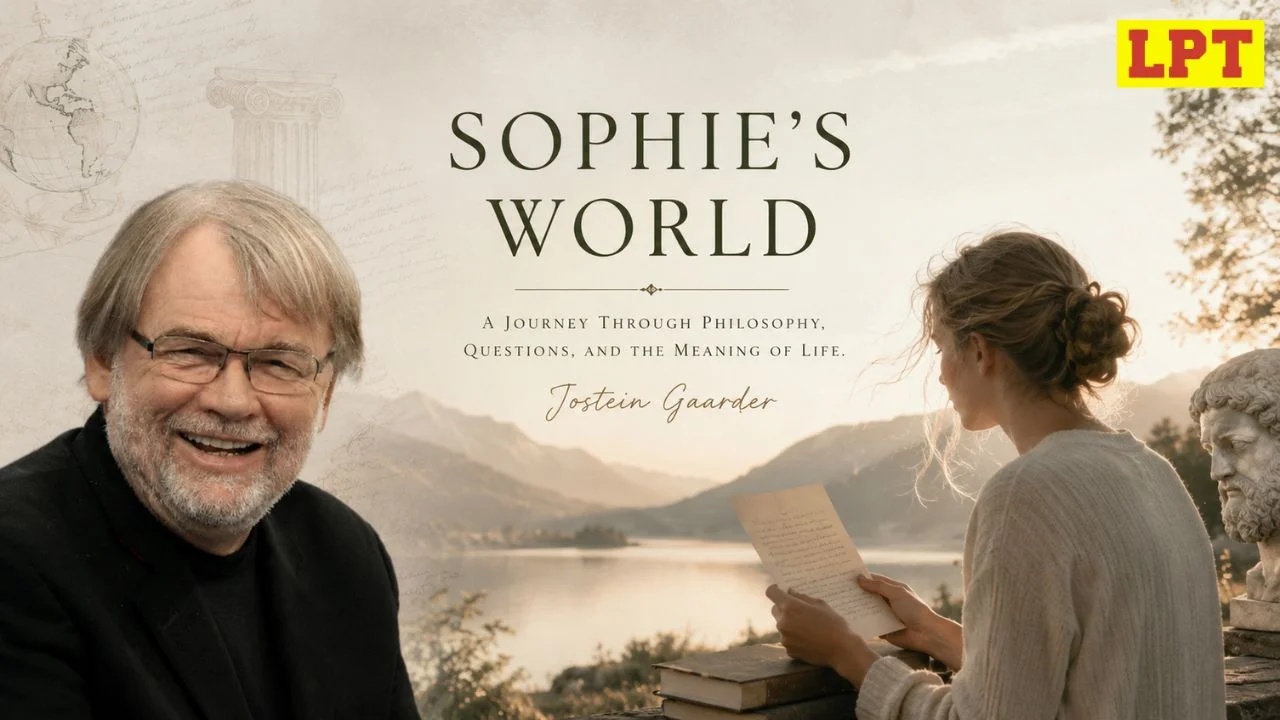
Sophie’s World by Jostein Gaarder is a philosophical fiction novel that combines storytelling with the history of philosophy in a simple and engaging way. The story mainly follows Sophie Amundsen, a teenage girl who starts receiving mysterious letters asking deep questions like “Who are you?” and “Where does the world come from?”
Through lessons from philosopher Alberto Knox, Sophie explores major philosophical ideas and thinkers from ancient Greece to modern philosophy. The central idea of the Sophie’s World novel is that curiosity, questioning, and independent thinking help people understand themselves, reality, and the world around them. Major themes include philosophy, self-awareness, identity, knowledge, imagination, existence, and the search for truth.
Below, we have covered the summary of Sophie’s World book, short summary, themes, central idea, important characters, literary devices, famous quotes, moral message, etc.
Explore The Complete Summaries of Novels, Stories & Essay Notes
Sophie’s World by Jostein Gaarder: Key Highlights
These are the key details about Sophie’s World book by Jostein Gaarder:
| Detail | Information |
|---|---|
| Book Name | Sophie’s World |
| Full Title | Sophie’s World: A Novel About the History of Philosophy |
| Author | Jostein Gaarder |
| Genre | Philosophical Fiction |
| First Published | 1991 |
| Main Character | Sophie Amundsen |
| Major Themes | Philosophy, Curiosity, Identity, Reality, Knowledge, Self-Awareness |
| Central Idea | Curiosity and questioning help people understand life, existence, and human thinking |
| Main Focus | Introduction to the history of philosophy through fiction |
| Writing Style | Conversational, educational, mysterious, and thought-provoking |
| Famous For | Explaining philosophy in a simple and engaging storytelling format |
| Recommended For | Students, philosophy beginners, readers interested in self-development |
| Important Topics Covered | Philosophers, philosophy, existence, reality, imagination, education |
| Key Lesson | Asking questions and thinking independently are essential for personal growth and understanding life |
About the Author Jostein Gaarder
Jostein Gaarder is a Norwegian author, teacher, and philosopher best known for writing Sophie’s World, one of the most popular philosophy-based novels in the world. Before becoming a full-time writer, he worked as a philosophy teacher, which influenced his simple and educational writing style.
Gaarder became internationally famous because he successfully combined fiction with philosophical concepts, making complex ideas easy to understand for general readers and students. His books mainly focus on curiosity, human existence, imagination, ethics, and the search for knowledge.
Sophie’s World Summary
Here is the summary of Sophie’s World by Jostein Gaarder:
Beginning
Sophie’s World begins with Sophie Amundsen, a fourteen-year-old girl living an ordinary life in Norway. One day, she starts receiving mysterious letters containing strange philosophical questions such as “Who are you?” and “Where does the world come from?” These questions make Sophie curious about life, existence, and human thinking.
Soon, she also begins receiving philosophy lessons from a mysterious teacher named Alberto Knox. Through these letters and lessons, Sophie is introduced to the early history of philosophy, including thinkers from ancient Greece like Socrates, Plato, and Aristotle.
The beginning of the novel mainly focuses on curiosity, questioning reality, and Sophie’s gradual entry into the world of philosophy and independent thinking.
Middle
The middle section of the Sophie’s World novel explores her philosophical journey in greater depth. Alberto Knox continues teaching her different philosophical movements and thinkers from various periods, including the Middle Ages, Renaissance, Enlightenment, and modern philosophy.
Sophie learns about philosophers such as Descartes, Locke, Hume, Kant, Marx, Darwin, and Freud. Alongside these lessons, mysterious events continue happening around her, especially involving a girl named Hilde and her father, Major Albert Knag. Sophie slowly realizes that her own existence may not be as real as she believed.
The novel combines philosophical education with mystery and imagination, making readers question reality, identity, free will, and consciousness. The middle part strongly emphasizes critical thinking, self-awareness, imagination, and the importance of asking meaningful questions about life and existence.
Ending
Towards the end of Sophie’s World, Sophie and Alberto discover that they are fictional characters created by Major Albert Knag as part of a philosophical gift for his daughter Hilde. This revelation changes Sophie’s understanding of reality completely. Sophie and Alberto attempt to escape the control of the author and gain freedom from their fictional existence.
The ending becomes highly philosophical and symbolic, encouraging readers to question the nature of reality, consciousness, imagination, and human existence itself. Through Sophie’s journey, the novel concludes that curiosity and questioning are essential parts of being human.
Short Summary of Sophie’s World
Sophie’s World is a philosophical fiction novel by Jostein Gaarder that follows Sophie Amundsen, a teenage girl who begins exploring philosophy after receiving mysterious letters and lessons from Alberto Knox. Through these lessons, Sophie learns about major philosophers and philosophical ideas from ancient Greece to modern times.
Alongside philosophical discussions, the novel introduces mystery and questions about reality, existence, freedom, and identity. The book combines storytelling with philosophy in a simple and engaging way. Its main message is that curiosity, questioning, and independent thinking help people understand themselves, the world, and the deeper meaning of human existence.
Download Sophie’s World PDF
Get the complete PDF of Sophie’s World.
Main Characters in Sophie’s World
Sophie Amundsen
Sophie Amundsen is the central character of the novel. She is curious, intelligent, thoughtful, and eager to understand life and philosophy. Through mysterious letters and lessons, she develops deeper awareness about reality and existence. Sophie symbolizes curiosity, independent thinking, self-discovery, and the human desire to understand the world.
Alberto Knox
Alberto Knox is Sophie’s philosophy teacher and guide. He is wise, intellectual, patient, and deeply knowledgeable about philosophy and human thinking. Through his lessons, he introduces Sophie to philosophical ideas and major thinkers. Alberto symbolizes wisdom, education, guidance, and the importance of questioning and critical thinking.
Hilde Møller Knag
Hilde is a mysterious girl connected to Sophie’s story through letters and philosophical lessons. Although she appears indirectly for much of the novel, her role becomes important later. Hilde symbolizes imagination, interconnected reality, and the blurred boundary between fiction and real existence.
Major Albert Knag
Major Albert Knag is Hilde’s father and the creator behind Sophie and Alberto’s fictional world. His actions create the philosophical mystery within the novel. He symbolizes control, authorship, creation, and philosophical questions related to reality, freedom, and existence.
Philosophers Discussed in the Novel
Philosophers like Socrates, Plato, Aristotle, Descartes, Kant, Marx, Freud, and others appear through lessons and discussions. They symbolize humanity’s continuous search for truth, knowledge, ethics, reality, and understanding of human existence throughout history.
Read Short Story Summaries
Read concise and student-friendly summaries of famous short stories along with themes, moral lessons, literary devices, and important questions:
| A Cup of Tea by Katherine Mansfield | Upper Division Love by Manohar Malgonkar |
| The Night The Ghost In by James Thurber | Dr. Heideggers Experiment by Nathaniel Hawthorn |
Themes of Sophie’s World by Jostein Gaarder
- Philosophy and Curiosity: The novel strongly encourages questioning, curiosity, and intellectual exploration about life, existence, and reality.
- Search for Truth and Knowledge: Sophie’s journey represents humanity’s ongoing search for deeper understanding, wisdom, and meaning in life.
- Reality and Existence: The novel constantly questions what is real, how reality works, and how people understand existence and consciousness.
- Self-Awareness and Identity: The story explores personal identity, self-discovery, and understanding one’s place in the world.
- Imagination and Creativity: The novel highlights imagination and creative thinking through its fictional and philosophical storytelling style.
- Education and Learning: Learning is shown as a lifelong process that helps people grow intellectually and emotionally.
- Freedom and Consciousness: The story raises questions about free will, human control, and the nature of consciousness and reality.
- Human Thinking and Wisdom: The novel explores how philosophy and human reasoning shape societies, beliefs, and personal understanding over time.
Central Idea of Sophie’s World
The central idea of Sophie’s World is that curiosity, questioning, and independent thinking are essential for understanding life, reality, and human existence. Through philosophy and self-discovery, the novel encourages readers to think deeply about the world, challenge assumptions, and continuously search for truth, wisdom, and personal understanding.
Sophie’s World by Jostein Gaarder: Literary Devices
These are the literary devices used in Sophie’s World book:
| Literary Device | Usage in the Novel |
|---|---|
| Symbolism | Philosophical lessons, letters, and fictional reality symbolize curiosity, self-awareness, and the search for truth. |
| Metafiction | The novel blurs the line between fiction and reality by making characters aware of their fictional existence. |
| Imagery | Descriptive storytelling helps readers visualize philosophical ideas, settings, and mysterious events clearly. |
| Dialogue | Conversations between Sophie and Alberto explain philosophical concepts in a simple and engaging manner. |
| Philosophical References | References to major philosophers and theories help build the educational and reflective nature of the novel. |
| Mystery Elements | Mysterious letters and hidden connections create suspense and maintain reader curiosity throughout the story. |
| Reflective Tone | The novel frequently encourages deep thinking about life, existence, reality, and human consciousness. |
Explore the Best Novels for IPMAT Preparation
Famous Quotes from Sophie’s World
“The most important thing in life is to learn how to think for yourself.”
“A philosopher knows that in reality very little is known.”
“To be a good philosopher, you only need one thing: the ability to wonder.”
“People are concerned with so many trivial things that they forget to wonder.”
“The world becomes a magic trick only when we stop taking it for granted.”
“The only thing we require to be good philosophers is the faculty of wonder.”
“What is the most important thing in life? If we knew that, we would know everything.”
“Human beings are not born to live blindly without asking questions.”
“Curiosity is the beginning of all true understanding.”
“The universe is much stranger and more mysterious than most people realize.”
Moral Message of Sophie’s World
Sophie’s World teaches that curiosity, questioning, and independent thinking are essential for understanding life and human existence. The novel encourages readers to think beyond ordinary routines, remain intellectually curious, and continuously search for truth, knowledge, and deeper self-awareness throughout life.
Read Essay Summaries
Explore student-friendly summaries of famous essays with detailed themes, moral lessons, literary devices, analysis, and important exam-focused questions.
FAQs About Sophie’s World
Sophie’s World is a philosophical fiction novel by Jostein Gaarder that follows Sophie Amundsen’s journey through the history of philosophy while exploring questions about reality, existence, and human thinking.
The novel was written by Jostein Gaarder, a Norwegian writer and philosophy teacher known for simplifying philosophical concepts through storytelling.
The novel became famous because it combines fiction with philosophy and explains complex philosophical ideas in a simple, engaging, and story-based format.
Philosophy is the core of the novel and helps Sophie explore questions about existence, knowledge, truth, reality, and human thinking.
Metafiction refers to the novel’s technique where characters become aware that they may exist inside a fictional story created by someone else.
The mysterious letters and hidden connections keep readers curious and make philosophical lessons more engaging and memorable.
The novel teaches readers to remain curious, think independently, question assumptions, and continuously search for knowledge and understanding.
Explore Other Exam Preparation Resources
Prepare smarter with our dedicated coaching programs, preparation guides, mock tests, and study resources for top competitive exams in India.